Centuries-old live oaks draped with Spanish moss line the winding road to Brookgreen Gardens. The foliage announces that we are in South Carolina’s Low Country. Live oaks and their wispy shawls of moss command the scene throughout Brookgreen’s nearly 1,000 acres.
The botanical gardens are a lush setting for a collection of American sculptures. Nearly 100 years ago, the grounds become the first public sculpture garden in America when four adjoining 1700s plantations were purchased by Archer Milton Huntington.
Today, there are 2,000 figurative works by more than 400 artists in the Gardens. Three indoor galleries close to the welcome center and the sculpture garden provide an easy walk for visitors who want to focus mainly on the sculpture or are seeking shelter on inclement days.
A wild alligator on the grounds of Brookgreen Gardens. Photo by Carol Stigger.
The zoo houses birds and animals native to the Low Country, as well as wild creatures that make the 1,000 acres their home. A docent invites visitors to join her in feeding the animals at 1:00 every afternoon. After exploring the outdoor zoo, more birds and animals – including alligators – can be seen from a pontoon boat.
This creek excursion goes through historic rice paddies and inlets while a naturalist narrates the history of the plantations, rice planting, and harvesting. He points out creatures easily missed by untrained eyes. Three alligators lazed along the creek, and I learned how to estimate their length.
Take the number of inches from snout to eyes, then change the inches to feet. All the alligators were longer than I am tall but looked bored by the passing pontoon boat full of potential entrees taking photos.
For more fauna before I focused on the flora, I visited Whispering Wings Butterfly Experience (open May through September). As an amateur photographer, I found photographing butterflies as fanciful as catching stardust on my tongue.
Chicago-based photographer Lee Balgemann said, “Butterflies are as flighty toddlers on a teeter-totter.” In the lush, tropical garden, queen butterflies teased with their bright, orange wings, but my only photo success was a dusty monarch.
Brookgreen Gardens. Photo courtesy of Brookgreen Gardens.
At the welcome center, tables display a labeled pot of each flower in bloom that day. Docents are happy to show visitors on a map where they can find a particular bloom. Spring arrives in mid-February with crocuses and daffodils rising from scatters of dead leaves.
Among unusual blooms to discover are fragrant olive bushes and Chinese ground orchids. By March, the Gardens are exuberant with three varieties of azaleas, every imaginable rose, and flowering dogwood. Southern magnolias scent the air in summer, more roses burst into bloom, and hibiscus and hydrangeas are everywhere.
As leaves thin in autumn, chrysanthemums, lilies, and sasanqua camellias add spots of color to the greenery. Tall, Mexican giant cigar plants resemble the tobacco product in shape only. The “cigars” are pleasing shades of peach and yellow.
The Sobering Side of the Gardens
Brookgreen Plantation was America’s largest violator of human rights with more than 1,100 enslaved people before the Civil War. The Gardens’ philosophy is to document history, even the evil eras, so they will not be repeated.
Excavations are uncovering quarters and cemeteries of enslaved people, cook sheds, and other outbuildings, as well as numerous artifacts. Some parts of Brookgreen Gardens are a sobering reminder of our not so distant past.
Brookgreen Gardens’ Nights of a Thousand Lights. Photo courtesy of Brookgreen Gardens.
A Holiday Extravaganza of Lights
One of the most beloved holiday events in the southeast is Brookgreen Gardens’ Nights of a Thousand Candles. Millions of sparkling lights form breathtaking displays. The candles cast a soft glow on garden paths and float on pools. Strolling carolers and musicians fill the air with holiday music.
In the exhibit hall, decorated trees are centerpieces of life-size holiday dioramas. Cups of warm cider and plates of hot, southern specialties such as BBQ and chicken bog, make the event a supper occasion as well.
The light show lasts from 3 p.m. to 10 p.m. making supper a welcome and refreshing stop. The ceremonial lighting of an 80-foot-tall fir tree decorated with 70,000 lights commences at the announced time each evening.
It’s no surprise that Travel+Leisure Magazine named this event the “Best Christmas Lights in South Carolina.” It runs from the Saturday after Thanksgiving until New Year’s Day. Tickets must be purchased in advance, so this popular event is not overcrowded.
Brookgreen Gardens. Photo by Carol Stigger.
Bring Home a Memory
The Gardens’ gift shop, Keepsakes, has unique items crafted by local artists. The shop is filled with tastefully displayed one-of-a-kind jewelery, pottery, and art, including fabric art. The large selection of books for adults and children is chosen to add to visitors’ appreciation of the area and the plants and animals on the grounds.
The coffee table book, Brookgreen 101, by Robin R. Salmon is a beautifully photographed and rich history of the Gardens. The author is Vice President of Art & Historical Collections/Curator of Sculpture and has worked for Brookgreen Gardens for nearly 50 years.
Look for bags of Carolina Gold Rice. This is the rice grown on plantations in the region, which became virtually extinct during the Depression. The first seeds were imported from Madagascar in the late 1600s and became the main rice sold in the U.S. until the early 1900s.
The rice was reintroduced to the Carolinas in the 1980s. Charleston chef Sean Brock calls the heirloom grain “the most flavorful rice I have ever tasted.” A serving of Carolina Gold rice is a forkful of history.
Nestled adjacent to the Atlantic shoreline, the 4-star Sonesta Fort Lauderdale Beach offers more than just oceanfront accommodations. It delivers a full-spectrum retreat that merges wellness, coastal sophistication, and Caribbean-American flavor.
With its new branding initiative under Sonesta Hotels, Resorts & Cruises (SHR&C) – centered on self-discovery, reflection, and mindful design – this vibrant Fort Lauderdale gem invites luxury travelers to experience the journey within.
Whether you’re a solo traveler seeking restoration, a couple in search of elevated romance, a friend group seeking fun under the SoFlo sun, or a stylish family drawn to coastal adventure, this hotel makes a compelling case for unpacking and unwinding in beach-chic style.
Reception at Sonesta Fort Lauderdale Beach. Photo courtesy of the hotel.
Elevated Stays with a Soulful Perspective
One of Sonesta Fort Lauderdale Beach’s best-kept secrets? Every guest room features an ocean view. This design choice creates a sense of instant tranquility and connection to nature. “We’re not just a place to stay -we’re a place to exhale,” a property spokesperson told me. “Our guests can wake up to sunrise over the Atlantic and end their day with moonlight over the water, all without leaving their room.”
The preferred suite at the Sonesta Fort Lauderdale Beach. Photo courtesy of the hotel.
The hotel’s interiors are newly refreshed with warm, natural tones inspired by SHR&C’s updated palette of blush reds, pistachio and hunter greens, mirroring the natural landscape of the Florida coast. You’ll also find new touches like self-reflection cards, motivational messages in the fitness center, and even digital-free zones designed to help guests unplug and truly be present.
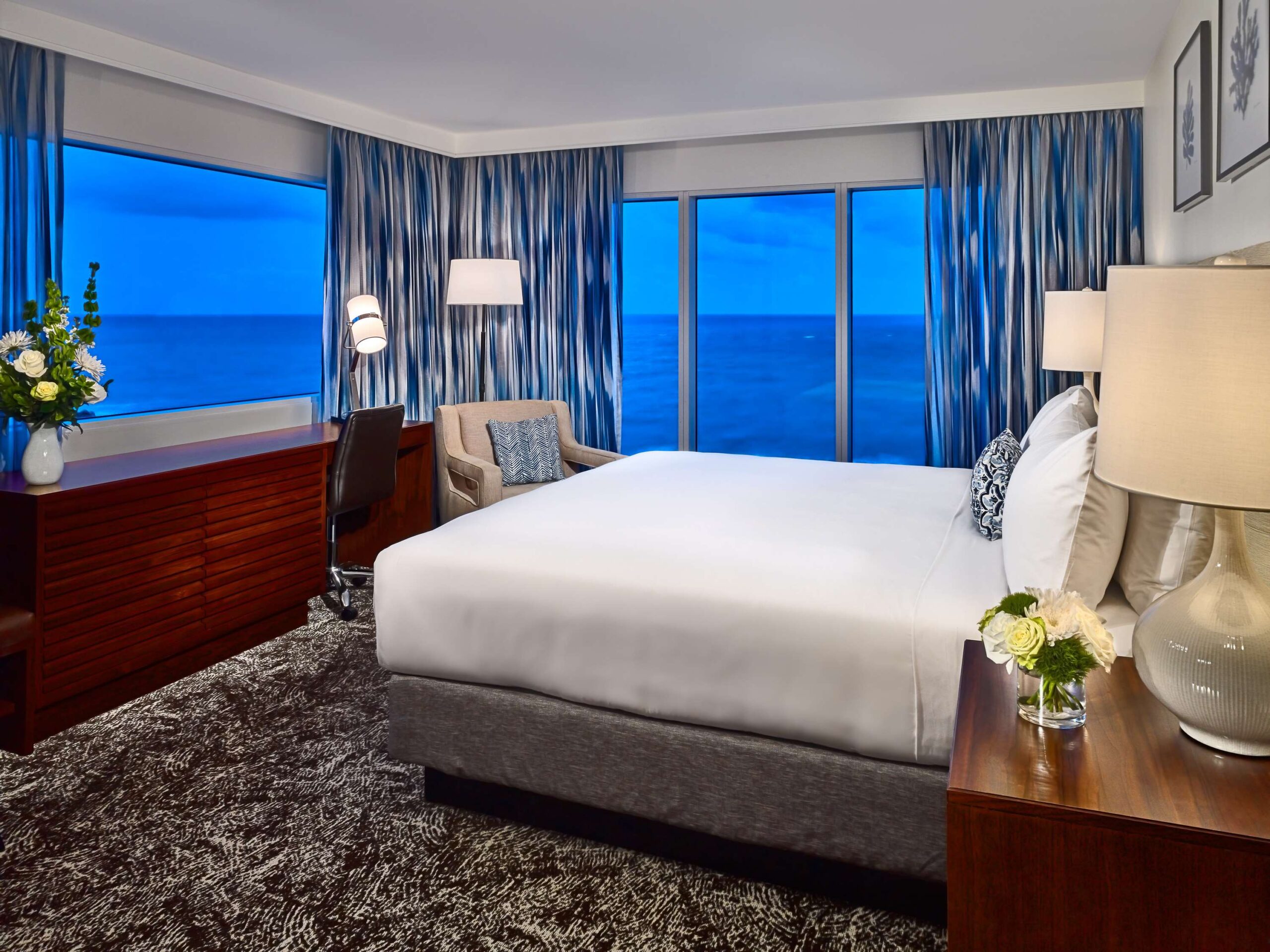
The property’s Ocean Corner Preferred Suite option is a stunning sanctuary designed for both comfort and indulgence. With sweeping ocean views framed by floor-to-ceiling windows, this corner room invites natural light to dance across its plush carpet, sophisticated hardwood finishes, and custom furnishings.
The preferred suite at Sonesta Fort Lauderdale Beach. Photo courtesy of the hotel.
The luxurious king-size bed with a pillow-top mattress offers the perfect place to unwind, while thoughtful amenities like a Keurig coffee maker, mini fridge, and rainfall shower elevate the stay. Whether you’re sipping morning coffee by the window while watching the sunrise, lounging on the comfy couch watching the large flat-screen TV, or catching up on work at the desk, every detail feels intentionally curated. Factor in complimentary WiFi, and you have a refined retreat that’s both serene and inviting.
Poolside at Sonesta Fort Lauderdale Beach. Photo courtesy of the hotel.
Not Your Average Fort Lauderdale Beach Experience
Unlike hotels situated amid the bustling beach strip, Sonesta Fort Lauderdale Beach enjoys a more tranquil setting parallel to Laudy’s famed shoreline, providing a peaceful buffer from the crowds without sacrificing access to the action.
And for nature lovers, it borders the verdant oasis of Hugh Taylor Birch State Park, a rare gem for jogging, kayaking, picnicking, or simply getting lost under a canopy of coastal hammocks. “It’s our secret escape hatch,” the hotel’s spokesperson shared. “Guests love that they can walk to the park right from our doors.”
Event space at Sonesta Fort Lauderdale Beach. Photo courtesy of the hotel.
If you’re planning a celebration or retreat, this is the only property in the area with event space on the Penthouse level, offering 360-degree panoramic views of the Atlantic Ocean and Intracoastal Waterway. That makes it ideal for weddings, business events, and milestone moments that deserve a dramatic backdrop.
Hospitality with Heart
One of the most defining features of the property isn’t visible on a map; it’s felt in the energy of the team. “Our culture is all about care, discovery, and fun,” the spokesperson explained. “We want each guest to feel like they’re part of something – like they’re known and welcomed.”
This philosophy has earned the property recognition as one of USA Today’s Top Workplaces 2025, and it’s reflected in everything from the smiling staff who remember your name to little details like pet amenities (yes, it’s pet-friendly, with cozy beds, bowls, waterproof mats, and welcome treats at check-in).
Steelpan Restaurant’s patio at Sonesta Fort Lauderdale Beach. Photo courtesy of the hotel.
Savor the Soul of South Florida at Steelpan
At the heart of the Sonesta experience lies Steelpan, the hotel’s onsite Caribbean-American fusion kitchen and bar that celebrates the bold, tropical flavors of the region.
With floor-to-ceiling windows and a laid-back oceanfront patio for al fresco dining from morning well into the evening, Steelpan offers an open-air dining experience that perfectly matches its menu: vibrant, soulful, and rooted in community.
Steelpan Restaurant at Sonesta Fort Lauderdale Beach. Photo courtesy of the hotel.
Must-try signature dishes and drinks include the Fish Dip – a smoky, creamy indulgence ideal for sharing; Tuna Tartare – bright and citrus-kissed with just the right heat; Fried Jerk Chicken Sandwich – a crave-worthy crunch with island spices; Whole Snapper – fresh-caught and perfectly grilled; and the Vegan Steak – a standout for plant-based diners craving bold flavor.
Pair your meal with Steelpan’s flagship cocktails, like the sultry Brown Sugar Old Fashioned, the floral-forward Hibiscus Hound Ball, or the zesty and bold Yellow Jacket – each crafted to reflect the rhythm and color of the islands.
Sonesta Fort Lauderdale Beach. Photo courtesy of the hotel.
The Perfect Day, Curated by Sonesta
If you’re wondering how to make the most of a stay here, the team offers this dream itinerary: “Start with sunrise yoga on the beach, and then enjoy breakfast on the Steelpan patio. Walk through Birch State Park, and in the afternoon, hop aboard a Water Taxi to Las Olas Boulevard for boutique shopping, art galleries, and cocktails. It’s the best of Fort Lauderdale without the stress.”
Recognizing the evolving expectations of luxury travelers, Sonesta Fort Lauderdale Beach has committed to modern convenience without sacrificing charm. Upgraded high-speed Wi-Fi, smart TVs with streaming capabilities, and a robust social media presence make this a seamless stay for digital nomads, wellness seekers, and aesthetic travelers alike.
For those who see luxury not just as lavishness but as a space to breathe, reconnect, and be inspired, Sonesta Fort Lauderdale Beach is a revelation. It’s where beachside bliss meets soulful design, Caribbean culture meets curated calm, and thoughtful hospitality elevates the everyday escape. And in a city as vibrant as Fort Lauderdale, that’s saying something.
Some or all of the accommodations, experiences, items, and/or services detailed in this review may have been provided or arranged at no cost, but all opinions expressed are entirely those of the author and have not been influenced in any way.
Champagne has long been the essential toast of holidays and other special occasions, but the landscape of sparkling wine is evolving. Today’s breed of bubbles offers an exciting range of choices from nearly every corner of the wine-producing world.
Regions across the globe are proving they can stand shoulder to shoulder with the world-famous fizz, offering exciting alternatives for wine lovers ready to expand their horizons. And, as people’s tastes shift, so do their preferences for flavor profiles, sweetness levels and production methods, there are more new styles to discover as alternatives to Champagne.
“Champagne is often enjoyed for its multi-layered aromas of fruit and brioche, finishing with a searing and elegant acidity,” notes Peter Douglas, DipWSET, a vinicultural expert with the “VinoVoss” AI Sommelier smartphone app and web-based semantic wine search and recommendation system perfecting wine discovery. “Yet, not all sparkling wines meet these lofty criteria, and some remarkable options exist that may surprise your palate and your wallet.”
Below, Douglas outlines 7 Champagne swaps that are sure to tantalize your tastebuds.
Corpinnat and Cava
It’s rare to see Cava and its innovative offshoot, Corpinnat, mentioned together, but these two Spanish sparkling wines share a commitment to quality. Corpinnat represents a collective of small, independent organic wineries that have opted out of the official Spanish quality hierarchy to craft sparkling wines that reflect their unique philosophies and practices.
What sets Corpinnat apart from Cava is its stringent requirement that grapes must come from owned organic vineyards and be vinified on the winery’s premises. Each bottle must mature for a minimum of 18 months, surpassing Champagne’s minimum requirement by six months. Many producers opt for extended aging, with some wines maturing for 60 months or longer.
This extended bottle maturation allows the wines to evolve from fresh fruity aromas into complex nutty and bread-like flavors, enriching the overall tasting experience. In contrast, Cava, while often perceived as more industrial, can also produce exceptional wines.
Major producers like Freixenet and Codorniu dominate the market, leaving smaller-scale artisans with limited exposure. Like Corpinnat, Cava is primarily based on the indigenous grapes Xarel-lo, Macabeo, and Parellada, which deliver a delicate, fruity profile with a light body.
Champagne racks. Photo courtesy of Manos Angelakis.
The German and Austrian Powerhouses
Cool climates are renowned for producing wines with vibrant acidity—the backbone of sparkling wine. This principle underpins the German and Austrian passion for their sparkling creation, known as Sekt.
In these countries, Riesling often takes center stage, although you may also encounter Pinot Noir, Chardonnay, and other varietals that can rival high-end Champagnes. Germany and Austria pride themselves on their quality sparkling wines.
Austria has recently launched a new Charta, establishing a hierarchy for “Sekt Austria.” This pyramid includes “Grosse Reserve” (big reserve), “Reserve,” and the foundational “Sekt Austria” quality, with aging requirements ranging from a minimum of 6 months on the lees to at least 36 months for the highest tier.
This commitment to quality has garnered increased interest from both tourists and consumers alike, prompting Austria to appoint Andreas Vitasek as their new sparkling wine ambassador.
When exploring German Sekt, focus on renowned regions like Mosel, Rheingau, and Rheinhessen. Notable producers include Kallfelz, Barth, and Raumland. In Austria, look for high-end offerings from Bründlmayer, Loimer, and Domäne Wachau.
Crémant de Bourgogne
If you prefer to stay in France, consider heading south to Bourgogne. The region primarily produces sparkling wines from Chardonnay and Pinot Noir, with Aligoté providing a refreshing exception. Crémant de Bourgogne offers a lighter, fruit-driven experience, illustrating a frothy texture that dances on the palate—an excellent alternative to its more famous cousin.
Sparkling wine. Photo by No-Name13.
Cartizze: Prosecco’s Crown Jewel
In the northern Italian region of Veneto, the hill of Cartizze stands as Prosecco’s most revered site. Officially classified in 1969, its reputation as an exceptional origin stretches back more than two centuries.
Rising to 350 meters (1,150 feet) above sea level, Cartizze encompasses just 108 hectares (280 acres). With land prices exceeding 1 million Euros per hectare, it rivals the world’s most expensive vineyard sites, including those in Burgundy. Ownership rarely changes hands, with plots typically passed down through families, underscoring the value placed on this unique terroir.
The slopes of Cartizze are so steep that vineyard work must be done entirely by hand. In some areas, workers use sledges to transport grapes and tools, their efforts evoking comparisons to mountaineering.
This challenging terroir, combined with the elevation and a predominance of old vines, produces Prosecco of remarkable intensity and character. Most wines from Cartizze are crafted in a ‘dry’ style, leaving a touch of residual sugar.
This subtle sweetness enhances the vibrant fruitiness, while the crisp acidity keeps the wine beautifully balanced. The result is a Prosecco of elegance and finesse, ideal for those looking to celebrate with something truly special.
Moscato d’Asti: The Sweet Charm of Piedmont
In the heart of Piedmont, a region famed for Nebbiolo’s brooding intensity and wines like Barolo and Barbaresco, Moscato d’Asti offers a gentler, more unassuming charm. Made from the highly aromatic Muscat grape, this sparkling sweet wine is often overlooked in favor of its more prestigious neighbors but has a unique role in the region’s vinous identity.
The defining features of Moscato d’Asti are its fragrant sweetness, low alcohol, and gentle spritz. This combination allows producers to fully explore the grape’s potential, highlighting its characteristic notes of orange blossom, ripe apricot, and honeyed peach. At just 5.5–7% ABV, it provides a light and refreshing contrast to the weightier wines often associated with Piedmont.
Its flexibility at the table is a key strength. Moscato d’Asti can elevate desserts like white chocolate and candied fruits or pair beautifully with creamy and blue cheeses. For some, it even becomes the dessert, offering a delicately sweet conclusion to a meal without overwhelming the palate.
Cap Classique: South Africa’s Sparkling Star
For those who find Italian fruitiness is too exuberant, South Africa’s Cap Classique offers an elegant alternative. Introduced as a defined style in 1971, this sparkling wine is crafted in the traditional method, involving a secondary fermentation in the bottle. While the classification is relatively modern, the South African tradition of producing sparkling wines dates back over 360 years, firmly rooted in the country’s winemaking history.
Cap Classique spends a minimum of 15 months on the lees, allowing delicate notes of brioche and hazelnut to develop. However, the hallmark of South African sparkling wine remains its bright, fruit-driven profile, often leaning into flavors of citrus, stone fruit, and even tropical notes, rather than the pronounced toastiness typical of Champagne.
Today, Cap Classique has earned its place among the world’s finest sparkling wines. Its ability to balance value and quality makes it an appealing choice for celebrations, offering a distinctive South African character without pretension. Whether as a centerpiece for an event or an unassuming companion to the moment, it stands ready to impress.
Sparkling wine on ice. Photo by Couleur.
Tasmania: A Sparkling Island of Innovation
Tasmania, Australia’s southernmost state, lies around 150 miles (240 kilometers) south of the mainland, separated by the often-turbulent Bass Strait. Known for its pristine wilderness and cool climate, it is the nation’s most southerly and coolest wine region, home to a scattering of nearly 1,000 offshore islands. This remoteness has shaped its identity as a haven for eco-tourism and, increasingly, as a center for world-class sparkling wine.
The island’s wine industry is small but tightly focused, with producers working collaboratively and sustainably. Biosecurity is paramount, and tourists are often barred from entering vineyards to prevent soil-borne pests or diseases inadvertently carried on footwear. Inter-planting with native vegetation, allowing certain ‘weeds’ to flourish, and preserving wildlife corridors reflect Tasmania’s dedication to environmental harmony.
Tasmania’s cool climate is particularly suited to Pinot Noir and Chardonnay, the cornerstone varieties of its sparkling wines. These wines are defined by their vivid fruit intensity, bracing acidity, and, in many cases, the nuanced autolytic complexity of toast and brioche. The sparkling wines often rival the quality of Champagne, though with a distinctive freshness and clarity born of the island’s maritime influence and clean air.
Despite its small scale, Tasmanian sparkling wine is increasingly found on the shelves of fine wine retailers and the wine lists of high-end restaurants across the globe. Its ability to combine precision, elegance, and sustainability ensures Tasmania’s place among the leading sparkling wine regions of the world.
Emerging Regions
Beyond the traditional producers, numerous up-and-coming regions are crafting outstanding sparkling wines. The United Kingdom, Argentina, and cooler areas of California are all making their mark in the sparkling wine scene, offering fresh and innovative options for consumers looking to diversify their celebratory toast.
“Champagne will long-remain a classic, of course, but it no longer holds an exclusive claim as the ‘must-have’ sparkling wine for holidays and other special occasions,” Douglas asserts. “While this iconic bubbly is a favorite celebratory beverage for many, the world of wine offers a range of exciting alternatives that deserve due attention.”
A quick jaunt to the most romantic city in the world is great at any time of year, but summer offers a special charm for visitors to Paris.
A junior suite at the Hotel Edouard 7. Photo courtesy of Hotel Edouard 7.
Where to Stay – Edouard 7
This gorgeous luxury hotel in the heart of the Opera district oozes luxury and composed elegant service from the first step through the front door. Hotel Edouard 7’s rooms are silk, cashmere, and velvet, accented with heated towel rods and soaking tubs or steam showers. It’s the perfect soother after strolling the streets and world class museum halls.
A view of the Paris Opera from a Hotel Edouard 7 balcony. Photo courtesy of Hotel Edouard 7.
Add a little ooh la la by opting for the suite that features a wraparound terrace with a view of the Avenue de l’Opéra, a favorite haunt of Edward VII, King of England. Clefs d’Or concierge service dishes all the inside info to make the most of your visit to the city of lights.
Breakfast at the Hotel Edouard 7. Photo courtesy of Hotel Edouard 7.
Start the day with an excellent breakfast of pastries, fresh-pressed juices, rich cappuccino, or cafe au lait, as well as charcuterie or cooked to perfection eggs and savories in the hotel lounge. Wander the city or stay in this prime neighborhood to treat yourself at one of the four gourmet chocolatiers on the block or a patisserie so exclusive there’s a velvet rope and boulangerie-bouncer controlling the crowds.
Chocolates in Paris. Photo by Sascha Zuger.
Don’t worry – the fabulous Tuileries Gardens of the Louvre dotted with sculptures, fountains, chess tables, and waterside sun loungers are just a few minutes away, to walk off your indulgences! A bustling collection of cafes, bars, and eateries is also just around the corner, or finish your night with a glass of champagne or signature Lily in Paris tipple with gin, strawberry, lemon, and cucumber. It’s a perfect nightcap served right in the lobby’s glam cocktail bar.
The lobby bar in the Hotel Edouard 7. Photo courtesy of Hotel Edouard 7.Bateaux Parisiens. Photo by Philippe Barbosa.
Where to Eat – Bateaux Parisiens
There’s no better way to capture the spirit of this beautiful city than a trip down the Seine at sunset. While the endless parade of monuments and museums serves as a teaser for all Paris has to offer visitors, what’s really memorable are the groups of friends, family members, first date couples, and long-lasting lovers sitting along the banks. Their legs hang over the river as they share wine, snacks, and camaraderie while they watch the barges pass, lingering until the glow of the sunset fades into night.
The author and her husband on the Bateaux Parisiens. Photo by Sascha Zuger.
While there are a number of options for barge tours, Bateaux Parisiens, located at the foot of the Eiffel Tower, offers a dinner with wine pairing option that’s a step above. The glass walls provide an endless vista of Paris and people-watching joie de vivre to accent a gourmet feast that kicks off with a glass of Pommery champagne.
A dish on the Bateaux Parisiens. Photo courtesy of Bateaux Parisiens.
This isn’t your typical dinner cruise fare. As foie gras with apricot chutney, thin-crusted tart of escargot and octopus, beef fillet, and crispy polenta with confit vegetables and ratatouille jus are dished out, live music accompanies the memorable meal. Sail from sunset until the stars come out for a tour that’s night and day above the others.
Notre-Dame de Paris. Photo by Melanie Votaw.
What to Do – Visit the Classics
Notre Dame has reopened for visitors with 10,000-15,000 snapping up timed complimentary tour tickets of the 860-year-old cathedral, every day. Ticket reservations are released three days in advance, so get ready to refresh-refresh-refresh your screen or settle for the standby line. Another special way to experience the famed basilica is to attend one of several masses held each day (which don’t require an entry ticket).
A couture dress in the Louvre Museum. Photo by Sascha Zuger.
While a trip to the nearby Louvre isn’t a revolutionary suggestion, the current Louvre Couture exhibit breathes a very fashionable fresh breath of air through the endless galleries and rotundas of artwork. It also provides the perfect excuse to have another look at some of the world’s most famous masterpieces.
Timed tickets are required to visit the art museum. To beat the crowds and heat, skip the famed glass pyramid entry, and slip into the underground shopping arcade mall that leads to the same main museum entrance. For those short on time, a handful of key works are highlighted on maps and with numerous signs guiding directly to Mona Lisa’s enigmatic smile – directed appropriately at the roped in mass of humanity doing the “subway shuffle” up to the front of the line for their 20 seconds to snap selfies of Leonardo’s lovely.
The Pommery. Photo by Fred Laures.
Where to Day Trip – The Art of Bubbles, a Train Ride Away
Whether on a long weekend or a leisurely escape, there’s always room for champagne. Fortunately, a short 45-minute scenic train ride through the French countryside brings you to Reims, the home of bubbly. With all the great houses lining the streets of the city, it might be hard to choose where to spend your time.
The Pommery. Photo courtesy of Champagne Pommery.
A true standout is Champagne Pommery. A tour includes a whirl through a museum celebrating the fascinating history of Madame Pommery, the matriarch of the 1868 winery and a visionary who’s credited with creating the world’s first brut (1874).
Le Grand Escalier at the Pommery. Photo courtesy of Champagne Pommery.
The blanc to blanc might be dry, but the museum is not. it’s peppered with the same irreverent modern art pieces as guests experience on a tour through the 60 crayeres chalkpits turned wine cellars, which extend 18 kilometers at a depth of 90 feet. (Post-tour tastings are enjoyed next to a full-sized upside down elephant.) The art installations are replaced every year, making this a tempting annual pilgrimage.
A visit isn’t complete without lunch at onsite Le Refectoire Vranken-Pommery, whose artful plates (delicate crusted pate croute with pickled legumes, rich beef tartare, and fresh goat cheese with wild herbs from the garden with a vanilla-chocolate profiterole finale) boast the same quality and attention to culinary detail as the cuvées they are served alongside. Don’t miss tasting the Apanage Cuvée, which pairs beautifully with gastronomy delights such as these.
The interior of a wine bag. Photo courtesy of VinGardeValise.
What to Bring – VinGardeValise, Wine Luggage
Who needs cheap souvenirs (you’ll hear the “Light Up Eiffel Tower, One Euro!” calls outside every tourist attraction) when you’re visiting the birthplace of champagne and other sparkling delights. Come prepared with a specially designed piece of luggage that features secure, individual bottle-padded inserts to protect your most valuable reminders of your trip. Then, you can keep the merriment going long after arriving home.
A wine bag. Photo courtesy of VinGardeValise.
The author received some complimentaryaccommodationsfrom the businesses mentioned in this article, but as always, we are dedicated to providing you with an unbiased assessment of our experiences.
It’s summer in the suburbs, and we enjoyed an outstanding dinner in a garden setting, fragrant with meats grilling on the large open-air grill!
The Spring House in Tenafly is a Northern New Jersey restaurant located in a majestic old house with a large back and side garden. It has been designated as a historic building. Valet parking is offered to all guests, making access stress-free in a largely residential locale.
We were welcomed by Executive Chef/Manager/Co-Owner Paco Fieola, a man of many talents and a true international restaurateur. Chef Paco has devoted his career to using only the best seasonal ingredients available for his gastronomic creations, many of which are imported in order to achieve his required level of excellence.
While his menu changes frequently with the seasons, he always reverts to classic Roman cuisine, which represents that city’s specific dishes and flavors. Yes, Roman cuisine is a very distinct segment of Italian cooking, and it’s fairly simple with a reliance on fresh, very seasonal ingredients and some unique dishes.
If you wish to experience the delights of Roman cuisine, you can always take a flight to this ancient city and look for a local restaurant, whether a locanda, an osteria, or a trattoria. They are often family-run, specializing in that traditional, regional cuisine.
Or you can make a reservation at the Spring House and enjoy Roman specialties, as well as regional dishes that Chef Paco discovered and made his own in his many years of working in different countries with different cuisines.
The Spring House is a friendly environment with both indoor and al fresco seating. One room of this large restaurant houses a very popular bar. We decided to eat al fresco, and we loved it since the weather was perfect.
Sitting in the garden, serenaded by “The Songbird” (more about this below) and reading the extensive appetizer menu, we decided to have a “meze” style experience – small plates that would give us a good idea of the kitchen’s abilities, accompanied for me by a glass of cold, slightly sweet Brachetto d’Acqui wine. Barbara had a long Pain Killer rum cocktail, but both our drinks were from the “Airstream Bar” at the back of the backyard.
On this occasion, we had dishes that you can partake of in specific Roman neighborhoods or nearby towns. Hidden in the heart of the city is Rome’s Jewish Quarter (the Ghetto di Roma 1555 to 1870) located in the area known as Rione Sant’Angelo near the Tiber River.
Carciofi alla Giudia (Jewish-style fried artichokes) and Fiori di Zucca (fried zucchini flowers stuffed with ricotta cheese and anchovies) are two very distinct dishes adored by tourists and locals alike. We enjoyed them many times during our Roman adventures.
These were two of the starters we were delighted to find on the Spring House menu, as they aren’t often found on this side of the Atlantic.
Fried artichokes at Spring House. Photo by Manos Angelakis.
In Rome, fried and smashed artichokes can be found with either baby or full-sized artichokes, but I prefer the smaller ones. Carciofi alla Giudia involves a two-step process – frying the artichokes first at a low temperature until tender and then refrying them a second time on higher heat to crisp them up.
In Rome, there’s an artichoke variety called cimaroli that’s free from the choke. They trim them, cook them, and eat them without worrying about the hairy center. Pure delight!
Zucchini blossoms at Spring House. Photo by Manos Angelakis.
The other plate to die for was “Fiori di Zucca Ripieni.” Zucchini blossoms, stuffed with ricotta blended with herbs and lemon zest, and then battered and deep fried. It’s served with a red sauce from Amatrice. They use rice flour rather than all-purpose flour to make the stuffed flowers crunchy and light.
Chilled Club Soda or Seltzer Water is a key ingredient to keeping the batter light. It’s a very seasonal dish that is beloved by everyone!
Grilled octopus at Spring House. Photo by Manos Angelakis.
We also had smoky grilled octopus on a bed of hummus with olives, pickled onions, large-sized pickled caper fruit, Calabrian pickled peppers, and fresh oregano – a ubiquitous Mediterranean meze dish. We also had fried calamari, which was crispy fried with Calabrese peppers and sage, served with a delicious marinara style dipping sauce.
Finally, we had what the menu called Small Lamb Bites with tzatziki, cucumber, lemon, olives, and a clay container of roasted Hen of the Woods – a rare wild mushroom.
Whoever is the sommelier, he/she has put together a very interesting list of representative Italian wines. Not that many bottles, but it was a very well thought-out list. It included a delightful Supertuscan, a very good Brunello, an outstanding Barolo from Piemonte, and many other very descent reds.
There were also nice bubblies from Italy and France, good whites from Italy, France, and the USA, a few French Bordeaux and Burgundies, and a couple of Kosher bottles of interest.
There are draft beers from Seven Tribesmen Brewing, plus Stella Artois and Bud Light in cans and a non-alcoholic beer version. There are also seasonal, as well as always available, cocktails and 6 non-alcoholic ones.
I was surprised there were only a couple of red bottles from Argentina and no reds from Chile that produces some very exceptional and well-priced reds. Also, the list contained only 3 Spanish reds and no whites or cavas. But I quibble!
Swordfish kebab. Photo by Manos Angelakis.
We tried the swordfish kebab, cooked on the nearby outdoor grill, whose odors had been drifting by our table since we sat down. If you have ever had swordfish souvlaki or swordfish kebab at a seaside Greek or Turkish taverna on the Eastern Mediterranean, you will instantly recognize that smoky delicacy!
The Santa Maria Charcoal Grill of the Back Yard makes skewers and burgers and grilled vegetables. There’s a separate list of grilled specialties for the Back Yard, so ask for it.
The Airstream Bar at Spring house. Photo by Manos Angelakis.
The outdoor bar was an Airstream travel trailer, which has become an American icon on the road, and parked at the back of the garden. There is also the very well attended large bar area indoors, but al fresco was our preference!
Another interesting feature, present every other week in a tent at the garden’s corner, was a purveyor of oysters and lobster rolls called “The Oyster/Lobster Party.” The oysters come on a plate of shaved ice, and they were plump and tasty. Barbara loves oysters, so she was in seventh heaven.
Lobster roll on paper boat at Spring House. Photo by Manos Angelakis.
I, on the other hand, love lobster, which I usually cook at home in dark stout beer. Here, the lobster comes out of the shell, stuffed in a milk roll that has been buttered and grilled.
The Songbird at Spring House. Photo by Manos Angelakis.
Live entertainment is presented in the garden from Thursday to Sunday, so we were fortunate to catch a young woman with an incredible voice. Our waitress, Valentina, who was knowledgeable and very pleasant, told us that it was the first time that the entertainer “The Songbird” had appeared at the garden. I hope they will make her a permanent fixture because she was really good!
Double Trouble dessert at Spring House. Photo by Manos Angelakis.
We were full, but who can resist a dessert and a double espresso? Certainly not us! Thank you Spring House. All in all, it was a great evening. The weather was amenable, the food was exceptional, and the entertainment was outstanding.
United flight emergency landing. On June 21st, a United flight from San Francisco to Rome issued a distress signal after 8 hours in the air when it suddenly descended by more than 20,000 feet. The flight managed to divert to Iceland and land with no injuries among the passengers and crew. Phew!
Middle East travel. If you’re traveling in or over the Middle East, check to make sure your flights are still viable. With the fighting this month, some airspace in the region has been shut down.
Overtourism demonstrations. Locals have been shooting water guns at tourists in demonstrations against overtourism in Barcelona, Lisbon, Venice, and other cities throughout Europe.
Europe airfare costs down. Since fewer Europeans are coming to the U.S., fares are down. So except for the demonstrations in European hotspots, it’s probably a good time to visit the continent (maybe while wearing Canada t-shirts if you’re afraid of anti-American sentiment).
The Louvre in Paris. Photo by Wanderer97.
Louvre worker strike. The Louvre in Paris was forced to shut its doors briefly this month when workers conducted a strike to complain about under-staffing and overcrowding.
What’s the dirtiest beach in the U.S.? According to the SurfRider Foundation, Park View Kayak Launch in Miami Beach, Florida is the most polluted and so filled with bacteria that it’s unsafe for swimming. Yuck!
Drive your own tuk-tuk in Sri Lanka. Now, you can rent a tuk-tuk and drive it yourself in Sri Lanka. What do you think? Would you do it?
The Mysore Palace gate in Karnataka, India. Photo by Barbara Angelakis.
Travel advisory for India. The U.S. State Department has issued a travel advisory, asking women not to travel alone in India due to a rising threat of rape and violence.
Banff rock slide. A rock wall gave way earlier this month in Canada’s Banff near Lake Louise, killing two and injuring three others.
Don’t use Airport Wi-Fi! Experts are saying that using the wi-fi in airports is a dire security risk and that we shouldn’t do it anymore – period.
Where’s the #1 hotel in the world? According to TripAdvisor’s Travellers’ Choice Awards, it’s in Lisbon: the luxury Santiago De Alfama Boutique Hotel, Have you ever stayed there?
Climate change could ruin cheese! Apparently, cows produce milk with less fat and protein when it’s hot. A study in France found that cheese could start to lose its wonderful taste as temperatures continue to heat up across the planet.
A woman rides a motorized scooter. Photo by Lazerkong.
Scooter threat. Apparently, there have been more and more accidents from motorized scooters across the globe, so be on the alert!
A royal stay. You can now book a stay at The Folly at Sandringham, a private country estate in the U.K. that’s owned by the royal family. It’s a favorite getaway enjoyed by King Charles III and Queen Camilla. Of course, it’ll cost ya – in the neighborhood of 3,500 pounds for a four-night stay.
New Capitol One lounge at JFK. Opened June 29 in Terminal 4 with limited hours until July 17, the word is that it’s going to be quite impressive with great tarmac views, afternoon tea, and shower suites. If I get access anytime soon, I’ll report back.
Have you ever watched the July 4th fireworks from the deck of your boat? What could be better, right? A clear view of the over-the-water fireworks show. A sky filled with colors.
Before you watch the display, you might fire up the grill for hamburgers and hot dogs. Maybe you plan to join the show and fire off a few bottle rockets.
What’s the harm? From personal experience, I can tell you it’s not a good idea.
It was in the late 1990s on the Fourth of July near my homeport of Ventura, California. A friend invited my young son and I aboard his 28-foot center console boat to watch the fireworks in the Channel Islands Harbor.
The fireworks show by the City of Oxnard was great, but a passenger on my friend’s vessel brought sparklers for the children. Bad idea on a boat. The only way to use a lit sparkler even kind of safely is to hang it off the side of the boat.
One of the children held one over the side and fell into the water. She was wearing a life jacket, fortunately, but we had to fish her out, dry her off, and end the night early.
So what are the things to worry about? How do you keep yourself and others safe?
Barbecue. Photo by RitaE.
Grilling Aboard? Play It Safe
Charcoal is king for grilling at home, but it can be a hazard on a boat. Use an electric or propane grill during any party on your boat. Even those can cause issues, however, if you fail to properly monitor them.
“The Coast Guard does not have a stance on grilling,” says Petty Officer 1st Class Diana Sherbs of the Seventh Coast Guard District in South Florida. “We do emphasize having the proper safety devices such as a fire extinguisher in the event something goes wrong. There are different styles of grills available on the market for boaters. Most [manufacturers] will provide input on where to best set it up on your vessel.”
When it comes to locations on the boat, avoid grilling in enclosed spaces or near flammable materials. Pay extra attention to a hot grill on a boat due to the tight spaces.
Fireworks. Photo by Melanie Votaw.
Lighting Fireworks on the Boat? Think Twice
Lighting fireworks on a recreational boat can be quite dangerous. For openers, the fire hazards are many on a boat. In addition, they pose a risk of injury for passengers and create potential environmental impacts.
Noise is also an issue, as there are legal restrictions depending on your state. Plus, in crowded waterways, there’s the possibility that unexploded fireworks land on other boats and boaters.
“It’s probably best to view the fireworks from your boat than to actually set them off,” Sherbs said. “Fiberglass is flammable, and along with a fuel tank, there may be serious fire safety risks. If you’re intent on bringing fireworks aboard, check your state laws first.”
Staying Out After Dark? Be Prepared
Night boating during July 4th festivities can be nerve-wracking and potentially dangerous, especially for novices.
If July 4th on your boat is going to last all day, stay hydrated, sober, and aware. Do you plan to be out past sunset? Ensure all of the boat’s navigation lights are functional. Are you experienced boating at night? If not, either invite an experienced night boater to accompany you, or consider skipping the trip.
“Monitor the weather, file a float plan, and carry working communication equipment,” Sherbs says. “Keep emergency gear readily accessible: life jackets, signaling devices, a throwable flotation device, and fire extinguishers. Schedule a safety check with your local Coast Guard Auxiliary to ensure you and your vessel are prepared for a fun, safe day on the water.”
For more safety regulations and safety gear information, please refer to our Safe Boating website.
Boat, stock photo.
Operation Dry Water Weekend July 4-6, 2025
The Operation Dry Water campaign encourages all boaters to boat responsibly and take extra precautions this boating season. Operation Dry Water’s goal is to keep you, other boaters, and law enforcement officers safe and healthy.
Law enforcement agencies that participate in Operation Dry Water are tasked with increasing Boating Under the Influence (BUI) enforcement during the targeted enforcement weekend of Operation Dry Water, July 4–6. Plus, organizers ask them to work with their local media, businesses, and recreational boaters to spread the message and raise awareness of the dangers of boating under the influence. That applies during the heightened enforcement weekend and all year long.
Operation Dry Water stresses three key points:
Boat sober
Wear a life jacket
Take a boating safety course
“The Fourth of July is a great time to enjoy our waterways, but it’s also one of the busiest boating weekends of the year,” Sherbs says. “We encourage everyone heading out to prioritize safety. Wear a life jacket, stay sober, and keep an eye on changing conditions. A few simple precautions can help ensure a safe and enjoyable holiday on the water.”
This fourth largest populous city in Australia is also the world’s most remote mini-metropolis. Friendly and easy to navigate, street art and sculptures greet you at every corner, while public transportation makes it easy for visitors to explore.
Quality museums highlight the unique history of Western Australia, and there is a vibrant culinary and drinks scene that balances a wealth of natural beauty and recreation options to hike, swim, boat, and bike your day away.
QT Perth lobby. Photo courtesy of QT Perth.
Where to Stay – QT Perth
Chic and welcoming, the QT Perth impresses from the first step into its lounge-worthy lobby. There’s an air of sophisticated “scene” to the public areas of the hotel, spiked with enough artsy quirks to avoid feeling stuffy or intimidating. The brand is known for its irreverence and attention to every detail with a high priority on service. This hotel does not disappoint!
Room at QT Perth. Photo courtesy of QT Perth.Room at QT Perth. Photo courtesy of QT Perth.
Try a lofty libation at Rooftop at QT’s scenic 18th floor digs overlooking the central business district and Swan River Valley (perch in the corner for a river view!). Then, retire to your room to relax before a night on the town.
Rooftop bar at QT Perth. Photo courtesy of QT Perth.
In the room, sumptuous purple and gold fabrics set the mood, with every luxury at your fingertips to create an indulgent oasis. Nespresso, Bose sound, Dyson hair, Kevin Murphy amenities all spell s-p-o-i-l. A multi-head rainshower and large soaking tub ensconced in dramatic black marble with gold fixture accents offer the perfect way to unwind after strolling through museums or the streets of this friendly, walkable city.
Santini Bar & Grill. Photo courtesy of QT Perth.
Where to Eat – Santini Bar and Grill
You’d be forgiven for not wanting to leave this hotel haven. Fortunately, Santini Bar & Grill, a stylish Mediterranean eatery on the ground floor, offers a valid excuse to stay. Amalfi favorites are accented with Western Australia’s local delicacies – from perfect produce to line-caught calamari and Margaret River venison.
Although an expansive Chef’s Tasting Menu is available, the al a carte options beckon with Crispy Zucchini Blossom Fritti (ricotta, pumpkin hummus. and chili honey), Wood-Fired Shark Bay Scallops. or Freemantle Octopus (whipped chickpeas and ‘nduja butter) and Squid Ink Rissoto served tableside topping the list.
If your inner culinary child wants to wander, consider a spot of afternoon tea before venturing out for dinner. GT QTea with Adriel Zumbo ain’t your Nanna’s pinky-lifting affair. Sweet (Croquembouche Verrine, a layered pistachio, raspberry, caramel, vanilla crème dessert) meets savory (Morton Bay Bug* Rolls, peppered with cucumber and chives). (*No need for alarm – think sweet, tender slipper lobster vibes.)
Wash it down with a unique QT GT made with butterfly pea Tanqueray and tonic with lime … or five if you opt for the two-hour free-flowing G&T or champ’ers package.
Mix it up and venture out to beautiful Elizabeth Quay, a short ten-minute stroll toward the water. The bayfront multi-level complex is home to famed Spanda, a 29m tall public art work by Australian-born Christian de Vietri, classic hand-carved carousel, 24-hour BHP Biliton Water Park splash area (with beautifully lit fountains at night), Four Winds art installation, Blade Wall light-box collection of Whadjuk art, and a charming island with al fresco bites and sips. There are also a number of restaurants and cafes for every taste.
Elizabeth Quay. Photo courtesy of Visit Perth/City of Perth.
Where to Drink – Oyster Bar Elizabeth Quay
One of the more charming aspects of this city is the many bays and water views to enjoy. Oyster Bar Elizabeth Quay is the perfect place to enjoy a sunset over the Swan River and sunstreaked glowing central business district, along with a crisp Margaret Bay Sauvignon Blanc or local craft ale.
Oyster Bar. Photo courtesy of Oyster Bar Elizabeth Quay.
Shell out for some amazingly fresh oysters, with a wide-ranging option of chilled (try Orange & Gin or Kilpatricks) or grilled with Truffle & Garlic, Prosciutto & Brie, or Chili Crab must-tries. If you don’t feel like multitasking with your sip and slurp, opt for Bloody Mary or Tequila oyster shooters for a one-shot option. Book in advance, as the rooftop stays hopping until the stars come out.
Rottnest Island. Photo courtesy of Rottnest Fast Ferries.
Where to Explore –Rottnest Island and Wine Valleys, Just a Day Away
Though wildly different experiences, both excursions are the perfect way to spend a day, and they are accessible right from the Barrack Street Jetty in Elizabeth Quay. Go your own way using the Rottnest Ferry, or book an all-day-adventure to explore car-free Rottnest Island.
Rent a snorkel set to make the most of Rottnest’s idyllic beaches, or rent a bike to cruise up to Wadjemup Lighthouse. However you spend your day, it won’t be the same without spotting a smiling quokka (readily seen around snacking areas).
Rottnest Island. Photo courtesy of Rottnest Fast Ferries.
Western Australia’s oldest wine region can be explored via a two-hour morning cruise up the Swan River into a fertile landscape of vineyards and farms. Tour the valley to visit cheese, chocolate, craft breweries, and the wineries of Swan River. Live music and tastings pass the breezy return sail.
A longer, but rewarding journey can be had venturing down the coast of the Indian Ocean into the Margaret River Valley. Tours begin with a wildlife spotting cruise through Shoalwater Islands Marine Park, which dolphins, sea lions, and penguins call home.
Sunrise on Rottnest Island. Photo courtesy of Rottnest Fast Ferries.
Natural wonder Canal Rocks, the longest jetty in the Southern Hemisphere, and famous surf breaks entertain enroute to the cellar doors of Margaret River’s award-winning wineries.
July carry-on. Photo courtesy of July.
What to Bring – July Carry-On Light and Camera Protect Pack
An interesting aspect of travel to and from Australia, which is a shock to many North American travelers, is the practice of weighing all carry-on bags with accompanying strict limits. This is even more of an issue if you’re taking advantage of Perth’s proximity (and inexpensive fares) to fabulous destinations such as Bali, Singapore, Malaysia, Hong Kong, and Thailand, where limits can be so tight as to barely accommodate the weight of an empty wheeled carryon, much less its contents.
July carry-on. Photo courtesy of July.
July boasts the lightest carry-on on the market, with the hard-sided stylish case coming in half to one-quarter the weight of other bags. If protecting your precious wildlife-pic lens or that great bottle of Margaret River Sauv is important to you, the camera protect pack is perfectly padded and balanced to slide onto the carry-on’s handle and travel in style.
Hot dogs, the “dachshund sausages,” as they were initially called because they were thin and long like the eponymous breed of dog, were first sold with sauerkraut in the 1860s from street pushcarts in Manhattan’s East Village neighborhoods around St. Mark’s Place.
At the time, the area was called Klein Deutschland (Little Germany) where immigrants from Germany, Austria, and Ukraine lived. Later, when the large Ruppert Knickerbocker brewery was built on a lot between 91st and 92nd Streets on Upper East Side Third Avenue (now known as Yorkville), it was nicknamed “Germantown” because German immigrant cooks and brewers moved up to that area.
Many built much smaller breweries and established German eateries, patisseries, and wurst purveyors, dominating East 86th Street, which was the heart of Germantown. The Kleine Konditorei was present on East 86th Street until 1997, and there are still a few German delis and restaurants in that neighborhood.
In 1871, a 15-year-old German immigrant named Charles Feltman opened the first hot dog stand in Coney Island. In his first year of business, he sold 3,684 dachshund sausages in a milk roll slathered with mustard.
Nathan’s quarter pound beef franks. Photo courtesy of Nathan’s Famous.
The better known Coney Island hot dog emporium, Nathan’s, is a relative newcomer. Nathan’s Famous began as a nickel hot dog stand in Coney Island in 1916. It was established by a husband and wife team, Nathan and Ida Handwerker, who used Ida’s grandmother’s spice recipe that still gives the Nathan’s hot dogs their distinctive taste.
There is also a kosher version of a hot dog under the Hebrew National brand.
There are numerous hot dog brands sold in New York City, but Sabrett, Boar’s Head, Nathan’s, and Hebrew National are ubiquitous, even though the headquarters of these companies are no longer located in NY State. Nowadays, in the USA, we eat over 20 billion hot dogs made by a number of producers throughout the country. That’s about 70 hot dogs per person per year!
A hot dog with mustard. Photo by Manos Angelakis.
According to the U.S. Food and Drug Administration, anything that’s sold as a hot dog or frankfurter must be a sausage in a casing that’s cooked and/or smoked. Today, however, there are also “skinless hot dogs” on the market. Though pork is one of the most frequent ingredients, you can also get all beef (for the kosher or kosher-style), chicken, or turkey hot dogs. Or you can get ones that combine pork and beef or meat and poultry.
Sausage is one of the oldest forms of processed food, having been mentioned in Homer’s Odyssey as far back as the Ninth Century BCE.
A hog dog with sauerkraut. Photo by Manos Angelakis.
Frankfurt-am-Main, Germany is traditionally credited as originating the hot dog, which is still known to much of the English-speaking world as a “frankfurter” shortened to “frank.”
However, this claim about Frankfurt is disputed by researchers who say that the sausage was created in the late 1600s by Johann Georghehner, a butcher in the town of Coburg, Germany. According to them, Georghehner traveled to nearby Frankfurt to sell his sausages in volume, and that became the connection between Frankfurt and the hot dog.
The Viennese point to the term “wiener,” also used as a name for the hot dog, to prove their claim that the birthplace of the hot dog was actually Vienna (Wien), not Frankfurt.
As it turns out, it’s more likely that the North American hot dog was a thinner variant of the bratwurst that was widely available in both Germany and Austria and then brought to the U.S. by immigrant butchers from Central Europe.
A Sabrett hot dog cart in New York City. Photo by Manos Angelakis.
When I first came to New York in 1967, boiled hot dogs on a roll with mustard and sauerkraut or onion sauce and relish were sold from ubiquitous stainless steel pushcarts at every corner throughout the city, as well as in storefronts and coffee shops.
The Sabrett pushcarts with their distinctive umbrella, now almost 4,000 of them, have been a quintessential New York City sight for decades. The ones sold from these carts are known to the locals as “dirty water” hot dogs.
A hot dog machine. Photo courtesy of Sabrett.
Hot dog-selling storefronts and coffee shops mostly sell grilled hot dogs, cooked on a metal flattop or on a machine with rollers that turns the meat as it cooks. Another option used in home kitchens was the “hot dog zapper” that cooked the sausages by “electrocuting” them with 110 volt electric current. I used to own one for a number of years, and it made two great hot dogs every time I needed a snack!
A Sabrett condiment package. Photo courtesy of Sabrett.
When I first arrived in Manhattan, the price for the street-food version varied from 75¢ for the “dirty water” Sabrett franks from a pushcart at a street corner to as low as 2 hot dogs for $1 in a number of storefronts. But those were sold in the bun with only mustard. If you wanted sauerkraut or onion sauce, it was an extra nickel.
In Little Italy, where my first New York City apartment was located, fast food was even cheaper – 40¢ for a hot dog on a roll with mustard and sauerkraut, 25¢ for a plain slice of pizza (the pepperoni slice was 35¢), and 10¢ for a mug of coffee with milk.
Today, you can purchase Sabrett, Nathan’s, or Hebrew National hot dogs, as well as other good brands, in most supermarkets. Many also sell the needed condiments and bread: sauerkraut, mustard, onion sauce, and buns. Now that I no longer live or work in Manhattan, I do miss the “dirty water” hot dogs from the pushcarts!
Many of us have had Moosewood cookbooks on our shelves for years. Well, I finally got a chance to sample the famous restaurant itself in Ithaca, New York recently.
Established in 1973 as “worker collective,” the restaurant self-published its first cookbook in 1974. (The name comes from a character in a book.) Meat was served at its original incarnation, but the focus later became vegetarian. Today, the menu has numerous vegan and gluten-free options as well.
In 2022, Danica Wilcox, the daughter of original Moosewood collective member Kip Wilcox, bought the restaurant and worked with original Moosewood collective member Wynnie Stein to make the menu more vegan, local, and sustainable.
The entrance to Moosewood Restaurant.. Photo by Melanie Votaw.
The design of the restaurant is very casual, but elegant, and the staff was decidedly friendly. My friends and I chose to eat outside on the lovely patio.
Guests wait to be seated at Moosewood Restaurant. Photo by Melanie Votaw.
I ordered the Moroccan stew since I have a recipe of my own that I love and wanted to compare. Moosewood’s version consists of chickpeas, Yukon potatoes, carrots, bell peppers, zucchini, roasted eggplant, tomatoes, currants, housemade harissa, herbed lemon couscous, apricot-date chutney, almonds, and labneh if you eat dairy products. The mixture of flavors was scrumptious! Honestly, even if you’re always a meat-eater, I don’t think you’d feel cheated if you ordered this dish.
Moroccan stew at Moosewood Restaurant. Photo by Melanie Votaw.
My companions each chose the black bean burger with pickled red onions, NYS sharp cheddar (or plant-based cheddar, if you’re vegan), and black garlic aioli on a toasted brioche or gluten-free bun with roasted potatoes. One of them opted to skip the bun entirely, and the restaurant accommodated them by serving the burger on a bed of rice. They both loved it.
The black bean burger at Moosewood Restaurant. Photo by Melanie Votaw.
For dessert, I tried the vegan chocolate cake with orange-chocolate ganache and coconut whipped cream. While the chocolate was rich, the consistency of the cake was light, and the combination of the chocolate, orange, and coconut flavors was special.
Since we were eating lunch, we chose not to drink alcohol, but the restaurant has a nice wine, beer, and cocktail menu, as well as zero-proof cocktails. There is also a special kids’ menu.
The gift shop at Moosewood Restaurant. Photo by Melanie Votaw.
If you’re in Ithaca, eating at Moosewood is a must unless perhaps you feel you absolutely must be carnivorous at every meal. The restaurant also has a nice gift shop that you can peruse before or after you eat. Enjoy!