I don’t understand why there are so few articles written about sweet wines, except for articles about madeiras, ports, and sherries. It seems that a number of wine writers veer away from sweet wines and consider aficionados to have “uneducated palates that cannot appreciate the complexity and beauty of dry wines.” That’s exactly what a well-known, very full of himself wine writer commented during a tasting we both attended.
I beg to differ. I can appreciate the complexity and beauty of a dry wine, as well as the lushness and splendor of a well-made dessert wine. My palate is as well-educated as any other older writer’s. I have been drinking very exceptional wines for more than 60 years now, and I have tasted the product of practically every major and most minor winemaking regions in the world, including regions that produce outstanding sweet wines.
Sweet wines from Montilla-Moriles. Photo by Manos Angelakis.
A 100% Pedro Ximénez bottle from Spain with its unique aromas of raisins, molasses, and hazelnuts. A Riesling Eiswein from the Mosel. A Muscat de Beaumes de Venise from France. A Malvasia from Italy’s Aeolian Islands. These are all delicious and very seductive. I have bottles from many of them and indulge whenever I feel I need a pick-me-up.
These wines pair beautifully with rich dishes, such as pan-seared foie gras, breast of duck in a black cherry and green peppercorn sauce, and well-aged cheeses. They also taste wonderful with a nice apricot cake covered by chocolate ganache, a raspberry cheesecake, or just a tree-ripened peach. In fact, many times I’ll have a glass of sweet wine at the end of a meal with my espresso instead of pastry.
This question came up recently: what wine does one drink with such rich dishes as a Goose Royal or a Foie Gras? The immediate and most obvious answer was “Sauternes, of course!”
Pan Seared Foie Gras with Fresh Figs. Photo by Manos Angelakis.
Foie gras can be baked, poached, or made into a pâté or mousse. But the best way is to either grill it over an aromatic hardwood fire or sauté slices until they are seared outside and barely pink in the center, then pairing them with fresh fruit like ripe figs. When you get an unctuous glass of sweet wine, get ready for a taste that’s been called an epicurian dream.
Yquem vineyard. Photo courtesy of Château d’Yquem.
Yes, Sauternes becomes a rich-on-rich match guaranteed to overload the taste buds. I think I have a much better answer: how about a German Riesling Trockenbeerenauslese or even an Eiswein?
Grapes with noble rot. Photo courtesy of Wines of Germany.
The Trockenbeerenauslese is a wine made from grapes dried on the vine and shriveled to raisins by botrytis, just the way Sauternes is made. The “noble rot” concentrates the sugar and flavors of the grape, resulting in a sweet and highly aromatic nectar. The German producers create sweet wines with much more acidity and citric flavors than the French, which helps in cutting through the unctuousness of foie gras.
And I’m not talking about Blue Nun or Liebfraumilch. These are mass produced, low quality, and fairly inexpensive sweet wines that were popular in the 1960s, 1970s, and 1980s.
Ice wine is created when grapes have been allowed to naturally freeze on the vine. Please note that grapes frozen in a freezer prior to pressing are not considered as making ice wine, though some producers circumvent the industry conventions and call them “iced wines.”
Ice wine is a relatively rare wine and is produced in climates where an early frost can be expected in late October or November in the northern hemisphere.
New York State has this kind of climate, and Dr. Dan Damianos at Pindar Vineyards on the North Fork of Long Island makes a good example. It’s readily available in the New York market. The Canadian Quebec region in the East, as well as the Okanagan Valley in British Colombia, also produce exceptional sweet wines.
Thanisch Trockenbeerenauslese. Photo courtesy of Winesellers Ltd.
But I think if you are willing to spend the money, the German sweet wine variety is superior, and many of the current outstanding vintages deliver concentrated flavors of peaches, apricots, and spicy minerality.
Goose Royale. Photo by Manos Angelakis.
An excellent possibility is an aromatic Riesling wine from the Doctor Thanisch vineyards. Their Doctor Trockenbeerenauslesewine is a very limited availability bottle, and yes, I’ll admit it’s expensive – almost as expensive per bottle as a Château d’Yquem.
But you don’t have to break the bank to get an exceptional sweet wine. There are many other great Rieslings or Silvaner bottles coming from the Mosel, Rheingau, Nahe, Pfalz, and Rheinhessen regions. With their delicate earthy and fruity notes and moderate acidity, these wines are as great to explore as any other exceptional wine.
The Thanisch wines are imported by Winesellers of Chicago that also imports many bottles from other venerable German producers, such as Dr. Pauly Bergweiler, Fitz Ritter, Dr. Heyden, Bollig Lehnert, Paul Anheuser, Schafer, and GA Schneider. I’ve tasted most of them and have also visited the Dr. Pauly and Fitz Ritter wineries and vineyards in the past. Many of those wines are truly spectacular.
Do you enjoy sweet wines? If so, comment below, and let us know your favorites.
It was a dizzying way to start our trip – especially after a late night landing in Quito and only four hours of sleep. But here we were standing on a mountain more than two miles high. We were on a slope of the Pinchincha Volcano, part of the Yanacocha Reserve in the Ecuadoran Andes. It was our first stop on the way to a week at Tandayapa Bird Lodge, an all-inclusive accommodation built precisely for bird enthusiasts like me and my traveling companion, Jean.
We traveled specifically to see some of the region’s 591 bird species, 75 of which are endemic, meaning they can be found nowhere else on earth.
A female booted racquet-tail hummingbird. Photo by Melanie Votaw.
To my weary eyes, the clouds hovering below us looked like an inviting down coverlet spread out between the peaks. A part of me wanted to just lie down and close my eyes. But as we looked out, there were seemingly infinite layers of mountain ranges, each melting into a lighter shade of blue against the hazy sky.
It didn’t take long to forget all about our sleep and breakfast deprivation. I barely even noticed I was slightly short of breath as I watched the sun scorch holes into the clouds, morphing the mist into new shapes.
The Lodge provided us with our own private bird guide. Although only in his 20s, Steve was already an experienced guide in his native England. We were often oblivious when Steve stopped suddenly, took down the spotting scope and tripod from his shoulder, and focused the lens on something much too far away for the average eye to see. This ability to spot a speck within miles of green blur or to hear a specific bird’s call in a cacophony of birdsong is the hallmark of a good birding guide.
Our driver did his best to navigate the whiplash-inducing roads with appalling potholes and then dozed in the van while we hiked the dirt roads of Yanacocha searching for avian treasure. Only an occasional cottage peeked through the endless trees, the varied shades of green marbled against the sky. With no other humans in sight, it was a shock to suddenly find benches and nectar feeders placed on the mountain by the local lodges. Oddly enough, certain bird species exist only at this elevation, despite the thin air and brisk 50-degree temperatures.
Andean emerald hummingbird with extended tongue. Photo by Melanie Votaw.
One of those species is the sword-billed hummingbird, a remarkable creature with a bill that reaches to 4-1/2”, causing it to tilt its bill upward to keep from tipping over when it perches. I knew it was possible to see this bird during our week’s visit, but I also knew we might not be so lucky.
There were many different species at Yanacocha’s feeders, and the sun moved in and out of view, causing their iridescent feathers to glow one moment and go dull the next. Turning my head rapidly from one feeder to another in an effort not to miss anything, my eye caught something unmistakable, and I gasped. “It’s a …! It’s a …!”
A female sword-billed hummingbird. Photo by Melanie Votaw.
“Sword-billed,” Steve said, completing my sentence.
It was a female, her bill impossibly long and almost needle-thin, her white breast covered with metallic splashes of green. She fed briefly and vanished, but she and her darker male counterpart returned several times before we left. I could have gone home right then and not felt at all cheated.
Of course, if I’d left early, I would have missed the true hummingbird circus on Tandayapa Bird Lodge’s verandah. With ten feeders just outside the Lodge doors, it’s not uncommon to see more than 50 birds buzzing, twittering, fighting, chasing, and scattering in what looks like chaotic choreography on an invisible high wire.
Thirty-one species have visited the feeders, seven of which are endemic, such as the booted racket-tail. His body is no longer than a woman’s little finger, and his tail is twice that long. His so-called boots are disproportionately large fluffs of white feathers hanging down over his tiny white feet. The rackets are two flat, round blue circles of feathers at the end of two thin streamer tails.
A male booted racquet-tail hummingbird. Photo by Melanie Votaw.
When defending territory, he leans back in mid-air, flaring his white boots menacingly as he squeaks like a dog’s chew toy. These displays of bravado are common among hummingbirds, but since they’re the world’s smallest birds, the show is as much a clown act as a trapeze act.
Female sword-billed hummingbird (Photo by Melanie Votaw) – the sword-billed hummingbird must sit with its bill pointing up, or it will fall over. As you can see, its bill is longer than its body.
Other species at the feeders include the purple-throated woodstar, a bird not much larger than a bee which sounds like a miniaturized helicopter or a distant lawn mower.
A scarlet-bellied mountain tanager. Photo by Melanie Votaw.
Hummingbirds are famously unafraid of humans, perhaps because of their ability to instantly lift off and fly in all directions, including backwards and upside down. This gave us the opportunity to stand within inches of the birds as they drank from the feeders, observing the details of their miniature feathers, which resemble the iridescent scales of a fish.
Between the birds and the beautifully landscaped grounds filled with flowers and native plants, I could have easily spent my entire visit on Tandayapa’s verandah. Its location has proven to be perfect for attracting birds.
The Lodge straddles the hemispheres in a remote subtropical cloud forest in the Andes 40 miles northwest of Quito at an elevation of 5,500 feet and just 200 yards from the Southern Hemisphere.
While most eco-travelers to Ecuador visit the Galapagos Islands or the Amazon basin, bird watchers and adventure travelers are beginning to discover the richness of the mountains that tower over the more well-known destinations. In addition to the prolific bird life, there is a fascinating array of flora in the region including 80 species of orchids, as well as opportunities for mountain biking and climbing, horseback riding, and whitewater rafting.
Getting to Tandayapa involves driving up a precarious concrete and gravel track at a sharp incline and then walking up numerous stairs. But once you arrive, the Lodge building is rustic and comfortable with Indian blankets on the walls and couches in a living area made for reviewing the list of birds seen during the day.
The 12 rooms are modest but include comfortable beds, a closet, a small bureau, towels, soap, and, most importantly, a hot shower.
Fawn-breasted brilliant hummingbird. Photo by Melanie Votaw.
The Lodge is the largest employer of the diminutive Tandayapa Village in the valley below, population 22. Among the employees from the Village are the cooks, who prepare traditional Ecuadoran meals for the guests. We had chicken, beef, fish, and pork during our stay, and upon request, dairy products were carefully omitted from my plate.
Soups are an important aspect of Ecuadoran cuisine, and while I’ve never been a great lover of soups, I found our cook’s creations to be a highlight of each lunch and dinner. The soup garnish in the country is often popcorn, which I loved. Dessert was frequently ice cream or a local fruit called the tree tomato served with a topping of sugar.
Since birdwatching is a hobby for early risers, we were usually out of bed by 4:00 or 4:30 a.m. for a 5:00 a.m. breakfast of scrambled eggs and toast. No matter how tempting it was to relax on the verandah, there was much to see on day trips from the Lodge.
One day, we were taken on a 45-minute drive to a town called Mindo, where we visited a thatch-roofed restaurant called Los Colibris. Its owners have discovered they can make as much money from their hummingbird feeders as their food. People pay a few dollars to watch the feeders and enjoy a complimentary glass of wine. You can enjoy traditional Ecuadoran fare on an outdoor terrace and take a walk in the garden.
A glass-winged butterfly. Photo by Melanie Votaw.
The forest near Mindo was filled with bromeliads, giant other-worldly leaves, and an unimaginable variety of ferns that varied in size from the length and width of a pencil to more than ten feet by five feet. From the forest floor to the tops of the trees, delicate flowers occasionally peered out from within the lush greenery.
Butterflies flitted about with pale green cellophane-like wings that looked as if they’d been sketched upon with a fine black felt-tip pen. Noisy flocks of parrots passed overhead, silhouetted against the sky.
A rider on an Andean road. Photo by Melanie Votaw.
Traveling on the bumpy roads to various elevations from 2,600 to 6,500 feet, we were able to see birds that have evolved in virtual isolation in these mountain ranges. We stood on the roads and watched for mixed flocks of flycatchers and tanagers. It was a rainbow of electric green, sunflower yellow, crimson, azure, and periwinkle blue.
The weather in the region is temperate year-round from 75 to 45 degrees, and November to May is the rainy season. On a rainy day, we watched birds through the Lodge windows. Carefully placed lights around the building attract moths, which, in turn, attract birds. We saw several species fly toward the building to pick moths off the outer walls for breakfast.
Another day, we hiked the very narrow and steep trails on the Lodge grounds. These are not for the faint at heart, but certain species are most easily found on these walks, such as the rare cloud-forest pygmy-owl and a pale green miniature toucan called the crimson-rumped toucanet.
A female green-crowned brilliant hummingbird. Photo by Melanie Votaw.
Our last morning, I was glued to the verandah for my final glimpses of the hummers when a new bird suddenly landed on one of the feeders. I searched for Steve, exclaiming that I thought I’d just seen a female green-crowned brilliant. “No, we almost never see those here,” he said.
I took out the Ecuadoran bird identification book but couldn’t find another bird that looked exactly like the one I’d seen. Dejected, I forced myself to my room to pack, only to return to a very excited Steve who had seen my bird. Yes, she was a green-crowned brilliant, the first one recorded at the feeders in a long time. Ah, satisfaction!
We left Steve on the verandah looking out at the mountains and watching the manic activity of the hummingbirds. “Do you ever grow tired of this?” I asked him. “Not a chance,” he answered.
The Ciragan Palace Kempinski Hotel is true to its name in more ways than one. Not only are the building and grounds palatial, but so is the ambience and the service. Of all the fine hotels I have had the good fortune of experiencing across the world, the Ciragan Palace is the finest. The property is allowed to call itself “5-star luxury,” but it is far superior to most 5-star hotels.
The entrance to the Ciragan Palace. Photo by Melanie Votaw.
Of its 302 rooms, 75% of them face the Bosphorus, and 25% face the park behind the hotel. My room was larger than the size of a normal suite and had a view of the Bosphorus and the outdoor pool below from a private balcony.
The view from my room at the Ciragan Palace. Photo by Melanie Votaw.
It also had a living room and hallway with a couch, chair, dining table, desk, television, and bureau. The bedroom had another television, chairs, and a pillow menu, and the beautiful bath contained a separate shower and bathtub, as well as a bidet.
My room at the Ciragan Palace. Photo by Melanie Votaw.
The Ottoman décor was in deep red and green velvets and brocades, with a faux brocade canopy over the bed. The lights were operated by push button on the telephone, along with a “do not disturb” button. WiFi was complimentary throughout the property.
My room at the Ciragan Palace. Photo by Melanie Votaw.
The Ciragan Palace is on the opposite side of the Bosphorus from the historical areas of Istanbul. You can take a taxi across the bridge or take the tram part of the way and a taxi the rest of the way. When traffic is heavy, it’s actually faster to take the tram.
Another view of my room at the Ciragan Palace. Photo by Melanie Votaw.
“Ciragan” is a word derived from Persian, which means “a special light source,” and the name was borrowed from the torchlit “Ciragan Festivals” that were held on the grounds in the 1700s. The word is not pronounced as it looks in English, however. So when you tell a taxi driver to take you to this hotel, it’s important to get the pronunciation right. The “g” in the name is silent, and the “c” has a “sh” sound, which means you pronounce it as “sheer-on.”
The lobby at the Ciragan Palace. Photo by Melanie Votaw.
Security is exceptional in the hotel. You have to go through a metal detector each time you enter. This is both a bother and a comfort. The lobby is expansive with large vases of fresh flowers and several luxury shops.
The grounds of the Ciragan Palace on the Bosphorus are stunning. Photo by Melanie Votaw.
The grounds of the hotel are also expansive. You can watch the boats go by and look at the other part of Istanbul across the water. There is ample room for lounging outside, whether by the heated infinity pool or in the gardens among the four ornate gates. The property consists of two buildings, one of which is technically called “the palace.”
A chandelier in the Ciragan Palace. Photo by Melanie Votaw.
More than one actual palace was built on the site throughout history, but the last one burned almost entirely in 1910. Finally, in 1987, a Japanese company teamed with a Turkish company to restore the palace and build the hotel next to it. The hotel opened its doors in 1990, and the palace reopened in 1992. Of course, it has been renovated since then.
Reception at the Ciragan Palace. Photo by Melanie Votaw.
Ciragan Palace Kempinski Hotel has 282 rooms and 20 suites, and the palace contains 20 ultra-luxurious suites with butler service. The largest suite in the palace – the Sultan Suite – is considered to be one of the best three suites in Europe. The palace is so upscale, in fact, that it caters to royal families and people like Bill Clinton, Sting, and Elton John.
The palace includes Tugra Restaurant, which serves both contemporary Turkish cuisine and Ottoman cuisine from 1910. This makes for a very interesting (and award-winning) menu.
The pool at the Ciragan Palace. Photo by Melanie Votaw.
The waterfront Gazebo Lounge on the grounds serves breakfast and high tea with live music, and there is also an open air cigar bar called Bar Le Fumoir. There are several other eateries on the premises, so you can always find something marvelous to eat. In the morning, the breakfast buffet is extensive with very fine eggs, meats, fruits, salads, breads, pastries, cereals, and more.
The Ciragan Palace. Photo by Melanie Votaw.
The property can arrange for airport transfers by limousine, boat, luxury van, or helicopter. Of course, as you would expect, there is a fitness center on the premises and a spa with a traditional Hamam.
The Ciragan Palace awards a scholarship to a young artist every two years. Monthly exhibitions are held in an art gallery on the ground floor of the palace, and discussions are free and open to the public. Readings and classical music concerts are held regularly as well, where they serve free coffee, tea, and food to anyone in the city who wants to attend.
The Ciragan Palace. Photo by Melanie Votaw.
I can’t imagine staying anywhere else while in Istanbul, nor can I imagine that there is a finer hotel in the city. The Ciragan Palace Kempinski was truly an exquisite experience that I will never forget.
The author received a complimentary stay at this hotel, but we are dedicated to providing unbiased reviews based on our experience. See our Disclosures page for more information.
I did the “trifecta” in Ecuador, visiting the Galapagos Islands, the Amazon, and the Andes. It was my second time in the Andes region (the first time was about 13 years before), and it didn’t disappoint.
As you can see, the bird life in particular is special in the Andes.
The Andean Guan. Photo by Melanie Votaw.A female booted racket-tail hummingbird sits on a leaf. Photo by Melanie Votaw.A beautiful fluted flower in the Andes. Photo by Melanie Votaw.A Masked Flowerpiercer. Photo by Melanie Votaw.A scarlet-bellied mountain-tanager enjoys a banana. Photo by Melanie Votaw.A toucan barbet. Photo by Melanie Votaw.In the cloudforest of the Andes, the leaves are often huge and otherworldly. Photo by Melanie Votaw.A white-throated screech owl. Photo by Melanie Votaw.A female white-bellied woodstar hummingbird with her tongue extended. She appears to have a slightly deformed bill. This bird is not much larger than a large bee but makes a very loud buzzing sound. Photo by Melanie Votaw.
The main draw of Tokyo’s Hotel Chinzanso is its 17-acre garden, and while that garden is nothing short of spectacular, there’s certainly a lot more to love about this hotel. Formerly a Four Seasons, Hotel Chinzanso has quite a history. The area was known for its wild camellias for six centuries, and the word “Chinzanso” means “guest house on Camellia Hill.”
The land was owned by Prince Aritomo Yamagata in the 1920s and then passed on to Baron Heitaro Fujita. The garden was destroyed by air raids during World War II, after which it was acquired by Fujita Kanko Incorporated and restored with 10,000 trees.
The gardens at Hotel Chinzanso. Photo by Melanie Votaw.
This property now is almost like a resort in the city. It has Tokyo’s largest hotel spa, 36 meeting and banquet rooms, and 260 rooms and suites.
Then, there are nine restaurants and bars: Il Teatro serves Italian cuisine; The Bistro provides casual French dining; Kinsui in the garden serves kaiseki meals; Mokushundo serves old-style dishes cooked on hot lava rocks from Mount Fuji; Miyuki provides elegant Japanese cuisine; Mucha-An is a Soba restaurant; Le Jardin bar serves English-style afternoon tea and drinks in the evening; Le Marquis is the hotel’s main bar that also allows cigar smoking; and finally, Foresta is a café that serves coffee and sweets.
Breakfast at Il Teatro, Hotel Chinzanso. Photo by Melanie Votaw.
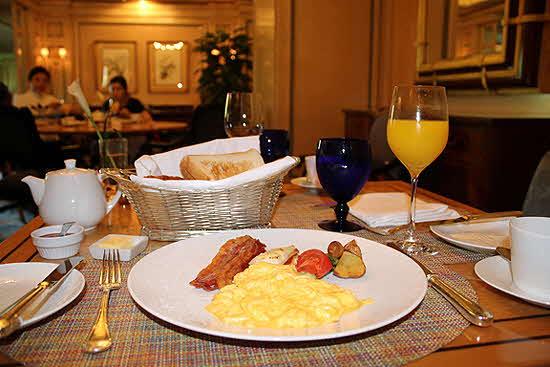
Breakfast at Il Teatro is decidedly elegant. Rather than buffet-style, there are various menus available at different price ranges. I had a full American-style breakfast with eggs, bacon, toast, juice, and pastries. Everything was as high quality as you would expect, including the service.
The décor of this hotel is traditional with antiques and Japanese designs throughout. Just walking through the many hallways and common areas is a treat for the senses. You’ll find paintings, sculptures, ceramics, unusual furniture, marble floors, and colorful carpets everywhere you turn.
A hallway in Hotel Chinzanso. Photo by Melanie Votaw.
My room was also beyond what I usually find in 5-star hotels. First of all, I had a panoramic view of the garden, and the thick, floral curtains alone were especially luxurious. Besides the customary amenities you find in luxury hotels, most rooms at Chinzanso contain CD and DVD players, tea/coffee-makers, and televisions in the bathroom. Humidifiers are also available on loan.
My room at Hotel Chinzanso. Photo by Melanie Votaw.
I had a king-sized bed, two chairs, a desk, a credenza with television, a minibar with dishes including wine glasses, and a separate bathtub and shower. Like many high-end hotels in Tokyo, I was provided with a cell phone for local use that also allowed unlimited international calls. You can enter your own data into the phone and erase it before checkout.
The minibar in my room at Hotel Chinzanso. Photo by Melanie Votaw.
This is such a wonderful perk in Japan, along with the extra amenities that you rarely get elsewhere like toothbrushes, hair ties, shavers, and shaving cream.
My room’s bathroom at Hotel Chinzanso. Photo by Melanie Votaw.
Regardless of Hotel Chinzanso’s many charms, I do need to pay appropriate tribute to the garden. With grounds of this size, the property isn’t what you’d call centrally located, but that’s a small price to pay for what amounts to a quiet oasis in such a busy metropolis. I took a glorious stroll on the grounds for about two hours in my first morning.
The pagoda in the gardens at Hotel Chinzanso. Photo by Melanie Votaw.
The garden contains a number of historical artifacts, including a three-story pagoda. At first, I assumed it was a replica built in modern times, but not so. The pagoda was found in Chikurin-jiTemple in the mountains of Hiroshima and is believed to have been built during the first half of the Heian period from 794-1185.
There is evidence that it was renovated in the 1100’s, and it underwent a full-scale renovation from 2010-2011. After the renovation was completed, a ritual was carried out by Raitei Arima, the 113th head priest of Shokoku-ji Temple.
A sculpture in the Hotel Chinzanso gardens. Photo by Melanie Votaw.
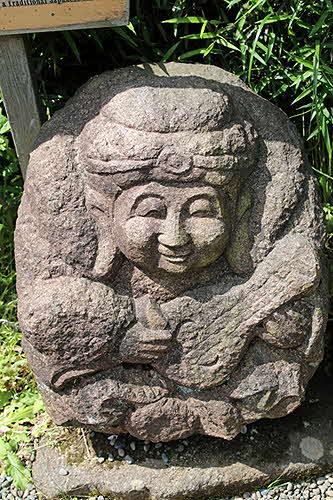
The garden also contains a pond, separate rooftop “serenity garden,” shrine, manmade waterfall, 500-year-old sacred tree, water basin from the Edo Period, 50 traditional copper lanterns, monuments that are hundreds of years old, numerous statues of gods and goddesses (all with markers explaining who they are and what they stand for), and other artifacts and features that make the stroll interesting, as well as peaceful.
At certain times of the year, there’s a spot within the garden that fills with fireflies, and dozens of cherry blossoms bloom there in early spring. With chapels on the grounds as well, it’s a popular location for weddings.
Staying at Hotel Chinzanso Tokyo is an experience that deserves the word “special.” It’s one of those rare hotels that will stay in your memory for years to come.
Sherry is one of the two spectacular fortified wines produced in the Iberian Peninsula, in the wine-growing maritime region of Jerez, mostly from white grapes. The other is Port, produced in Portugal at the country’s northwestern Atlantic seaboard, mostly from red grapes grown in vineyards along the Douro River.
Palomino grapes on chalky soil. Photo by Manos Angelakis.
The Jerez winemaking tradition goes back over 3,000 years. The region’s unique climatic conditions are ideal for cultivating the grape varieties used in creating sherry: Palomino, which is used to produce the drier types of sherry and Pedro Ximénez and Muscatel, which are used for the sweeter varieties.
Jerez Wines. Photo by Manos Angelakis.
There are three styles of Sherry wines: the dry sherry wine (Vino Generoso), the naturally sweet wine (vino Dulce Naturale), and the sweet sherry wine (vino Generoso de licor). They are all made in the Solera style of winemaking, where casks (called butts) are stacked one row on top of another row on top of a third row and even possibly a fourth.
Young wine is then poured into the butts of the top row, and the aged wine is drawn from the butts of the bottom row. The wine is transferred from top to bottom as it ages, and the liquid in the lowest butts is drawn for bottling.
Dry sherry wines are created when there is complete fermentation of the must (the freshly pressed grape juice that still contains the grape skins and stems), which creates minimal residual sugar from the grape juice. There are five styles of dry sherry: Fino, Manzanilla, Amontillado, Oloroso, and Palo Cortado.
Veil of flor in sherry butt. Photo by Manos Angelakis.
Fino is a dry sherry that is aged entirely in the interior of American oak butts (casks or barrels), always protected by a film of yeast called the “veil of flor,” which prevents the wine from oxidizing. It is very pale straw yellow-colored, and its aromas and flavors are due mostly to these yeasts that constantly interact with the wine.
Gonzalez Byass Solera butts. Photo courtesy of Lustau’s.
The Fino wines are fresh and crisp on the nose with almond notes that are very characteristic of the yeast. They have a very dry flavor and low acidity. Their alcohol content is usually low, about 15%.
Amontillado is a wine that initially follows the same production process as Fino, but continues to age without the veil of flor and is, therefore, exposed to oxidation. This gives it its nose and taste characteristics. Golden to mahogany in color and gentle on the nose with notes of hazelnut, it’s more structured than a Fino. It’s dry on the palate with notes of spice and wood and with great persistence. Its alcohol content is usually between 17% and 20%.
Manzanilla is a distinctive form of Fino – an exclusively specific DOC sherry “Manzanilla de Sanlúcar de Barrameda.” It’s a dry white sherry made from palomino grapes and is also aged under the layer of flor. Usually, a level of oxidation is allowed for the Manzanilla that produces greater complexity in the wine.
It’s very bright but pale straw-colored with a sharp, lightly briny, delicate bouquet and predominantly floral aromas of chamomile, almonds, and dough. Dry and fresh on the palate, it’s smooth in spite of the dry finish. The light acidity produces a pleasant sensation of freshness but a slightly astringent and saline aftertaste. Its coastal origin gives it distinctive qualities that differentiate it from other Finos.
Oloroso is an opulent, oxidized wine made in Andalucia. It has nutty and caramelized characteristics on the nose and palate. It’s fermented to approximately 11% alcohol and is then fortified with a mix of grape spirit and old wine. Grapes for Oloroso tend to occupy the less-premium soils, as there is less need for finesse in the base wine.
Oloroso has around 17% to 20% alcohol, which is too high to encourage the growth of flor, the yeast that is essential to the production of other kinds of sherry. The Oloroso has a dried fruit and wood character. Although the wine has been made for hundreds of years, it’s currently enjoying a boom in popularity.
Lustau’s East India Solera is a dark mahogany-colored sherry, which is a blend of 80% Oloroso and 20% Pedro Ximénez butts that have been aged separately for about 12 years. The name refers to the East India Company, a trading company that transported silk, spices, tea, decorated porcelains, and other “luxury” commodities from the East Indies and Cathay to England. (The featured photo above is of Lustau’s Bodegas Soleras, courtesy of Lustau’s.)
As a fortified wine (which lasts very long), sherry was taken along to serve the ship’s crew on its transatlantic and transpacific journeys.
Lustau is one of the few bodegas honoring the East India Company with its Solera, one of the better known sherry products. This producer has a long history since 1896 when José Ruiz-Berdejo started cultivating the vines of the family’s estate.
His daughter, María Ruiz-Berdejo Alberti, acquired a small winery closer to the center of Jerez de la Frontera in 1931 and moved all the preexisting soleras there. In the 1940s, Maria’s husband, Emilio Lustau Ortega, moved the winery to the old Santiago district.
Lustau East India Solera. Photo courtesy of Lustau’s.
In buildings that were part of the historic Moorish walls of the city, he slowly began to expand the business. In 1990, Lustau’s merged with Luis Caballero, a Spanish-owned company prominent within the wine and spirits business. This meant important financial support and the possibility of further expansion.
The East India Solera is available in the U.S. in the better wine stores and is one of my favorite sipping sherries.
Tapas are the fare associated with the dry sherries, which are an exceptional aperitif accompanying small but delicious finger foods – even small cooked dishes like Albondigas (small meatballs in sauce) or Pulpo a la Gallega or Tortilla Española and much much more.
If you are in Spain, you go “tapear,” that is walk from taska to taska, tasting the best tapas they offer, washed down with a Fino or an Amontillado, and you can have a great meal for relatively little money. Actually, the Sherry Producers Association awards plaques of distinction to the taskas that offer the best tapas.
In addition to the dry sherries, there are also exceptional sweet sherries based on the Pedro Ximénez and Moscato or Muscatel grapes. PX as the Pedro Ximénez sherries are called, is usually a luscious after-dinner sip or to accompany acidic fruits and deserts. We’ll talk about the sweet Sherries in a future article.
Turks & Caicos Islands (TCI) is considered one of the world’s premier beach destinations, prized for its exquisite sandy beaches, new hotels, all-inclusive resorts, and luxury rental villas.
But its history was far less glamorous. The first European visitor there was Christopher Columbus. When he anchored at this string of 40 islands in 1492, they were inhabited by indigenous peoples, including the Lucayan Amerindians, who had preceded him by almost 1,000 years.
After Columbus, other Europeans visited the islands, and in the 16th century, they enslaved the Lucayans and harvested salt from the shallow waters surrounding the archipelago. In the 21st century, salt is a commodity that’s cheap and widely available. But in those pre-refrigeration days, it was crucial for preserving meat and fish. The navies of the world depended on it.
For decades, Spain, France, Britain, the Bahamas, and Bermuda fought amongst themselves for ownership of Turks & Caicos until in 1962, the islands became one of Britain’s overseas territories (formerly known as British Crown colonies).
Twenty years later in 1982, Club Med, the Columbus of its age, made landfall and opened Club Med Turkoise on Provo, officially starting the tourist age there. In 2023, the islands received more than a million visitors, and tourism is the country’s main source of revenue.
What To Do
The islands’ greatest attraction are the beaches: gorgeous, clear water, plus a variety of water sports, from diving and snorkeling to kayaking, kiteboarding, and stand-up paddleboarding.
Grace Bay Beach is the largest and most famous. Taylor Bay Beach, where my family stayed in a rented villa, is wonderful for young kids: smaller and less overwhelming than the 12-mile-long Grace Bay Beach, with water that’s quite shallow for easy wading with little danger.
Nearby Sapodilla Bay Beach is also shallow enough for kids (about one foot deep, unless you walk out dozens of yards), with limestone rocks framing the water.
Royal Turks & Caicos Club on Provo Island. Photo courtesy of Royal Turks & Caicos Club.
TCI has only one golf course, but it’s a great one: Royal Turks and Caicos Club on Provo has twice been named the Best Caribbean Golf Course by USA Today. Thanks to its choice of turf – Platinum Paspalum grass – the fairways are always fresh, dark greens and playable.
The club house, bar, and pro shop are all inviting. Besides golf, the club offers two floodlit courts for evening tennis.
Where To Stay
Grace Bay is where most first-time visitors stay. The beach is world famous and the hotels are first class. In addition to all that, it offers sidewalks, streetlights, cafés, and stores.
Some of Grace Bay’s hotels are all-inclusive. That’s something to consider because even for the Caribbean, TCI is expensive. Food is especially costly because almost nothing grows on the island. Most of what you’ll eat is imported, and there’s a 30% tax on most imports.
An all-inclusive hotel arrangement that covers food and drink might offer significant savings, especially if you have a lot of mouths to feed. Three all-inclusive, family-friendly places are Alexandra Resort, Grace Bay Club, and the Island Club.
Alexandra Resort on Grace Bay Beach lets kids under 12 stay and eat free. It has a lagoon-style pool, water sports, and tennis courts.
Grace Bay Club is thought of as the number-one hotel on Providenciales, and it’s famous for its kids’ program.
Then, there is the Island Club, a reasonably priced condo complex near the Saltmills Plaza and close to restaurants and the beach. It’s a perfect location on the islands because you can walk everywhere without needing a car.
The house that we rented. Photo by John Coyne.
If you or your family prefers the more relaxed atmosphere of a rented house, these abound, and we saw many more under construction in our neighborhood. We found our place on VRBO, and it did not disappoint – four air-conditioned bedrooms and bathrooms, including a spacious main suite with outdoor porches. It also had a pool, hot tub, and two kayaks. It was a five-minute walk to the beach, entered via a private gate.
Most of these houses are hidden from sight, encased by thick trees but with commanding views of the water and within short walking distance to the beach and sea.
We bought food the first day at a grocery located about 10 minutes away and were able to get most of the basics. We later discovered a “gourmet” version of that grocery called Graceway Gourmet in Grace Bay.
Officially, the tap water is drinkable in TCI. However, if you choose bottled, know that it’s taxed even higher than other foods – 40% instead of the usual 30%. Our house supplied a water cooler at no additional cost, which is a perk renters might look for.
Obviously, house renters come into much greater contact with the community than guests at a resort. That has both plusses and minuses. Our trips to the grocery store were fun, and the people we met were friendly and helpful.
In terms of safety, in the community of villas where we stayed, private security cars were visible day and night. According to the official U.K. government website (UK.GOV), “levels of crime across the Turks and Caicos Islands are relatively low. . . . Most crime tends to be as a result of opportunistic burglary and theft.”
Of course, if you opt for a house, you’ll need a car, and you’ll need to drive the British way on the left side of the road. “No problem,” you might say. Just bear in mind that the tarmac roads are narrow and crowded with local cars and a fair share of aggressive drivers. During my four-day visit in the month of February, I spotted five accidents.
If you’re new to the island, I’d recommend checking out Grace Bay. It’s a long curve of sand on the north shore of Provo with a spectacular world-famous beach, plenty of shops, and lots of restaurants.
A good friend stayed recently with his wife and their two young daughters at Grace Bay’s Club Med Turkoise. They had an all-inclusive package, which meant that for one flat price, they all enjoyed unlimited food, drink, and group activities, such as pickleball, kayaking, catamaran sailing, and snorkeling off one of the resort’s boats.
They also took sailing tours to various inhabited islands, including Iguana Island and Mangrove Cay. “Scuba diving was all I had to pay for,” he says. He found the food “fresh and good,” and he noted that there were many food stations that allowed them to choose among as many as 12 different types of cuisine at their hotel.
He also realized that this Club Med has “lots of return visitors.” One woman we met was making her 16th visit to the hotel. And there was a nice mix of people. Everyone wasn’t young.
While considering Club Med Turkoise as one of the best bargains on the islands, he also noted that “the rooms are small, and the resort has the feeling of a summer camp. It’s great if you have kids.”
Many Turks & Caicos restaurants have wonderful views of the ocean while you dine. Photo by John Coyne.
Where To Eat
There’s an abundance of good places to eat. At even the fanciest, dress is pretty casual (neckties never required). Two restaurants I would suggest where you can watch beautiful sunsets while you dine are the Magnolia Restaurant & Wine Bar and Mango Reef Restaurant & Bar.
Magnolia is on a hilltop with a compelling view of Turtle Cove Marina and the north shore. It’s famous for its banoffee and lemon-lime-curd pies. And all of their dishes have a European and Caribbean taste.
Nearby and closer to the water is Mango Reef, an outdoor restaurant loved by families with children. It serves typical American and island dishes. Their charred lobster tail was particularly delicious. Dining outside, you can enjoy the sunset and watch the boats sail in from the sea. Also, the kids can watch gray herons up close as they snap up offerings from diners and friendly waiters.
While you can visit TCI year-round, the peak tourist season is December to April. May to August, of course, has favorable weather but fewer tourists, and as in most of the Caribbean, there’s always the possibility of a hurricane in the late summer and early fall.
One drawback of the islands, and one you can’t avoid, is the international airport. TCI is in the process of building a new one, but for now, the small terminal seems ready to burst. On the day we departed, it was so jammed that crowds of departing tourists never found a seat. They spent several hours standing on their feet with no place to rest even briefly as they waited to leave the Caribbean paradise.
Arriving in Turks & Caicos, however, is not a problem. Come when you can, and stay as long as you can. These small islands in the sun have much to give.
In only a few days, I covered a lot of terrain in Jordan. I was able to see several historical sites. Petra isn’t all there is to see by a long shot! It’s a stunning country with friendly people who are deeply saddened by the turmoil happening in the countries that surround them. My guide told me that he used to take tourists into Syria, for example, on a regular basis. He misses being able to go there.
Nevertheless, I felt absolutely safe in Jordan, and it appears to be a stable place to visit. Below are some of my favorite photographs from my visit.
Petra isn’t the only set of beautiful ruins in Jordan. I loved Jerash (or Jerasa) just as much. It’s believed that Jesus visited there. This Roman city must have been stunning when it was new.
There was a sewer system underneath the city, and this is an ancient manhole cover. It was one of my favorite things that I saw. I had no idea there was such a thing as a manhole cover from Biblical times!
An ancient manhole cover in Jerash. Photo by Melanie Votaw.
Another thing at Jerash were indentations in the stone streets from chariots. Holy Ben Hur!
The columns of Jerash in Jordan. Photo by Melanie Votaw.The ancient site of Jerash in Jordan. Photo by Melanie Votaw.Beautiful carving detail at Jerash. Photo by Melanie Votaw.The amphitheater in Jerash had numbered seats! I wonder what they used for tickets – papyrus, maybe? Photo by Melanie Votaw.Another view of Jerash. Photo by Melanie Votaw.Gorgeous decorative plates in Jordan. Photo by Melanie Votaw.An ad at Petra for Bedouin Kohel eye makeup, which is popular with the women of Jordan. Photo by Melanie Votaw.The marker at Mount Nebo in Jordan, where Moses purportedly got a view of the Holy Land. Photo by Melanie Votaw.The view from Mount Nebo, which includes Israel in the distance. Photo by Melanie Votaw.A camel jockey at Petra. Photo by Melanie Votaw.The famous treasury is far from the only building at Petra. It takes hours to walk through the ancient ruins. Photo by Melanie Votaw.The rocks at Petra have exquisite colors and designs. Photo by Melanie Votaw.Aramaic writing at Petra. Photo by Melanie Votaw.The flies were quite a bother to the camels at Petra. Photo by Melanie Votaw.The upper floor of the famous pink stone treasury at Petra. Photo by Melanie Votaw.At the ancient site of Umm Qais, I saw these strange tiger-like insects. Photo by Melanie Votaw.The view from the ruins of Umm Qais, which was the ancient city of Gadara. In the distance is the Sea of Galilee. Photo by Melanie Votaw.I met this family at the historical site Umm Qais, which was built around 90 AD. They asked me to take a photo of them, but despite our best efforts, our language barrier prevented us from communicating how I would ever get the image to them. We laughed at ourselves, and I was left with this sweet image of people I have no idea how to contact. I adore that the child’s sweater says “LOVE” in English. May we all learn to love each other, despite our differences. Photo by Melanie Votaw.
January may be an odd time to visit Beijing because it’s very cold and dry, but the plus side is that the crowds are seriously reduced from the warmer months, when I’m told you can barely walk at the most popular sites. Since crowds are not my thing, I was happy to visit the city in January (even if my toes felt numb by the end of the day).
The best thing about Beijing is that the most famous sites in all of China are in the vicinity, including the Great Wall, the Forbidden City, Tiananmen Square, the Ming Tombs, the Temple of Heaven, the Summer Palace, and the famous pandas at the zoo.
The Great Wall of China. Photo by Melanie Votaw.
The Great Wall is the only one of the above attractions that requires a short drive outside of the city. There are several different sections of the Great Wall, but the portion called Badaling is the easiest, especially if your time in Beijing is limited. It’s fairly close to central Beijing, and you can work in the Ming Tombs afterward.
Tiananmen Square. Photo by Melanie Votaw.
If you’re with a tour, you’ll no doubt stop at one of several large buildings near tourist spots where you can have fantastic Chinese food or tea surrounded by enormous jade sculptures and aisle upon aisle of souvenirs so beautiful that it will make you dizzy.
I hired a private guide to take me around the city, but you can easily navigate it on your own using public transportation and taxis. Some taxi drivers don’t speak English, however, so you’ll need to get your concierge to write down the name of your destination in Chinese. Most young people in Beijing speak English very well, though, as they’re taught the language in school. So, for the most part, it isn’t difficult for English speakers to get around the city.
Even if you don’t hire a private guide, it helps to have a guide show you around the historical sites. You’ll miss a lot of the fascinating intrigue of Chinese history if you don’t have someone to tell you the details. No matter how much you’ve studied in books, you’ll get a lot more juicy information from a local guide.
The Forbidden City. Photo by Melanie Votaw.
For example, my guide showed me the passageway in the Forbidden City where the last emperor rode the bicycle he was given by his British tutor. I was also told how all of the construction of the Forbidden City, the Summer Palace, and the Temple of Heaven is free of nails. The intricate pieces were carved with such precision that they fit together without any connecting metal and have remained intact through all sorts of weather events.
Of course, that doesn’t mean that no restorations are done to the buildings. One of the Forbidden City buildings had scaffolding on it during my visit.
My favorite site was the Summer Palace. Located on the water, this was the Empress Dowager’s place, a very intriguing character in not so distant Chinese history who was the voice and true power behind several child emperors. For exercise, she walked one of the passageways every morning with her entourage behind her and then was transported by boat back to her starting point.
The Marble Boat at the Summer Palace in Beijing. Photo by Melanie Votaw.
There is an exquisite marble boat in the water next to the palace that was built for the Navy but never allowed to sail.
Near the Temple of Heaven, considered to be one of the most sacred spots in the world, locals gather to play cards and checkers, sing, dance, and play music together. It really sunk in that I was in China as I watched this joyful community of people and listened to the traditional music and singing.
The Temple of Heaven in Beijing. Photo by Melanie Votaw.
One night, I went to an acrobatic show. It’s primarily for tourists, but it’s well worth seeing. These performers do things that seem inhuman, such as balance on a cylinder while standing on the head of another guy who is balancing on a cylinder. The finale consisted of 15 girls riding a single bicycle around the stage. There are other shows in the city, such as the Peking Opera, if you’re so inclined.
Shopping in Beijing can make you crazy. Wangfujing Street is the main shopping area, and at night, it’s filled with outdoor stalls where you can buy all sorts of strange food (if you dare risk the dysentery.)
My guide took me to one of the large “silk district” buildings filled with one vendor after another. Each floor is devoted to something different – silk fabrics, jewelry, etc. I bought a painting on silk and a terra cotta teapot, but the sellers were too aggressive for my taste. A couple of them literally grabbed me and pulled me back toward them as I tried to walk by.
A Beijing street scene. Photo by Melanie Votaw.
I stayed at two hotels located in different areas of the city. When I arrived at my first hotel, the Hilton Beijing, there were women in red Chinese silk dresses playing traditional instruments in the lobby. Fine Chinese hotels provide you with enormous feather pillows, and the Hilton’s linens were especially fine with a crisp white down comforter.
Breakfast buffets are usually spectacular in top Asian hotels, but the Hilton gets the prize as my favorite because the service provided by the staff was superb. My orange juice and tea were constantly topped off, and I was brought a special exotic juice concoction, different types of breads right out of the oven, and a selection of newspapers.
Of course, the hotel has an additional restaurant and two bars, as well as a health club and pool. One nice touch was a card that you’re given at check-in, which includes useful sentences in Chinese and a list of the main sites, which you can circle in order to show your taxi driver where you want to go.
My room in the JW Marriott Hotel in Beijing. Photo by Melanie Votaw.
While the Hilton is located in a tourist area not too far from the Forbidden City, my next hotel – the JW Marriott – was located in the Chaoyang District, which is part of the Central Business District or “CBD” area of the city. The hotel is part of a massive complex of upscale stores and office buildings called China Central Place. It’s an exceptional property located next door to the Ritz-Carlton.
The TV in the bathroom in my room at the JW Marriott Hotel in Beijing. Photo by Melanie Votaw.
I especially loved the smaller flat screen TV at the foot of the bathtub. After walking around cold Beijing all day, I thawed out in the tub while watching an American movie. Now, that’s luxury!
I came to New York City in 1967 with the dream of becoming an award-winning advertising photographer. I had worked as an assistant in 1964 London in the studio of David Bailey, a famous photographer of the period. Plus, I had started doing some “semi-professional” work in Athens in ’65 and ’66.
I knew I didn’t have enough insight into the techniques, and I wanted to do much more sophisticated work, such as fashion or advertising. Unfortunately, there were no real opportunities to learn in Greece at the time.
Then, I saw an ad for the New York Institute of Photography that was promising to train individuals as “professional photographers,” and I thought that would be a place to get the experience I needed. Little did I know that it was, in reality, a waste of time and money. Working for Bailey, I learned much more about the art, craft, and business of photography than the Institute and its “professionals” could ever teach me.
I stayed in New York and rented an apartment on Mott Street on the Lower East Side and started working as a freelance assistant in top NYC studios to learn firsthand from the best advertising photographers of the period. That was when I fell in love with rye bread.
Corned beef sandwich on rye with coleslaw. Photo by Manos Angelakis.
There were a number of quirky Jewish restaurants on the Lower East Side offering humongous sandwiches piled high with corned beef with coleslaw on rye bread.
For a long time, I thought there was no good New York-style rye bread in any other area than Manhattan’s Lower East Side. So it was with great pleasure that I recently discovered a bakery near me that makes a classic artisanal New York rye loaf with a somewhat dense interior and a crispy crust.
Exterior of La Brea Bakery. Photo by Manos Angelakis.
The La Brea bakery, one of the largest sellers of artisan bread in the U.S. with a west coast production plant in Van Nuys, California, started in Los Angeles making handcrafted hearth-baked breads. It opened its first retail store in 1989.
In 2001, it opened a baking facility in Swedesboro, New Jersey, now renamed Aspire Bakery – the new name of the company that purchased the La Brea brand in 2021 – in order to keep up with demand from the east coast for its 35 varieties of artisan breads. It also has a bakery in Queens, and both are now wholesale operations. The brand name is still La Brea and can even be found in a number of supermarkets.
La Brea Bakery sourdough baguettes. Photo courtesy of La Brea Bakery.
In the past, I’ve had their sourdough baguettes, and in 2024, they introduced their seeded rye loaf. Both extremely good.
I prefer the rye because I can make a humongous corned beef sandwich right in my own kitchen. This hearty rye is crafted from wheat and rye flours, making for a moist, slightly dense interior with a crisp crust. Caraway seeds, the aromatic ingredient of a classic rye, are both baked in the bread and sprinkled on top for a finishing touch.
But you don’t have to be Jewish to make a great corned beef sandwich. As far as I’m concerned, enjoying good food has no real ethnicity. I love the corned beef on rye as much as I enjoy steamed soup buns (Xiao Long Bao) or eggplant Imam Bayildi.
A corned beef sandwich with coleslaw is also an excellent way to celebrate St. Patrick’s Day. Just add potato salad as a side dish!
Additionally, this rye bread can be enjoyed when fresh or just warmed up a little, slathered with fresh butter. I prefer Irish butter for its rich taste along with peach, apricot, or quince preserves for a very enjoyable breakfast or a quick midday pick-me-up.
I still like the sourdough baguette, of course, but not as much as the rye!