

Exploring Norway’s Lofoten Islands
Towering jagged peaks rise like formidable granite columns, overlooking a pristine white sandy beach that seems at first to fade into low lying clouds further beyond the shoreline and the incoming receding waves. The Lofoten Islands of Norway have many transcending scenes, which continue to grab the attention of the seasoned travelers who are willing to explore this enchanted archipelago.
For the final leg of my journey, which began in New York, I took a 25-minute flight from Bodø on the mainland to Svolvær, which has one of the two airports on the island chain.
On my very first night in this coastal town, I discovered by chance the spectacular northern lights, which displayed intriguing green swirling patterns on a dark blank canopy. This most unexpected encounter lasted less than an hour but will forever be an unforgettable experience.
This event took place during a quiet leisurely stroll along the harborside, not far from my hotel but far enough away from the town lights that gradually faded in the distance. On my hotel balcony later that evening, I enjoyed the delightful view of the shimmering moon that seemed to shiver in the cold still air while bright, multiple-illuminated reflections lightly flickered on the calm waters of the harbor below.
My stay at the Scandic hotel in Svolvær turned out to be the ideal location, situated near the middle of the harbor on a small island connected by a short causeway. From the comfort of my hotel balcony, I had wonderful views of the surrounding harbor, the town center, the fishing boats leaving early in the morning and returning at dusk, various species of arctic seabirds on the water, and the spectacular mountains that seemed so close.
A local guide, Jann Engstad of Lofoten Aktiv, came to my hotel to give me a personal tour of two fishing villages – Kabelvåg and Henningsvær. These two charming tightly knit communities soon provided some interesting scenes that fulfilled my keen photographic interests.
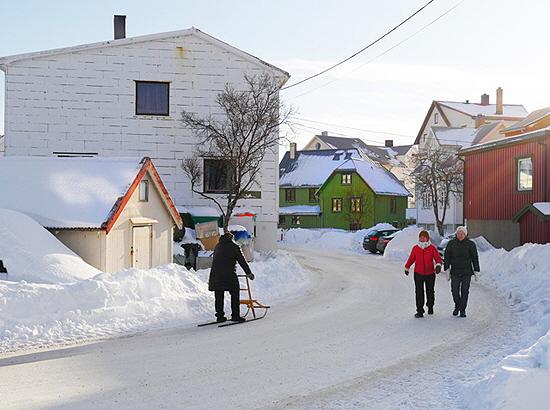
An enthusiastic photographer himself, Jann knew the time and place best for capturing some unique local aspects of daily life in the community: fishermen mending nets onboard while making repairs to the boat docked on the jetty. Children and older folk sledding to school or to the local shop. Racks of codfish hung for drying in the cold fresh air near the fishing boats.
This centuries old tradition of preserving cod is very much part of the cultural fabric of the Lofoten islands. Many of the local restaurants prepare this popular fish as a main course.
While in these small vibrant communities, I had the unexpected opportunity to meet many locals whose genuine friendliness and refreshing openness I will always fondly remember. Many shared their personal experiences of living on these faraway islands and provided meaningful insight into their unique way of life.
Later in the day, Jann drove to the town of Lekness, where I would spend several days at a new hotel.
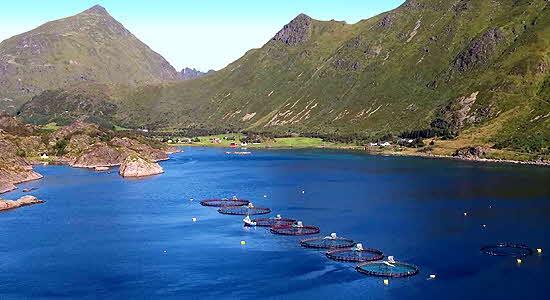
On the following day, I visited the Lofoten Seafood Center located not far from my hotel. The visit afforded an opportunity to learn more about the economic mainstay of the archipelago’s fishing industry, while experiencing an enjoyable introduction to salmon farming.
Early on the day of my visit, snow gently fell as our small launch left the jetty heading toward the salmon pens. Cold, misty air revealed clear outlines of small barren islands and snowy caps in the far distance. As the boat plowed through the icy waters, our charming young skipper kept up an interesting banter of relevant details about the day-to-day operation of the salmon farm.
Reaching the pens, I saw huge fish jumping and disturbing the surface water in these oval-shaped, netted enclosures. The skipper said some salmon can weigh as much as four kilos, and each pen can hold about 60,000 fish. I counted eight pens.
I soon learned that salmon farming is very much a computerized operation. The entire fishing stock is fed four times a day and is fully automated with an above-water machine that sprays food back and forth on the surface like a stationary garden hose.
After returning to the jetty, I went inside the small adjacent fish-processing factory and saw the newly arrived catch of cod, which is the very traditional fishing mainstay of the region. Spotlessly clean stainless-steel containers held the codfish.
Later that day, I had the great pleasure of dining at the Lofoten Seafood Center’s restaurant and enjoying the freshly caught seafood.
The restaurant’s executive chef prepared various dishes using a variety of local seafood, ranging from fresh cod and halibut to delicious local crab meat, enhancing each dish with special seasonings and fresh vegetables.
I enjoyed the chef’s carefully selected wine pairings with each course. The restaurant has a wide-ranging selection of international wines, especially prominent wines from Northern Italy and France.
The town of Leknes is conveniently located within striking distance of the coastal Lofoten Seafood Center and is central to most other major attractions on the Lofoten archipelago. The town itself is unassuming with a main street and a small residential population scattered outwards from the main shopping district.
I stayed at the Scandic Hotel, which proved to be a well-placed choice since it has a nice in-house dining room serving wholesome and satisfying three-course dinners. Sometimes just relaxing in comfortable quarters after dinner without a constant need to venture out to restaurants can be a most desirable option.
Only about a ten-minute drive from Leknes, Haukland Beach is a beautiful wide stretch of blond sand and gentle waves. It can be even more beautiful when changing shades of daylight enhance the natural surroundings.
The beach is enclosed by steep rugged mountains on all sides, and beyond the breakers, large barren rocks break the momentum of the surging sea. Walking along and observing the incoming clear aqua marine waters that retreated along the beach, I enjoyed the solitude.
Some of this trip was subsidized by the Norwegian Tourism Board, but as always, we are dedicated to providing unbiased assessments of our experiences.


