If you’re going to a concert at New York City’s Carnegie Hall (pictured above) in the near future, you may wonder where to have a meal. There are countless restaurants in the area, but here are my favorites.
La Grande Boucherie is my number one choice. It’s a classic French menu and definitely a luxury experience, though not outrageously priced. It’s just a few blocks south of Carnegie Hall on West 53rd Street off Seventh Avenue. It’s also great for brunch if you’re staying near Carnegie Hall, or you’re going to a matinee. Read my full review of this restaurant here.
La Grande Boucherie restaurant. Photo by Melanie Votaw.
La Bonne Soupe is another French option. It’s a little bit east of Carnegie Hall on West 55th Street. I am disappointed that they removed their terrific crepes from their menu, but there’s still much to love from seafood to classic boeuf bourguignon. And they have good value prix fixe options for both lunch and dinner.
Russian Tea Room. Okay, if you hate French food, or you just aren’t in the mood, this famous restaurant is a must at least once. The ambience is gorgeous, and you never know who you might see there! (I saw Ringo Starr my first time there.) Located on West 57th Street, the restaurant even serves vegetarian dishes now, such as wild mushroom stroganoff. Or if you’re a meat eater, try the Beef Wellington or the apricot-glazed duck breast with braised red cabbage and an apricot cherry chutney. Yum! Entrees are $35-$60.
Redeye Grill. This popular spot that’s sometimes used for opening night Broadway parties is right across the street from Carnegie Hall. Its eclectic menu is the perfect choice if you have a party with diverse tastes in food, although it does skew a little toward seafood. You can order a burger, a seafood tower, sushi, or a big dinner salad. Prices are mid-range for the area.
Trattoria del’Arte. I couldn’t miss including Italian choices for you, and this one is also right across the street from Carnegie Hall. The large menu here will surely please everyone, from its vegetable antipasto bar to seafood to meat to pasta to pizza. They have gluten-free pasta available, and prices are mid-range for the area.
Patsy’s is almost as famous as the Russian Tea Room because it was a favorite of Frank Sinatra’s! Located just west of Carnegie Hall on West 56th Street, the menu is classic Italian at mid-range prices with prix fixe options for both lunch and dinner.
If you go to any of these, let me know what you think!
What a lovely blast from the past! Motown legends The Temptations and The Four Tops practically defined popular American music in the late 1950s and 1960s, along with the other performers on the Motown roster. They will be in concert at the New Jersey Performing Arts Center (NJPAC) next April 19, 2025 at 8 pm, and tickets are already going fast! (Photo courtesy of NJPAC.)
The Temptations were major chart-toppers with such classic hits as “My Girl” and “Papa Was a Rollin’ Stone,” while The Four Tops charted with “Baby I Need Your Loving” and “I Can’t Help Myself (Sugar Pie, Honey Bunch),” among other well-known songs.
The Temptations, considered the greatest black R&B/soul vocal group of the modern era, released more than 50 Gold, Platinum, and multi-Platinum albums. They were awarded five GRAMMYs®, including the prestigious Lifetime Achievement Award. In 1989, they were inducted into the Rock & Roll Hall of Fame.
The Four Tops achieved a total of 24 Top 40 pop hits, and they were one of the most commercially successful pop music groups of the early 1960s. Both groups helped propel Motown Records to international fame.
To quote Barry Gordy, the founder of Motown Records, “A dream is just a dream. A goal is a dream with a plan and a deadline.”
The Motown record label and its subsidiaries has been the highest-earning African-American business for decades. The roster of Motown artists still reads like a who’s who in music and has included such greats as Diana Ross & the Supremes, Smokey Robinson & the Miracles, Stevie Wonder, Marvin Gaye, Michael Jackson, Martha Reeves and the Vandellas, Gladys Knight & the Pips, Lionel Richie, and many, many more.
Only one original member of The Temptations remains (Otis Williams), and none of the original Four Tops remain. But the men who continue the legacy are fantastic and not to be missed.
The story of The Temptations was recently commemorated in a Broadway show called “Ain’t Too Proud,” and the bass singer who played original member, Melvin Franklin, in that show is now a member of the touring Temptations. This gentlemen, Jawan Jackson, will perform with the group at NJPAC.
Tickets are now available, and if you wish to experience these exceptional artists, you should purchase as soon as possible. They are extremely sought after!
I will attend this performance and report afterwards.
NJPAC Prudential Hall Betty Wold Johnson Stage One Center Street Newark, New Jersey 07102 njpac.org or 888.GO.NJPAC (888.466.5722) Follow NJPAC Online: Website: njpac.org Twitter: @NJPAC Instagram: @NJPAC Hashtag: #NJPAC Facebook: facebook.com/NJPAC YouTube: NJPACtv
I don’t think I have a personal prejudice against low calorie, no-alcohol wines. Still, through the years, I have tasted a number of these bottles and thought most had very little to no taste.
But the product line, Ventessa by Mezzacorona, has proved to me that I can be wrong about this and should try more of these wines just to make sure I know what I’m talking about.
I received two sample bottles – a white and a light blush rosé. Perhaps they were the exception, but they tasted good in the glass and also were good in cooking. All things considered, I think they would make an excellent libation for warm weather, both spring and summer.
Ventessa Pinot Grigio. Photo courtesy of Ventessa.
The wines are designated Vigneti delle Dolomiti IGT and are made in Trentino, which is in Italy’s Adige Valley region. Both Ventessa expressions are hand-picked and estate-bottled, made with 100% Pinot Grigio without any chemical alterations.
Both offer delicate floral notes. The white shows casaba melon and white peach with hints of white flowers and rosé citrus fruits, especially red grapefruit, plus a hint of plum and comice pears. Both were very interesting!
They are well-priced in the $10 to $15 range, depending on the retailer.
Another couple of interesting samples I received were two reds – one from Spain and the other from Argentina.
Montecillo no alcohol wine. Photo courtesy of Montecillo.
The 2013 Montecillo Reserva from Rioja Alta is a lovely blend of 90% Tempranillo, 8% Garnacha, and 2% Mazuelo. I’d had many bottles from that producer when I lived in Manhattan because a good friend, Reinhold W., loved this brand and always opened a well-aged Montecillo bottle when we dined with him.
It’s one of those Riojas that require some bottle aging, because they are quite bold and tannic in their youth. At the winery, the wine is aged for 18 months in American oak followed by 12 months of bottle age to allow the tannins to soften and the flavors to build. It’s well-priced for the quality offered at under $25 per bottle.
Alavida no alcohol wine. Photo courtesy of Alavida.
Another interesting bottle is the Alavida Malbec 2021 from Domaine Bousquet. It’s Argentina’s first USDA-certified organic and kosher wine, and it’s one of few estate wines to achieve this unusual double status. The price is usually under $20.
The vines are grown at high-altitude vineyards in the Uco Valley, an area producing some of Mendoza’s finest wines. As an organic wine, it’s produced with no chemicals either in the vineyard or during production. This means that no pesticides or herbicides are used when farming, and no sulfites, preservatives, stabilizers, or other additives are added during the winemaking process.
In this wine, black plums and blueberries, minerals, and wild herb notes dominate the palate. As it opens, you get violets, licorice, and a hint of cigar box. In diapers now, it will only get better and smoother over the next few years.
Finally, I have two more bottles to mention – a Chardonnay and a Pinot Noir from Cristom Vineyards of Oregon’s Willamette Valley.
Cristom Chardonnay. Photo courtesy of Cristom.
The smoky 2019 Chardonnay Eola-Amity Hills has broad, intense flavors and tangy acidity. It offers aromas of cooked apple, honeysuckle, white peach, toast, and white blossoms. It’s ripe, lean, and balanced.
This is surprising because when I first tried it, it was herbal and showing yeasty aromas, finishing with intense hints of Meyer lemon zest and a refreshing finish. It’s well-priced at about $50 per 750ml bottle, and most critics rate it between 90 and 94 points out of 100.
Cristom Pinot Noir. Photo courtesy of Cristom.
The 2019 Cristom Pinot Noir Mt. Jefferson is another Oregon wine that’s very seductive with ripe strawberry and cranberry, orange peel, licorice, black tea, and hints of cloves and cinnamon. As tasted, it was full-bodied but tight with chewy, pronounced tannins.
It will be much better after 3 to 4 years in cellar and will probably peak by 10. Currently priced between $30 and $40 for the 750ml bottle.
New UK Electronic Travel Authorization (ETA). Travelers from the U.S., Canada, and Australia will have to apply online for an ETA to enter the UK starting January 8, 2025. It can take up to 72 hours to process, so you need to apply in advance with your passport information, a photo per their guidelines, and your travel details. The ETA, which isn’t the same thing as a visa, will last for 6 months or for two years if you don’t plan to stay for a consecutive 6 months. That means you can potentially enter the UK several times over that two-year period without needing a new ETA, but if your passport expires during that two-year period, you will indeed need a new ETA. The cost is 10 pounds, which is about $13US right now.
London’s Houses of Parliament. Photo by Melanie Votaw.
Planning a cruise to Mexico next year? If so, it will cost you more starting July 1, 2025. Mexico will start a port tax of $42 per passenger.
JetBlue will offer domestic first class. Starting in 2026, airplanes that don’t already have lie-flat first class seats will have 2-3 rows of regular first class seats on domestic flights.
New Alaska Airlines routes. Now that Alaska Airlines and Hawaiian Airlines have merged, they will launch new routes from Seattle to Toyko, Japan and Seoul, South Korea in 2025.
Amsterdam working toward banning cruise ships. While it’s only reducing the number allowed for now – from 190 to 100 – the city plans to ban cruises entirely by 2035.
Virgin Voyages Annual Pass. if you have $120,000 (plus taxes and fees) available, you can buy a Virgin Voyages Annual Pass through March 31, 2025 and sail on any of their ships for an entire year starting from January to April, 2025. If you do this, be sure to let us know!
Travel luggage. Stock photo.
TSA liquid rules. Did you know that your stick lip balms don’t count toward your total carry-on liquid allowance? Did you also know that the 3.4-ounce maximum applies to the size of the bottle and not just the amount of the liquid? In other words, you can’t carry on 3.4 ounces of a liquid in a bottle that holds more than that. If you have a larger bottle, it has to be placed in your checked baggage.
Back in the day (1920s to 1940s), the port city of Tangier had a reputation for depravity, where everything and anything was available … as long as you paid the price. Tangier is located in the Straits of Gibraltar, at the very tip of the African continent between the Atlantic Ocean and the Mediterranean Sea, inexorably linking the cultures of Europe and Africa.
In 1906, France and Spain split the country of Morocco between them. However, due to its strategic location, Tangier was designated by an international convention held in Paris in 1924 as a neutral demilitarized zone to be administered jointly by France, Spain, and Britain.
During this Protectionist Era, Tangier was occupied by more than 20 countries, including the United States. After World War II, Spain continued its control over Tangier, but in 1956, Morocco gained its independence. Then in 1975, Tangier was finally reunited with the rest of the country.
During the neglect of the years governed by the international committee, Tangier’s gateway position provided easy access for the transfer of unlawful goods and services, i.e. smuggling. After World War II, it was the home port for numerous “cigarette boats,” which were very fast speedboats that brought untaxed cigarettes and a few other contraband to Sicily and from there to the rest of Europe.
Its laissez faire attitudes regarding sex – in all its variations – opened the city to homosexuals who could live freely and taste forbidden fruit without fear of retribution. Intrigue lay heavy on a city that was flooded by diplomats, secret agents, international spies, smugglers, scoundrels, and in general, people of ill repute from all over the world.
Of course, that level of potential peril naturally brought with it an undesirable consequence, and Tangier could be a very dangerous place. As a matter of fact, according to our entertaining and very knowledgeable guide, Mohammed Harrak, King Hassan II, father of the current King Mohammed VI, disowned the city of Tangier as morally incorrigible and refused to visit his palace there.
Tangier’s Royal Palace. Photo by Barbara Angelakis.
Notwithstanding, this level of decadence attracted prominent artists, musicians, and writers seeking inspiration and adventure. During that period, William Burroughs lived in Tangier and wrote Naked Lunch, his “Beat” masterpiece. Jack Kerouac, Allen Ginsberg, Paul Bowles, and Tennessee Williams, to name but a few, passed through and used the local color to flavor their novels.
Henri Matisse was fascinated by Tangier and painted a number of scenes during his one-year residence in the city that are still identifiable today. If you start at the highest point of the Medina, you will find arrows painted on the street under an ancient tree that will lead you to the many recognizable sites.
Tangier Railroad Station. Photo by Barbara Angelakis.
But time moves on, and King Mohammed VI has made a concentrated effort to redeem Tangier and turn it into a luxury tourist destination with a citywide beautification and building program. This includes a modernized port that welcomes the yachts of the rich and famous and a glamorous new railway station.
The entrance to the medina in Tangier. Photo by Barbara Angelakis.
The ancient medina has been restored, and the modern city has beautiful buildings, broad tree-lined boulevards, beaches on both the Atlantic and Mediterranean, and an affluent and sophisticated population.
Tangier has become so respectable that celebrities and international people of means have built opulent villas in the hills above it that afford spectacular sea views. A visitor would be remiss in not taking a drive along the hilly, serpentine roads to see the gated, but nevertheless sumptuous, properties.
The Lighthouse at Cap Spartel. Photo by Barbara Angelakis.
Hugging the scenic coastline, another short drive out of Tangier will take you to the 150-year-old lighthouse at Cap Spartel. A sign designates it as the spot where the Atlantic Ocean and the Mediterranean Sea meet. It affords tourists a perfect setting as a backdrop for their selfies.
It’s notable that in 1777, Morocco became the first nation to recognize American independence. After the American Revolution, the United States concluded a Treaty of Peace and Friendship with Morocco, which is still in effect today. This makes it the longest-standing unbroken treaty that the United States has with any nation.
This special relationship is officially represented by the “Tangier American Legation Institute for Moroccan Studies” (TALIM), the first American public property outside of the U.S. and the only museum/cultural center in Tangier.
The American Legation Garden in Tangier. Photo by Barbara Angelakis.
Located in the medina, it was built and presented to the U.S. Government by Sultan Mouley Suliman in 1821 to house the U.S. Legation and Consulate. As the oldest diplomatic property outside the U.S. and a Historic Landmark, the Legation has been visited by Presidents Roosevelt, Eisenhower, Regan, Kennedy, and Obama.
The original Moroccan-style building was constructed with an open-air courtyard, garden, arched windows, and intricate tile work.
Over the years, it was expanded and now includes a museum of the history of Moroccan-American relations, plus a research library. It offers an Arabic literacy program for the women of the medina. In the old section of the house, we were fortunate to catch an exquisite temporary exhibition devoted to traditional wedding costumes and jewelry.
Beautiful paintings adorn the hallways and walls from prominent expat artists, and there is a room devoted to author/composer Paul Bowles.
Dried fruits and nuts in the Tangier medina. Photo by Barbara Angelakis.
It’s advisable to have a guide when visiting the medina with its unmarked narrow alleyways and its distractions of craftsmen plying their trades. Goods of all descriptions loudly offered for sale will assault you from both sides of the street, and this can be a challenge for even the most directionally astute, security-minded traveler.
Explore by yourself at your own peril, or accept the adventure of getting lost and the satisfaction of getting un-lost and back to your hotel loaded down with the spices and oils, candied fruits and nuts, carpets, leather goods, brass objets d’art, and Berber jewelry (either authentic or copies). There are also dozens of other uniquely Moroccan treasures that can be acquired on your sojourn.
Many hotels fancy themselves as “Grand” and “Royal,” but in the case of Vienna’s Hotel Imperial, the description can be taken literally.
Custom-built in 1863 as Palais Württenberg, it was designed and constructed as a residence for Duke Philipp of Württemberg, who married Austrian Archduchess Maria Theresa. Five years later, when they sold it and moved, the palace was converted into a hotel for visitors attending the 1873 Vienna World’s Fair.
Since that time a century and a half ago, the hotel has been patronized by a magnificence of celebrities — Queen Elizabeth, Charlie Chaplin, Sigmund Freud, the Rolling Stones, and the Emperor of Japan to name a few.
Situated conveniently on the Ringstrasse just a ten-minute stroll from the city’s iconic St. Stephen’s Cathedral and a two-block walk from the Opera House, it retains its splendor as a Luxury Collection Hotel under the efficient management of the Marriott group.
Directly from the street, guests enter the sumptuous lobby with a multi-colored patterned marble floor, gold-frame chairs upholstered in red velvet, and royal portraits of Prince Philipp and the Archduchess gazing down at the reception desk overseen by the hotel’s acclaimed “Clef d’Or” Imperial Concierge.
Doors at the far end open into Imperial Hall, which originated as an open courtyard for horses and carriages. Its cobblestones have been covered over in marble with frieze panels adorning the walls.
Within, the Imperial Bar serves cocktails and snacks, and during his stay, tenor Luciano Pavarotti delighted hotel guests when he used the cocktail pianist’s grand piano to rehearse.
Cafe Imperial Vienna. Photo by Sharon King Hoge.
To the left of the main doors, the Café Imperial is fitted out in paneled wood and chandeliers with windows overlooking the street. The breakfast buffet is laid out there, and all day long, belying its origin as the birthplace of the legendary Viennese kaffeehaus, several coffee delicacies are served. These include a Wiener Melange mixture of coffee and milk, the Pharisaer local version of Irish coffee, and Maria Theresia spiced up with orange liqueur and whipped cream. Afternoon tea and champagne brunches are offered.
Food at Restaurant OPUS. Photo by Sharon King Hoge.
For fine dining, elegant meals are served in Restaurant OPUS five days a week.
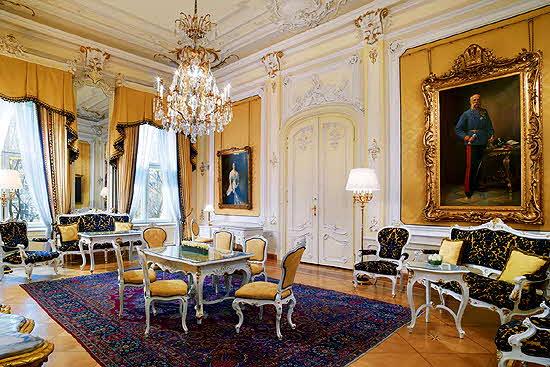
A Royal Suite at Hotel Imperial Vienna. Photo courtesy of Hotel Imperial.
Furnished in the style of Schönbrunn Palace where Marie Antoinette spent her childhood, two symmetrical Royal Suites provide bedrooms and seating areas with brocade draperies, upholstered walls, and glittering chandeliers. The traditional décor is carried out in a variety of classic suites that feature desks and seating areas, large screen televisions, and walls of closet space.
Even basic suites offer Marriott Residential Amenities in large marble bathrooms with tubs, showers, and double sinks. Butler service is provided with many of the more expensive rooms.
Not to be overlooked is the establishment’s famous Imperial Torte. Created in honor of Emperor Franz Joseph I to commemorate the Hotel’s 1873 opening, its secret recipe that fuses buttercream and marzipan with a slight aroma of almonds and melty chocolate icing, is a legendary favorite to this day. And it’s a good reason to use the array of elliptical machines, exercise bikes, stair climbers, and weights in the extensive Fitness Studio with a sauna, which is open 24 hours a day.
For an extra cleaning fee, one dog is allowed per room and greeted with a Pet Welcome Kit, including a bowl, bed, and mat.
A first floor hallway is lined with posters of photos and quotes tracing the hotel’s fascinating legacy of celebrities and events. Studying the information, hotel guests can feel a part of the establishment’s unfolding history and lore.
The author received a complimentary stay at this property, but as always, we’re committed to providing you with unbiased assessments of our experiences.
I had occasion to visit Yosemite National Park in California recently. The only downside to seeing the park in fall is that it’s quite dry, which means the famous waterfalls are almost nonexistent. You have to be there during the spring to see the falls in all their glory. Still, there’s plenty to love about Yosemite year-round.
Here are some of my favorite photos.
Yosemite National Park. Photo by Melanie Votaw.Yosemite National Park. Photo by Melanie Votaw.Yosemite National Park. Photo by Melanie Votaw.Yosemite National Park. Photo by Melanie Votaw.Yosemite National Park. Photo by Melanie Votaw.Yosemite National Park. Photo by Melanie Votaw.Yosemite National Park. Photo by Melanie Votaw.Yosemite National Park. Photo by Melanie Votaw.Yosemite National Park. Photo by Melanie Votaw.
Fegato alla Veneziana is a fried calf’s liver recipe that is probably one of the best known dishes of La Serenisima, together with risi e bisi (rice and peas). Walk around Venice, and you’ll see it on most restaurant menus, from lowly bacari to high-end luxury hotel restaurants.
One place still cooks the definitive Fegato alla Veneziana – the famous Harry’s Bar, which was Ernest Hemingway’s favorite watering hole where he had his very own reserved table while working on his novel, Across the River and Into the Trees, in Venice.
If you are a Hemingway aficionado, chase the Fegato with a high quality Amarone della Valpolicella Classico. He loved to drink bottles of Amarone while in Venice as he worked on revisions of his book in the winter of 1950.
Across the River and Into the Trees was his first book after the publication of his Spanish War novel, For Whom the Bell Tolls in 1940. The novel was first serialized in five installments in Cosmopolitan magazine early in 1950.
Below is Giuseppe Cipriani’s original recipe I received during a trip to Venice in 2015.
Ingredients:
2 lbs. calf’s liver, trimmed with the thin membrane peeled off 5 tablespoons extra virgin olive oil, divided into 3 and 2 tablespoons 6 small yellow onions, peeled and thinly sliced 4 tablespoons butter 1/2 bunch parsley, trimmed and chopped Salt and fresh ground pepper to taste (coarse sea salt and Malabar Black pepper is considered the best combination)
Method:
With a sharp knife, cut the liver into four long pieces with the grain. Then, slice each piece crosswise into smaller pieces.
Heat 3 tablespoons of olive oil in a large skillet over medium heat.
Add the onions, and cook, stirring frequently until soft and golden brown. Make sure you don’t burn the onions. Remove them with a slotted spoon, and set aside.
Increase the heat to medium-high, and add the remaining oil. When it is sizzling hot, add the liver, and cook, preferably in batches to avoid overcrowding the skillet. Continue until the liver is brown and crispy on the edges, 4-5 minutes each batch.
Season liberally with salt and pepper, and add the reserved onions and accumulated juices. Cook for another 2 minutes, stirring and turning the liver and onions constantly while shaking the skillet over the heat. Transfer to a warm serving platter.
Add butter to the skillet, and deglaze as the butter is melting. Remove the skillet from the heat and stir in the parsley. Spoon the mixture over the liver and onions, and serve with grilled polenta.
A heavy cast-iron skillet works best for electric stovetops.
I just received a copy of a cookbook I have been looking forward to called Sri Owen’s Indonesian Food from an imprint of Interlink Publishing. As I’ve mentioned in the past, I’m very partial to Asian dishes, and I have a good number of cookbooks from different Asian countries.
Sri Owen’s Indonesian Food book. Photo by Manos Angelakis.
Not only do I have Asian cookbooks, but I also have a number of “Standardized Menu Item Sheets.” These are very detailed descriptions of finished dishes that could be found in binders in the kitchens of some of the exceptional restaurants in 5-star hotels in Bangkok, Hong Kong, Bali, and Tokyo. I use these sheets to prepare versions of these famous dishes that the restaurants have become known for.
The Sri Owen book is a rather thick tome and has a wide-ranging number of recipes (more than 100) from the ancient land of Indonesia. Most are easy to follow once you have secured all the ingredients. The recipes vary from everyday dishes to specialties for festive or special occasions. The pages place the dishes in Indonesia’s appropriate regional and cultural setting, and they are delicious!
There are also recipes for assorted sauces, meat and vegetable stocks, salads, soups, and more – whatever is needed to assemble a great tasting and exotic-looking meal.
Bali Lompox Wakatobi Beef and Chicken Satays and Spring Rolls. Photo by Manos Angelakis.
The book includes such well-known dishes as satays, sambal goreng and nasi goreng, and numerous regional specialties like lalampa (glutinous rice cakes stuffed with tuna), oseng oseng ayam dengan jamur (spiced and shredded chicken thighs with mushrooms), panggang bebek dengan kuah bayem (duck breasts with spinach sauce), and terik daging (spiced beef boiled in coconut milk).
Luckily, most of the required ingredients are now available in Asian ethnic markets or supermarkets with large international sections in the USA. Where I live, there are many Caribbean, Korean, Indian, Thai, Chinese, and Japanese markets, in addition to American supermarkets with large ethnic sections that carry ingredients particular to the cooking recipes and methods of these ethnic groups. I rarely have difficulty securing everything needed for a delectable dish.
Indonesia Villa Omback Salads and Fruits. Photo by Manos Angelakis.
In my travels, I also pick up ingredients, especially spices, that I might not easily find near me or which would be too expensive in the USA, such as high quality powdered saffron.
If you enjoy trying different cuisines, particularly Asian ones, take a look at Sri Owen’s book.
Las Vegas offers a variety of shows, entertainment, and special events that will be sure to please travelers coming to this desert haven. What’s even better is that many shows are geared to different price points and audiences, which means there is something for everyone.
As a travel writer and recent resident of Las Vegas, I have had the unparalleled opportunity of enjoying various shows currently being showcased on the Strip and surrounding area.
Each has its unique appeal and strong points. My top “3” favorites that you will want to check out during your Las Vegas trip are:
AWAKENING at the Wynn (the photo at the top by Karin Leperi Pezo is of AWAKENING)
AWAKENING is one of the newest and best production shows on the Strip with an extravaganza of colors, lights, illusions, choreography, original music, and a coherent storyline that ties the show together in a way that leaves you wanting to come back for another viewing.
The show clocks in at 80 minutes without any intermission. The theater houses a 60-foot, 360-degree prismatic stage with 1,600 seats. One of the ushers explained to me how the theater was specially designed for this production and represents some of the most technologically immersive experiences in Las Vegas.
Each seat has its own speakers built in for a surround-sound experience. Headsets are handed to each guest just before the show, but in all honesty, I didn’t really find they added much difference.
AWAKENING at the Wynn in Las Vegas. Photo by Karin Leperi Pezo.
Dancing, aerialists, magic, comedy, lights/lasers, and epic drama create a fantasy world and show like no other. I was mesmerized. Be prepared for one of the most awesome finales in Las Vegas. A true sensory extravaganza.
Narrated by Anthony Hopkins, the mythical storyline is about the hero’s journey – a reluctant hero who must unite the forces of light and dark.
IO is our reluctant heroine and has been chosen to reunite the forces of lightness and darkness, to integrate and restore love again. She hails from the Fire Realm and is tasked with retrieving the crystal shards from the water, earth, and air realm. Once united, together they will restore harmony to the world. Accompanied by two comical sidekicks named Bandit and Boo, they add a lightness to an otherwise somber endeavor.
For me, the most awe-inspiring moments were watching the larger-than-life puppets created by world-famous designer Michael Curry. I was dazzled and engaged. The puppetry, especially the final act, is truly phenomenal.
PRO TIPS: Take advantage of the free parking at the Wynn. If over 3 hours, pay is minimal. Valet parking is also available. Children must be at least 5 years old, with children from ages 5-17 requiring an adult supervision. Tickets range in price from $99-$159 USD.
“O” by Cirque du Soleil is a Las Vegas staple that has been playing for over 30 years at the Bellagio, with minor modifications. And it goes without saying, that anything affiliated with Cirque du Soleil is guaranteed to have some of the best acrobatics, costumes, stage design, and choreography in town. They are tops in their field and recruit worldwide for their cast.
Cirque du Soleil “O” at the Bellagio in Las Vegas. Photo courtesy of Cirque du Soleil.
This water-themed stage production takes place in a theater with a 1.5-million-gallon pool with 1,800 seats sold for each show. Be advised that there are no nets for this performance, just water to soften some of the high-level dives.
Acrobats and gymnasts perform for 90-minutes in stupendous, gravity-defying actions, while synchronized swimmers and divers will amaze the audience on how long they can be submerged underwater. That is why every member of the “O” cast is Scuba-certified. A little-known fact is that submerged scuba tanks allow performers to breathe underwater.
The reason the show is called “O” is that is represents the concept of infinity as an inspiration for show. The French language provides the key as “O” is a phonetic interpretation of the French word for water that is spelled “eau.”
Cirque du Soleil “O” at the Bellagio in Las Vegas. Photo courtesy of Cirque du Soleil.
The story is set amongst a 14th century European Opera House, but the storyline seems weak and was somewhat difficult to understand. But I guess it really doesn’t matter, as the performances are stupendous and breath-taking. And quite entertaining without a plot. Multiple things happen all at once, so there is plenty to absorb.
However, many reviews found the clowns a bit boring, much like me. The comedic routines just seem very dated.
Drinks and snacks are somewhat limited with lines and prices that seem over-the-top. No diet drinks were available, other than still water. My $8.00 bag of popcorn was way too salty and without much taste. Eat beforehand and forego the over-priced theater snacks.
PRO TIPS: The theater tends to be in a small corner that tends to get bottle-necked and crowded, so be sure to build in extra time. VIP suites are considered the best seat. This show is suitable for children 5 years and older. Tickets range from $158-$193 USD.
WOW is a variety show that will appeal to families as well as adults. It combines comedy, acrobatics, gymnastics, water ballet dancers, jugglers, and unique acts like archer Sylvia Sylvia who can precision shoot just about anything with her crossbow.
WOW at the Rio in Las Vegas. Photo by Karin Leperi Pezo.
Just be aware that the storyline is loose, and sometimes difficult to follow. Essentially, it’s about a fisherman who gets lost at sea and then is magically transported to a water spectacular by a beautiful mermaid he caught. Be prepared for pirates, sea creatures, the Titanic, and an act about Singing in the Rain.
The theater features a 1,000 square-foot liquid centerpiece. The way the theater is constructed ensures there really is no bad seat. It’s a world of water, wonder and fantasy with over 85 performers.
A big plus for my husband was that as a Spanish speaker, he was delighted there was basically no dialogue. Made it much easier for him to enjoy.
WOW at the Rio in Las Vegas. Photo by Karin Leperi Pezo.
On the downside is that you will need to navigate your way through the interior of RIO, with renovations occurring everywhere. My hope is that this is temporary as it certainly detracts from the environment.
Also, both of us felt there was too much clown comedy in the show that fell flat. It seemed as if it was essentially filler. It needs to be improved or the role reduced in the overall show.
Finally, RIO is off the strip. However, that is one of the main reasons ticket prices are affordable along with free parking. Just know in advance that RIO will not match the elegance of hotels on the Strip.
PRO TIPS: This is a family-friendly production with reasonably priced tickets. The show is geared toward ages 4 years old and up. The Archery show with Sylvia Sylvia is quite impressive and arguably the highlight. Great seats and great prices, along with free parking. Ticket prices range from $49-$90 USD.
The author received complimentary tickets for these shows, but as always, we’re committed to providing you with our honest opinions of our experiences.