Rum or rhum – depending on whether you’re in an English or French-speaking area – is the Caribbean’s most frequently produced spirit. It’s also produced in the Southern USA and Central and South America. Every island and every country where sugarcane is grown make their own version of the spirit in varying qualities, alcoholic content, and price ranges. (The top photo is a pot still at a rhum distillery in Grenada. Photo by Manos Angelakis.)
The earliest accounts of rum makings come from the Caribbean in the 17th century. It originated in the West Indies and is first mentioned in records from Barbados in about 1648. The oldest commercial rum producer in the world is Mount Gay Distilleries Ltd., established in 1703.
In Caribbean island plantations, African slaves working the sugarcane fields to make sugar discovered that molasses, a byproduct of sugar refining, would ferment in the warm tropical environment and then distill into an alcoholic beverage.
By the late 17th century, rum production became prevalent in the Caribbean colonies. It quickly became popular and was traded extensively across the region and the USA, as well as western Africa.
It also became a staple on British Royal Navy ships. From 1766 to 1970, a rum ration called a “tot,” consisting of rum at 95.5 proof (54.6% ABV), was given out to the sailors every day. The ration was split into two servings, one between 10 am and noon and the other between 4 and 6 pm.
In 1795, Royal Navy regulations started requiring quantities of lemon or lime juice to be added to the ration as an anti-scurvy remedy. The Navy rum was procured from distillers in Jamaica, Trinidad & Tobago, and Tortola Island. Rations were cut in half in 1823 and again in half in 1850 to arrive at the traditional amount, one-eighth of an imperial pint (71ml).
Senior ratings (petty officers and above) received their rum neat, but for junior ratings it was diluted with two parts of water to make three-eighths of an imperial pint (213 ml) of grog. Due to its highly flammable nature, the rum was stored in large barrels in special storage on the ships.
Rum also became important in the slave trade of the American colonies. Slaves were bought with rum as payment from western African kingdoms and traded to the West Indies plantations for molasses. The molasses was made into rum in New England, and the rum was then traded back to Africa for more slaves.
Sugarcane. Photo by Sarawutopkhonburi.
Most of it is now made from molasses, which is the residue remaining after sugar has been crystallized from sugarcane juice. On underdeveloped sugar-producing islands, it’s made from fresh sugarcane juice. Some South American countries import molasses from the Caribbean for use in their production. A low-quality spirit called tafia is made from impure molasses or other sugarcane residue, but it isn’t considered a true rum.
The sugar necessary for fermentation is already present in the raw material, and rum retains more of the original material taste than most other spirits. The flavor of specific rums is determined by the type of yeast employed for fermentation – natural or induced – as well as the distillation method and the aging conditions.
Most of the better distilleries use second- or third-hand oak barrels and barriques to age their rum. It comes out colorless and with limited taste from the still. It acquires color and more taste from the oak barrels and what the used barrels previously held.
The better distilleries purchase used barrels from wine, cognac, brandy, and whiskey-makers in the European Union, especially France, Portugal, Spain, Italy, Germany, and Scotland. They also purchased used barrels from bourbon-makers in the USA. Especially desirable are old barrels that held sweet and aromatic wines, such as the Spanish Pedro Ximenez, the French Sauternes, or the German Rieslings – the older the better.
Distillation is done with pot stills and column stills, and there’s quite a taste and aroma difference among the two methods.
Pot stills (alembics) are less “efficient” than column stills, and traces of fusel oils and other aromatic elements are carried over with the alcohol, giving each rum its distinct nose and palate. Column stills are much more efficient and strip away much of the fusel oils, therefore removing most of the aromas and taste from the resulting distillate.
Some brands are made by blending pot-distilled and column-distilled spirits in a manner similar to the production of Armagnac. The rum is nowadays distilled twice, usually in pot stills and more rarely in column stills. This produces a clear distillate that turns a golden color as the alcohol picks up coloring and aromatics from the oak of the wooden barrels used for storage and aging.
A few distillers will deepen the distillate’s color and taste with the addition of caramel near the end of aging. A few of the better and more expensive rums are aged for as much as 25 years before being released for sale.
Editor’s note: I’m a big fan of Appleton rum from Jamaica, so if you’re a fan of rum and haven’t tried it, I highly recommend it. In my opinion, a smoother rum doesn’t exist.
Most chefs worth their salt have a dream to captain the kitchen of a 3 Michelin-starred restaurant.
The award of 3 stars is an indication that the anonymous reviewers of the Red Michelin guides thought the entire restaurant, not just the kitchen, was “worth a special trip.”
Many starred chefs claim it’s them who received the Michelin stars or other Michelin recognitions. In reality, however, stars aren’t given to an individual chef. Of course, the accolade does have a great deal to do with the quality of the kitchen’s product.
Chef Martin Pfefferkorn, currently the Executive Chef at the Hyatt Regency in Atlanta. Photo by Manos Angelakis.
But the award is given to the entire restaurant after a number of anonymous visits to ascertain the quality, originality, and consistency of the dishes, continuing with the expertise of the bar and cellar, and ending with the restaurant’s ambience, décor, and demeanor at the front of the house.
Large stuffed calamari at Disfrutar in Barcelona. Photo by Manos Angelakis.
I don’t want to brag, but through the years, I have been lucky enough to eat in many Michelin-rated restaurants – several in Spain where starred establishments are almost a dime a dozen, a couple in Scandinavia, and a few in Rome, Torino, and Milan, as well as one in Piraeus, Greece and a number in New York City.
In the past, I never had the chance to eat at El Bulli, which was repeatedly voted as the best restaurant in the world. But I have eaten at El Celler de Can Roca, which has been frequently voted best in the world, at The French Laundry in California, The Fat Duck in Bray, England, and René Redzepi’s Noma in Copenhagen, also frequently named as best in the world.
The Fat Duck in Bray, England. Photo by Nick Ross.
I ate at The Fat Duck and The French Laundry years ago before they were ever awarded their stars, and I definitely agree with the Michelin reviewers.
An appetizer at the Catalan El Celler De Can Roca in Girona, Spain. Photo by Manos Angelakis.
I have eaten in the outstanding Catalan El Celler de Can Roca in Girona and at Lasarte and Disfrutar in Barcelona. Also at Azurmendi, Arzak, Elkano, and Akelarre in or very near San Sebastian and at Atrio in Cáceres.
There are two 3-starred restaurants in New York City – 11 Madison Park and the classic Le Bernardin – started originally in Paris in 1972. I enjoyed both very much. I have also partaken of Thomas Keller’s cosmopolitan Per Se, and the tasting menus there are quite spectacular.
Interestingly, Chef Daniel Humm of 11 Madison Park, the Manhattan-based 3–star recipient, was just named UNESCO Goodwill Ambassador for Food Education.
There is also one 3 Michelin starred Japanese restaurant called Masa in New York City that has some of the most impressive omakase (chef’s choice) sushi I have ever experienced. Unfortunately, Masa is also one of the most expensive restaurants I have ever dined in, so if you don’t want to drop about $750 per person to eat their omakase, there are many other exceptional Japanese establishments to try in NYC.
Duck carving in Chinatown, NYC. Photo by Manos Angelakis.
To be honest, however, as far as I’m concerned, a restaurant with very good food doesn’t need stars to be enjoyable. I have loved hole-in-the-wall restaurants in Manhattan’s Chinatown, where a roast duck is as authentic and tasty as possible, just as much as eating at the venerable 21 Club (now unfortunately gone) back when Chef Erik Blauberg was in charge of the kitchen.
I also enjoyed Din Tai Fung at Taipei 101 that offers the best Xiao Long Bao I’ve ever had, though it’s actually one in a chain of international city restaurants.
And some of the restaurants near my home, such as Halifax in the W Hotel in Hoboken; the Avenue, Le Club, in Long Branch; and the Troutbeck Estate Dining Room in Amenia, New York don’t have any stars. But they all have a large number of great dishes that rival any Michelin-starred restaurant I have experienced.
What about you? Have you eaten in Michelin-starred restaurants? If so, did they live up to their reputations?
As a travel writer and frequent flyer on many different airlines around the world, I am seldom impressed with onboard flight innovations that usually are designed to appeal to an elite, select few. But Turkish Airlines, the flag carrier for Türkiye (Turkey), just impressed me big time.
They have just come out with an onboard amenity kit collection called the “UNESCO Türkiye Series” that is based on world heritage sites, a modern interpretation of traditional Turkish art, and the richness of Turkish culture to travelers around the world.
The amenity kit collection is inspired by six outstanding UNESCO World Heritage sites in Türkiye which are Nemrut, Gobeklitepe, Cappadocia, Ephesus, Ani, and Troy. They come in four different ebru (Turkish Marbling) designs and three traditional carpet-rug motifs.
These kits are now being offered in Business Class on flights ranging from 5-8 hours, while different versions will be introduced in mid-January for Economy Class on flights lasting more than 8 hours.
Each kit contains the essential items travelers need most in the skies.: hand and body lotion and lip balm formulated by the luxury fragrance brand Ex Nihilo; socks, eye mask; toothbrush; and toothpaste.
Turkish Airlines amenity kits. Photo courtesy of Turkish Airlines.
Commenting on the new collection, Turkish Airlines Chief Operation Officer M. Akif Konar said: “With the UNESCO Türkiye Series, not only are we providing our guests with a memorable flight experience, but we are also showcasing Türkiye’s rich cultural heritage to the world. This collection is a tangible expression of our efforts to present Anatolia’s millennia-old history and art to our passengers in a contemporary way. We hope our guests will form a unique bond with Türkiye’s deep-rooted past through these sets.”
Turkish airlines is also introducing several new direct routes this year that will increase their global coverage. Currently, they have a fleet of 493 passenger and cargo airplanes flying to 352 destinations worldwide. For frequent flyers, it’s nice to know that Turkish Airlines is also a member of the Star Alliance. I can’t wait to see what UNESCO site my amenity kit will be. Hopefully Troy, as I was just there last November.
It’s a massive understatement to say that the Appenzell region of Switzerland has character. It’s exactly how you hope the German part of Switzerland will be. Well-known among the Swiss as the most traditional area in the country, its inhabitants remain astoundingly true to their roots.
The residents are devoted to time-honored rituals, and the entire community supports local products from handmade leather belts to artisanal cheeses. The pride that the people take in their traditions, foods, and goods is beyond anything I have seen anywhere else in Europe.
Beautiful downtown Appenzell. Photo by Melanie Votaw.
In fact, Appenzell has a festival of some sort every month, as well as an annual cow market, sheep market, and goat market – all held on different days. The farmers periodically have “cow parades” in which the men and boys put on their traditional red embroidered vests and walk along the roads with the cows wearing enormous cowbells. Each family has their own parade on the day they decide – without announcing it to anyone else. So it isn’t for show.
Appenzell, Switzerland. Photo by Melanie Votaw.
Appenzellerland is a region of several villages in the northeastern part of Switzerland, and Appenzell itself is a village with a population of about 6,000 people. It’s filled with gingerbread-style houses and flower boxes, and the nearby countryside consists of rolling hills draped in what looks like an impossible shade of green. All of this is enveloped in the distance by the Alps.
A traditional bonnet in Appenzell that’s still worn during festivals. Photo by Melanie Votaw.
The village also has a museum that contains traditional costumes, the likes of which are still worn by the residents during their festivals. There is an old bed in the museum as well that is very short, attesting to the fact that modern Appenzellers are taller than their ancestors.
I’ve got a fever. and the only cure is more cowbell. Photo by Melanie Votaw.
You can partake of many of the local traditions by contacting the Appenzellerland Tourism office. All of these activities would be great fun for kids. For example, we had a yodeling lesson with cheese salesman and veteran singer, Tomas Sutter, who also taught us how to spin a coin in three ceramic bowls to make three continuous notes as we sung. He even thought we were good enough to sing in the Appenzell village square, which was one of the comical highlights of our visit.
Our yodeling instructor, Tomas Sutter. Photo by Melanie Votaw.
We visited a leather and metal workshop owned by 7th generation craftsman Hampi Fässler on the street called Kaustrasse, where he helped us make a leather key ring with a metal cow shape on top from a design created by his ancestors. Fässler makes belts and suspenders for the local farmers in the traditional style and custom makes designs for many tourists.
A traditional belt buckle that’s still worn today. Photo by Melanie Votaw.
We also visited a butcher shop with some of the most delicious cured meats I have ever tasted and partook of the famous herbed Appenzeller cheese made from a secret recipe that is protected in a bank vault.
Another highlight was making our very own biberli, a dessert from the region which consists of two layers of gingerbread with marzipan in between. This marzipan isn’t as sweet as the marzipan in the U.S., so I liked it much better. We weren’t given the recipe, but we saw the original recipe written in German in the owner’s grandfather’s diary from the late 1800s.
Instead, we were allowed to spread the marzipan in between the gingerbread and use a cookie cutter to create a shape on the top. At Christmas, the Appenzellers “paint” the biberlis with icing and decorate their trees with them.
I had never heard of this region prior to my visit, and I wasn’t sure what to expect, particularly where the food was concerned. I was surprised to discover that the food was exceptionally fine, whether we ate at an upscale restaurant or a simple café. I don’t recall eating anything that I didn’t like, and I tend to be a picky eater.
Hotel Hof Weissbad in Appenzell. Photo by Melanie Votaw.
We stayed at the Hotel Hof Weissbad, a large 4-star property in Weissbad, the train stop immediately after Appenzell (unless someone presses the button on the train to stop in Steinig – be sure to pay attention.) The ride from Zurich was about two hours.
Hof Weissbad is a first class hotel with an outstanding chef and a garden on the grounds where they grow many of their own vegetables and microgreens. Everything we ate at the hotel was not only excellent, but creatively plated – even the homemade raspberry and mango sorbets.
The breakfast buffet was extensive with a variety of international cheeses, as well as meats, pastries, breads, and mueslis. The view from my lovely room was the garden and the rolling green hills dotted with sweet orange-brown-roofed buildings.
The biggest draw of Hof Weissbad, however, is its spa with thermal baths. It actually functions as a rehabilitation site, so you will see many people with canes and crutches during your stay. There is a medicinal herb soup available in the spa that’s made from herbs grown in the hotel’s garden.
But don’t be fooled. This hotel offers amenities and service on par with any top European hotel. WiFi is available, as well as computer stations, and each floor is equipped with a snack and drink station. My favorite drink was Flauder, a locally made mineral water flavored with elderflower. There is also a hut on the hotel grounds, where you can watch a man make cheese on certain days of the week.
Appenzell. Photo by Melanie Votaw.
We had a wonderful lunch one day at Café Conditorei within Hotel Appenzell, a small property in the village of Appenzell with only 16 rooms. I especially loved the red cabbage sauerkraut with the taste of apple, while someone else had a fruit salad in a yellow coconut-based curry sauce.
Sunset over the village of Schlatt. Photo by Melanie Votaw.
Another evening, we went to the nearby village of Schlatt for a simple but tasty dinner at the restaurant of the hotel, Gasthaus Bären, which has beautiful views of the countryside.
Urnasch, Switzerland. Photo by Melanie Votaw.A goat in Urnasch, Switzerland. Photo by Melanie Votaw.
One day, we took a train to Urnasch, a very cute village with pastel buildings, abundant flower boxes, and goats that lounged leisurely by the train station. From there, we took an “Oldtimer Bus,” a yellow vintage bus service in Switzerland that has a unique and comical horn, to Schwägalp, where we caught the 8-minute cable car to the top of Mount Säntis for a panoramic view of the Alps.
The view from Mount Santis. Photo by Melanie Votaw.
While it was temperate down below, Mount Säntis is the highest mountain in the region (8,200+ feet), so it was quite cold and icy at the top. Still, spectacular is the only word to describe the views. In fact, you can see Germany, Austria, Liechtenstein, France, and Italy from up there. Just make sure you try to go when the weather is clear. If it’s cloudy, you won’t see anything, but you’ll spend 41 Swiss Francs for the round-trip on the cable car.
A view of the Alps from Mount Santis. Photo by Melanie Votaw.
We had lunch at the restaurant on the mountain, which is a 7th generation business that has photographs of the current owner’s ancestors on the wall. Even though it was a simple establishment, the food was excellent. I had a pasta dish with beef and a ratatouille-type sauce.
Another excursion is a hike through the caves after riding on the cableway of Ebenalp, where you can also go paragliding. Hiking is immensely popular in the region, and Swiss Rail is exceedingly easy to use to get around to the best starting points. More than 200 different companies run in the Swiss Rail system, which still miraculously maintains synchronized lines and has no carbon blueprint. That’s because it runs on 75% hydro and 25% nuclear electricity.
Most of the local cattle are grass-fed, and one farmer even feeds his cows the byproducts from a local brewery, as well as gives his calves two massages a day to create some of the most tender beef available.
Appenzell-made wines and beers, including a beer that’s only brewed during the full moon, round out the very sophisticated culinary experience in the region. Coupled with the cultural richness and natural beauty, Appenzellerland is a unique and fun place for all ages to visit. You could easily spend a week there and not run out of interesting things to do.
River cruises are among the most popular forms of vacation, offering virtually every amenity available on larger cruise ships but at an affordable price. They also feature enticing, unique itineraries often unavailable with their bigger rivals.
My favorite river voyages range from 8 to 23 days and include mostly European itineraries highlighting Europe’s Rhine, Main, Danube, Seine, Rhône, Douro, Moselle, Elbe, Dordogne, Garonne, and Gironde rivers.
Familiar sights like the Eiffel Tower are easily seen on a river cruise on the Seine. Photo by Tom Wuckovich.
My last voyage was aboard the Viking Idi, part of the luxurious Viking River Cruises fleet. It sailed from Paris to Prague with stops in idyllic German cities such as Heidelberg, Wurzburg, and Rothenburg, before concluding in Nuremberg and departing by bus for Prague and a potential post-tour.
The astronomical clock in Prague’s Old Town is a huge tourist draw. Photo by Tom Wuckovich.
After my introduction to river cruising with Viking, I found myself booking with them on several occasions due to itinerary considerations and the overall fantastic onboard and onshore experiences available during each sailing.
Viking has been named Best Cruise Line for rivers and oceans and number one for expeditions in Conde Nast Traveler Reader’ Choice Awards, and it’s tops in those categories in Travel + Leisure’s World’s Best Awards. The line has scored on the top of the list every year for 19 years in Conde Nast and 20 years in Travel + Leisure.
I’ve sailed with Viking on four occasions and three times with other lines, which has enabled me to learn a great deal about what to expect and how to get the most out of my river cruise vacation. Here are a few insights to river cruising to help you get the most or out your sailing vacation:
Book Early
Once you determine where and when you want to go, don’t hesitate and wait until you get too close to the actual sailing date. I found that out the hard way and almost missed out on some of the featured itineraries offered because they were booked to capacity. That also holds true for the optional excursions. I had to be placed on standby on some desirable options because I waited too long to make my choices.
You will find that Viking excursions are among the very best available, and even the included ones are just as good as those that cost a little extra. So browse the list, and book them immediately. It’s quite satisfying to know you won’t miss out on anything that looks appealing to you.
Shore excursions are fun and pleasant because of the small size of the group. I do recommend using the provided headset because the guides are quite knowledgeable, and you’ll get more out of the tour if you listen to the narrative.
Guests have a leisurely trip on the river complete with magnificent views. Photo by Tom Wuckovich.
Shipboard Amenities
I always consider my ship cabin as my top amenity, and there are several options to choose from. The opulence you get with a suite or anything that’s preceded by the word “deluxe” is sure to be a guaranteed guest-pleaser. But make no mistake: the accommodation options are designed to make the sailing experience a memorable one, and the choice of cabin is usually dependent on a number of considerations.
It comes down to budget and comfort level. Many passengers are quite content to stay on the lower decks where a fixed window is the only avenue to a view. Being close to the waterline, the windows can’t be opened, and when docked next to a pier or another ship, there isn’t a desirable view at all.
Cabin terminology can vary, but cruise lines feature staterooms and suites of various sizes, including some with a French balcony, which is my preference. Suites generally have floor-to-ceiling windows and a small balcony containing two chairs and a small table. It’s ideal for sitting and watching the world go by, while sipping a cocktail or taking incredible photos rather than ascending to the top deck.
Other amenities onboard, which vary but are generally included the sale, are:
• Complimentary shore excursions led by knowledgeable guides
• Premium toiletries, plush robes and slippers, safe, refrigerator, bottled water, and free WiFi
• Enrichment lectures and destination performances
• Ground transfers with Viking air purchases
• Beer, wine, and soft drinks with lunch and dinner
• Specialty coffees, teas and bottled water 24 hours a day
• Flatscreen TVs with movies on demand
Docking in town offers the opportunity to explore more sights. Photo by Tom Wuckovich.
Onboard Dining and Entertainment
Dining on river ships is free, with open seating and no reservations required. I sometimes scope out a table with limited seating where I would be less likely to be forced to be sociable early in the morning at breakfast. I prefer a quiet time at that meal, sitting with my wife and enjoying private reflection on the day’s upcoming events.
The meals offer every option, including vegetarian, and chefs can usually accommodate gluten-free diets and any other restrictions. It’s best to outline these dining choices on the cruise forms prior to the trip.
Throughout the day, smalls snacks, desserts, coffee, tea, and water are available at various stations located on the ship. Limited room service options are also available.
Dining at a local restaurant and people -watching is a lovely pastime. Photo by Tom Wuckovich.
Don’t plan on seeing major entertainment productions onboard. The size of the ships’ interior simply won’t permit these kinds of shows. Most lines, including Viking, offer live music in the lounge, themed show nights featuring cultural presentations, and occasional lectures or demonstrations highlighting the region.
If an upcoming presentation strikes your fancy, be sure to arrive at the lounge early, as seating is at a premium, and ship guests aren’t shy about “saving” seats for their newfound friends or relatives. It’s annoying, but a fact of life.
Shore excursions on Viking River Cruises offer a blend of local acts, musical performances, and engaging activities that immerse passengers in the cultural tapestry of each port of call. While exploring these destinations, passengers have the opportunity to participate in traditional dances, witness folklore storytelling, and even try their hand at local crafts like pottery or weaving.
The vibrant energy of bustling markets and colorful street performances further enrich the journey, allowing travelers to interact firsthand with the customs and traditions of each unique community.
Prague is a favorite post-cruise destination. Photo by Tom Wuckovich.
Pre- or Post-Cruise Options
On a river cruise, you have the opportunity to explore multiple destinations in one trip. However, I’ve found that often, you find a city, town, village, or area that you want to delve into more intensely. That’s where the pre- or post-cruise option comes in handy. Most options center on a port of call that has a rich history, vibrant tradition, notable architecture and monuments, or simply stunning beauty. The pre- or post-tours are reasonably priced and only serve to enhance the overall river cruise experience.
I have selected pre- or post- tours on more than one occasion and was delighted by the experience. There are captivating destinations beyond the waterways, and I recommend considering one of these to get more than a glimpse into these dynamic regions.
Lastly, throughout your journey, you will explore the world’s most beautiful rivers and the captivating destinations that reside along their banks. Each port of call offers a unique adventure, whether it’s exploring historic landmarks, indulging in local cuisine, or immersing yourself in the cultural traditions of the area.
Enjoy it. The river is like a moving sidewalk, taking you through a world full of enchantment.
Vegan and French cuisine sound like quite the mismatch, but Delice & Sarrasin in Manhattan’s West Village makes it work. There aren’t that many vegan fine dining establishments, even in NYC, but this place qualifies. The ambience is elegant but not fussy.
The interior of Delice & Sarrasin. Photo by Melanie Votaw.The interior of Delice & Sarrasin. Photo by Melanie Votaw.
My companion started with the French onion soup with faux Gruyère. We thought it was quite tasty, and the cheese was a decent replica of the real thing. I had vegan brie with tiny roasted potatoes and delicious bread. I also thought this brie was a good replica.
French onion soup at Delice & Sarrasin. Photo by Melanie Votaw.
Often, vegan cheeses are disappointing. That said, if you’re accustomed to dairy, you might still find these vegan versions to be inadequate. As someone who can’t have dairy, I thought they were divine!
Brie at Delice & Sarrasin. Photo by Melanie Votaw.
Other appetizers on the menu include oyster mushrooms as escargots and tahini paté as foie gras.
For my main course, I ordered the boeuf bourguignon, which was made from pea protein. The sauce was delicious, and I thought the pea protein created a nice texture. While it wasn’t exactly like beef, it was a reasonable facsimile. I enjoyed it immensely.
Boeuf bourguignon at Delice & Sarrasin. Photo by Melanie Votaw.
My companion was less impressed with her main course crab cake with Brussels sprouts. She felt it didn’t really taste better than the frozen vegetarian crab cakes you can buy at the grocery store.
The crab cake at Delice & Sarrasin. Photo by Melanie Votaw.
For dessert, we shared an orange crème brulée, which we both agreed was excellent. We didn’t miss the dairy at all.
Orange crème brulée at Delice & Sarrasin. Photo by Melanie Votaw.
Without wine, the two of us spent just over $100, including tip. This is a small place, so reservations are imperative. We were happy with the service, but on a particularly cold night, the restaurant’s heating system wasn’t doing a good enough job. We were seated near a closed door that wasn’t insulated well. I’m sure it’s fine on nights that aren’t exceptionally cold.
The entrance to Delice & Sarrasin. Photo by Melanie Votaw.
I will definitely visit Delice & Sarrasin again to try some of their other dishes, such as classic coq au vin or a seitan version of duck, as well as a different dessert like dairy-free dark chocolate mousse, one of many crepes on offer, or lavender-infused rice pudding.
FTC in the U.S. passes law about “junk fees.” This new law prohibits bait-and-switch pricing that hides fees at hotels and in live-event ticketing. It’s about time, right? But bear in mind that this doesn’t prohibit fees, just the hiding of them.
Free city tours during airport layovers. The following cities offer free tours, so if you have a layover, take advantage: Singapore, Istanbul, Seoul, and Taipei.
The Maya Train. This new train is now running. It connects towns in the Mexican states of Chiapas, Tabasco, Campeche, Yucatan, and Quintana Roo. Reserve tickets!
An artifact in the Rubin Museum. Photo by Barbara Angelakis
Rubin Museum closes. I’m sad that the Rubin Museum of Art in NYC closed its doors in early October. It will continue to share its collection of Himalayan art digitally and in traveling shows, but I will miss the permanently housed collection.
Trevi Fountain reopens. The Trevi Fountain has been under construction, but it has now officially reopened. So you won’t be disappointed if you’re traveling to Rome!
Steepest cable car opens. The Schilthorn Cableway, the world’s steepest cable car, is now in the Bernese Alps of Switzerland. You can ride it to a revolving restaurant on the mountain that was featured in the James Bond movie, On Her Majesty’s Secret Service. It climbs 2,543 feet in four minutes.
I decided to go back and reread some of the theatrical plays of antiquity that I had read many years ago as part of my high school curriculum.
I dusted off my copies of Euripides, Sophocles, and Aristophanes and started going through them, especially looking at what Athenian thinkers of ancient times had to say on subjects that could apply today.
I found it remarkable how Aristophanes’ comedies and commentary about Athens and its politics of 4th century B.C.E. could so easily apply to 21st century USA by just changing a few names.
Perhaps if we had an Aristophanes today, showing the folly and deceit of some of the politicos as he did for the Athenians of his time, we wouldn’t have such deep polarization and hate. Or the election to power of what many consider as “corrupt and intellectually dishonest” politicians.
Today, only a few of Aristophanes’ comedies are in existence. Scholars know the titles of perhaps 32, although several are in dispute.
Bust of Aristophanes at Uffizi Gallery, Florence, Italy. Photo from Wikipedia Commons.
Babylonians (which now exists only in fragments) was particularly controversial, since it was the first Aristophanes’ play to ridicule Kleon (c. 475–422 B.C.E), the money-hungry leader of the party that ruled the city/state of Athens at the time. He was the most prominent representative of the merchant class in Athenian politics and was elected as the city’s leader after the death of the great Pericles.
There are many references to Kleon’s character in the literature of the times. The chronicler, Plutarch, described him as vulgar and alleged that he encouraged the greed of the merchants in The Life of Nicias. (Nicias was an Athenian politician and general during the Peloponnesian War.) Kleon was described as an irresponsible buffoon.
Aelian, another chronicler, mentioned that Kleon was in debt when he entered politics but died worth 100 talants. In other words, he became a millionaire by today’s standards.
One of Aristophanes’ plays, The Clouds (in Greek: Νεφέλαι), is a lampooning of intellectual and philosophical thinking in classical Athens. It was originally produced for the Great Dionysia Festival of 423 B.C.E. The version we have today is considered a later adaptation by Aristophanes of his original comedy.
In The Clouds, Aristophanes ridiculed Socrates, the “greatest philosopher” of the time. In reality, the play is an attack on the sophistry movement. Socrates was never part of that movement, but Aristophanes used him as a convenient foil since every Athenian of the period knew of him and his ideas. As far as Aristophanes was concerned, all philosophers of the time were bizarre charlatans and intellectually bankrupt.
Aristophanes regarded The Clouds, with main themes of morality and learning, as the finest comedy of his career.
It’s a satire about Strepsiades and his son, Pheidippides, both representing the “middle class” Athenians of the time and “The Thinkery,” supposedly a school headed by Socrates. At this school, students learned philosophy and oration, as well as how to avoid intellectual and financial consequences of their actions. The ancient world knew well how to treat demagogues and sophists. Perhaps we should still relate to those lessons.
Some 60 feet below us stretched the Irish Sea. Distant waves swept barely audible sounds onto the shore. Apart from the twitter of birds, we couldn’t hear anything else. Quite a difference from New York City where we live!
My wife, Roxie, and I were following a narrow grassy path known as the Cliff Walk next to Clifford House, our new home away from home in Rosslare Harbour in the southeastern corner of Ireland.
Originally a Victorian summer house and open as a guest accommodation since the 1950s, Clifford House calls itself a luxury bed & breakfast, which may sound like a contradiction in terms, but it proved an appropriate representation.
The interior of Clifford House. Photo by Bo Zaunders.
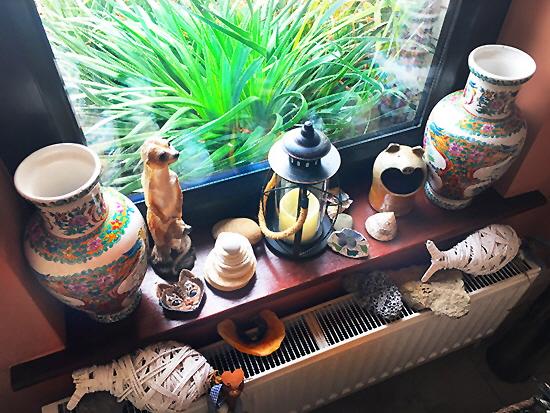
Inside and out, there was an abundance of flowers, greenery, paintings, small sculptures, and of all things, broken pottery pieces from the cargo of a ship wrecked in a gale in the 1850s. The paneling of that ship indicating first class, second class, and steerage now lines the walls of the narrow corridor that led to our room.
At the end of our first day, it was time for yet another walk in search of a place to have dinner. We found Kilrane Inn & Pub, an establishment claiming to be the first (upon arriving by ferry from a distant port to Rosslare Harbour) and the last pub (on the way to travel to farther shores) in Ireland.
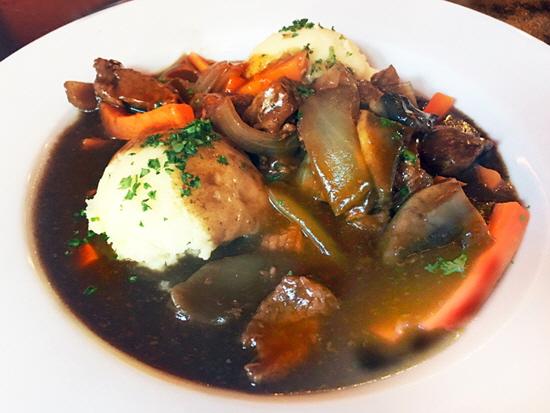
Delicious food at Kilrane Inn & Pub. Photo by Bo Zaunders.
Roxie decided to try a chicken mushroom tagliatelle, and I went for a beef & Guinness casserole.
“How much Guinness goes into it?” I asked the waiter. “Two pints,” he said, surprising me not a little. Then I saw the twinkle in his eye and the smile on his face, which made me think he might be exaggerating.
Maybe so, but the casserole turned out to be rich and succulent, rather like an Irish take on Boeuf Bourguignon.
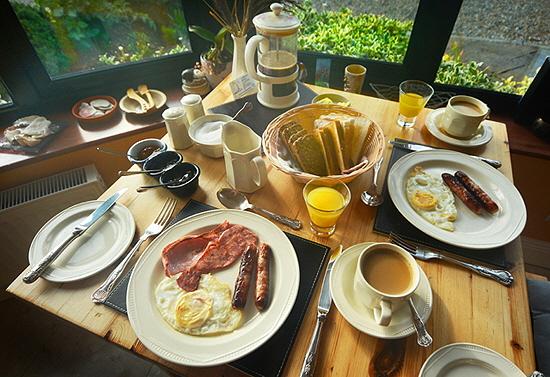
Breakfast at Clifford House. Photo by Bo Zaunders.
Speaking of food, right after we checked in at Clifford House, our hostess, Margaret, made sure that our every wish for a perfect breakfast would be met. How many sausages, how to make the eggs, or maybe oatmeal served with orange marmalade, strawberries, and black currant? All to ensure a satisfactory beginning of each and every one of the six days we were there.
Our walks in the immediate neighborhood included visits to the harbour, where sometimes as many as three giant ferries could be loading and a multitude of trucks waiting to board. Walks also included a stroll through Memorial Park and Kirwan’s Garden, which showcased a maze of swirling paths through thick sensory plantings, interrupted by surprising and whimsical outdoor sculptures.
One day, we took the 20-minute train ride north to the historic town of Wexford. Founded by the Vikings in about 800 AD, its history goes way back and can still be felt in its medieval lanes, as well as in a restored 13th century tollgate and ruined abbey.
That brings to mind the nearby Irish National Heritage Park, an open-air museum with a series of reconstructed human settlements. These begin with one from the Mesolithic period from between 10,000 and 8,000 BC and end with a settlement following the Norman invasion in 1169 AD. In other words, a 9,000-year journey.
Our visit to Wexford had a rather bizarre ending, as we found ourselves at Rob’s Ranch House, a Western cowboy style restaurant, lavishly decorated by the sorts of things you would expect to see in the heart of Texas. Roxie picked a pizza, surprisingly served with fried potatoes.
As for nearby restaurants in Rosslare Harbour, we found one at the Dock Boutique Hotel to which we returned at least three times. We even got to know Clare, one of the bartenders, and met with Wayne Strong, the chef, who once brought us a most satisfying Salmon Darne served on a bed of stir-fried vegetables.
From Rosslare Harbour, we took a bus to Waterford, from which we continued to Kilkenny, a town described as a gem in the heart of Ireland’s Ancient East – as well as one of its most cosmopolitan places.
Sure enough, it brimmed with medieval treasures, narrow alleyways, and painted storefronts.
With its deep religious roots, it has many well-preserved churches and monasteries. Then there’s the grand Kilkenny Castle (pictured at top), which was built in 1195 by Norman occupiers. Walking all the way to the castle, we relaxed for a while in its peaceful, expansive garden.
I also visited the Rothe House & Garden, which is high on the list of things to do in what is sometimes nicknamed the “marble city.” The Rothe House is a 16th century merchant townhouse complex made up of three houses, enclosed courtyards, and a large reconstructed orchard garden. I wound my way through it all, feeling I was hundreds of years back in time.
Through the middle of Kilkenny flows the River Nore, one of the principal rivers in the southeast region of Ireland. I crossed a couple of its four or five bridges, and it was beautiful as dusk fell.
We spent the night in Kilkenny, and on the following morning, we found Kilford Arms, a place for a perfect breakfast.
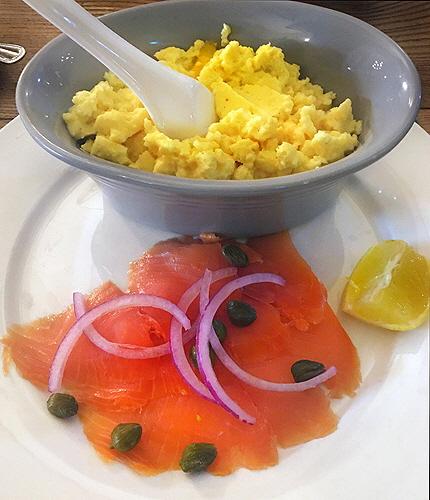
Breakfast at Kilford Arms in Kilkenny. Photo by Bo Zaunders.
In came bowls of scrambled eggs, sitting on plates next to slices of smoked salmon and with a sprinkling of capers and finely cut red onion. This was all served with the kind of brown bread that only the Irish know how to bake. Quite delicious.
Thinking back on our Irish adventure, the last day of which was spent in Dublin, I keep remembering my chat with Michael, the husband and partner of our hostess, Margaret. I had been watching the news on TV in one of the sitting rooms of Clifford House when he joined me.
Minutes earlier, I saw him sawing wood and trimming one of the big trees outside. In true Irish spirit he was ready to discuss poetry, specifically the works of W.B. Yeats.
Our attention then went to the giant TV, which he handled rather like a magician, turning on and off any number of games I never even knew existed, and finding a sort of virtual reality.
“Where do you live in New York?” he asked. I gave him the address and suddenly found myself in virtual reality, walking up the avenue in the direction of our street.
“Aha! There it is,” I said, pointing at our apartment building.
So there I was, just virtual steps away from home. Yet, glancing at the window to my right, I could see the shimmering Irish Sea. Miraculous!
A galette is a French flat, round, crusty cake or even a flatbread. It’s associated in the French-speaking world with the celebration of the Epiphany.
January 6th is the feast of the Epiphany that celebrates the biblical story of the arrival in Bethlehem of the Three Kings (or Three Magi or Three Wise Men in other traditions) to bring gifts to the baby Jesus.
I was introduced to this tradition when I lived in Paris. It’s traditional to eat this delicious pastry the evening before the 6th and wash it down with glasses of champagne!
The flaky pastry “cake” is filled with a mixture of almond paste and crème pâtissière, baked until puffy and golden, and topped off with a gilded paper crown. Inside the galette is a small figurine – a fève – and the person who finds that in their slice will wear the crown and become king or queen for the day.
In southern France, the cake is called le gâteau des rois and is a brioche ring studded with candied dried fruits. It also contains the fève.
Ingredients
The almond cream:
1 stick unsalted butter at room temperature
1/2 cup granulated sugar
2 large eggs at room temperature
2 teaspoons pure vanilla extract
1 pinch grated nutmeg
1 cup almond meal
1/2 teaspoon sea salt
The pastry:
2 rolls Pepperidge Farm or Trader Joe’s puff pastry (1 lb.), thawed but chilled
Assemblage:
1 large egg, lightly beaten, for egg wash
1 tablespoon heavy (35%) cream
1 fève
1 paper crown
Method
To make the almond cream:
Using a handheld electric beater on high speed, beat the butter and sugar until smooth and creamy, about 3 minutes. Add the egg and vanilla, and beat until well combined. Your mixture may look curdled, but that’s okay.
Using a rubber spatula, gently fold in the almond meal and salt until you have a smooth paste. It will be quite stiff.
Cover the almond mixture with plastic wrap, and refrigerate it for at least 1 hour or overnight.
Prepare the pastry by rolling it out and cutting two circles (10 inches in diameter). Place them, separated and sandwiched by parchment paper, on a baking tray in the refrigerator until you are ready to use them.
Assemble the galette by first whisking the egg and cream together to make an egg wash. Remove one pastry circle from the refrigerator, and place it on a baking tray. Peel off the top layer of parchment, leaving the bottom parchment in place.
Spread the almond cream at the center of the pastry circle, leaving a border of about 1 inch around the edge. Place the fève in the almond cream so that it’s completely covered. Spread the cream evenly over the pastry. Brush the edge of the pastry circle with the egg wash, making sure to keep the egg on the pastry and not dripping down the edges. If you let the egg wash drip, your puff pastry might not puff.
Remove the second pastry disk from the refrigerator, peel off the parchment, and carefully place it on top of the almond cream, lining up the edges of both pastry circles. Gently press the edges down on both the egg-washed border and the almond cream. Then use the tines of a fork to lightly press around the edges to seal the galette.
Use the back of a small sharp knife to score a pattern on top of the pastry. You can make a diamond pattern or a sun pattern (see photo). Do NOT cut through the pastry. Turn the galette and repeat until you have scored the entire top. Then brush the top with more egg wash.
Place the baking tray with the galette in a refrigerator for 30 minutes. Preheat the oven to 375˚F.
Remove the galette from the refrigerator, brush it one more time with the egg wash, and bake it for 35-40 minutes until the pastry is puffed and golden brown. Place the galette on a wire rack and allow it to cool down before serving, topped with the paper crown!