In an organization known for its spectacular displays and events held both indoors and outdoors, the New York Botanical Garden’s display of “Tim Burton’s The Nightmare Before Christmas Light Trail” is over-the-top spectacular.
Tim Burton’s The Nightmare Before Christmas Light Trail at the New York Botanical Garden. Photo by Barbara Angelakis.
The not-to-be-missed toy train extravaganza is located in the Bronx borough of New York City and held in the beautiful Italian Renaissance revival Enid A. Haupt Conservatory (where the orchid show is held both inside and outside the domed building annually). But the current extravaganza along tree-lined, sculptured garden paths is a fantasy vision guaranteed to delight all ages.
It’s a perfect family outing to usher in the holiday season, but hurry because it’s only on view from dusk to 10PM every Thursday through Sunday until December 1st. After that, a holiday display will replace it.
Tim Burton’s The Nightmare Before Christmas Light Trail at the New York Botanical Garden. Photo by Barbara Angelakis.
Based on Disney’s Tim Burton’s The Nightmare Before ChristmasLight Trail, it was created by Adventurelive, the producing team behind Broadway’s Hamilton, and LETSGO, the Madrid-based creative team behind Tim Burton’s Labyrinth and Lights in Nature. It was presented by special arrangement with Buena Vista Theatrical.
Bringing the film’s distinctive characters to life, the outdoor adventure features more than 8,300 square feet of dazzling light installations forged by cutting-edge technology, including interactive video projection, intelligent LED lighting, and 3D printed sculptures of the film’s iconic characters. The experience ignites the senses and invites audiences deep into the imagination of the story’s visionary creator.
The entrance to Tim Burton’s The Nightmare Before Christmas Light Trail at the New York Botanical Garden. Photo by Barbara Angelakis.
The previous paragraph describes the creative effort behind the exhibit, but once on the ground, the experience becomes personal and dramatic. Leading the way toward a large orange neon pumpkin, which serves as the entrance into the exhibit, you are led along paths that have flashing organic forms playing on the pathways, while the huge trees on either side are highlighted with changing colors against the night sky. You can’t help but feel like you’ve entered into a magical forest of delights.
Once past the orange pumpkin, you encounter a brightly colored tunnel leading into the heart of the exhibit where Tim Burton’s characters are displayed.
Delighted visitors of all ages lined up to have their pictures taken with the beloved characters, patiently waiting their turn. There was such an air of fun and friendliness that I found myself chatting with many groups along the way. Everyone was in high spirits and meandering rather than rushing through, taking time to embrace the fantasy.
The Garden is accessible to strollers, wheelchairs, and walkers alike, and there are helpful attendants from the entrance all the way through the exhibit to lend a hand if need be.
Oops! The wine I just poured tilted to one side of the glass. Most odd. Then, looking around, seeing the low, heavily beamed ceiling and taking into account the age of this place – the house was built about six hundred years ago – I realized that, most likely, the floor must be leaning a little.
Downstairs at Chesil Rectory in Winchester. Photo by Bo Zaunders.
We were on a three-day visit to Winchester, the ancient capital of England, and were dining at the Chesil Rectory, the city’s oldest commercial property.
Rosary Goats Cheese Rotolo. Photo by Bo Zaunders.
Local partridge was served to our friend, Julie, while Roxie had Rosary Goats Cheese Rotolo, and I had Chesil Bouillabaisse. Though fully enjoying her partridge, Julie jokingly commented that it might have been cooked at the time the house was built. She also took note of an asterisk at the bottom of the menu with a warning that “game birds may contain shot.” Seriously, though, everything was quite satisfactory – cozy and rustic, yet elegant.
Honeyed Set Cream, Sour Blueberries, and Brandy Snap rounded off the meal, complete with the recommended glass of dessert wine, Moscato d’Asti.
Honeyed Set Cream and Sour Blueberries. Photo by Bo Zaunders.
We were seated upstairs. Downstairs, on our way out, after we’d passed several intimate rooms with beamed ceilings, I noticed a private dining area, named after one of Winchester’s former residents, Jane Austin.
Which brings to mind a house cocktail called “The King” after King Alfred, another prominent resident. Back in 828, he made Winchester the capital of England. He now stands, sword in hand, as a statue just three or four blocks from the restaurant, close to the city’s medieval East Gate. A Winchester landmark, he is a towering figure, measuring 17 feet from the base to the top of his outstretched arm.
The statue of King Alfred in Winchester. Photo by Bo Zaunders.
Walking back in a westerly direction, we soon found ourselves on High Street, the city’s main drag. This was my second visit to Winchester, and everything looked rather familiar. Here was the Victorian Guild Hall, and there was the Buttercross, a structure from the 15th century featuring 12 statues.
Guild Hall in Winchester. Photo by Bo Zaunders.
We passed some historic half-timbered buildings, such as the God Begot House, said to have originated in 1001. Then came the High Street clock, jutting out from one of the eaves, and telling us not just the hour but that it was time to turn right for Winchester Royal, our hotel on St. Peter Street.
Winchester Royal Hotel. Photo by Bo Zaunders.
The Winchester Royal turned out to have quite a history. A former Bishop’s home and Benedictine convent built in the 16th century, it has some delightful Renaissance period features such as high ceilings, sash windows, and heavily patterned carpets. It also features a walled garden, which made me wish we had been there in the summer.
Roxie and Julie were in Winchester for the annual Society of Children’s Book Writers & Illustrators British Isles Conference while I was free to roam and explore the city.
The interior of Winchester Cathedral. Photo by Bo Zaunders.
Oooh, Winchester Cathedral, you’re bringin’ me down, You stood and you watched as my baby left town…
The 1960s hit came to mind as I entered the famous place of worship (pictured at top). I must have spent an hour or so walking around in its vast interior. Boasting the longest nave and overall length of any Gothic cathedral in Europe and built in successive stages spanning the 11th to the 16th centuries, it was impressive indeed.
King Arthur’s round table (or so they say) in the Great Hall in Winchester. Photo by Bo Zaunders.
A few minutes’ walk, and I was at another historic landmark, the Great Hall of the Winchester Castle, which claims to house King Arthur’s Round Table. Actually, the table dates from the 13th century, which is about seven hundred years after King Arthur is supposed to have been around. The table was originally unpainted wood. Then, in 1522, it was painted for King Henry VIII, with the names of the legendary Knights written around its edge, and with a portrait of King Arthur – which looks suspiciously like King Henry VIII as a young man.
Still, the table is of considerable historical interest and a great tourist attraction. In the Great Hall, I also noted a monumental statue of Queen Victoria sitting on her throne in full regalia and dimly lit by a stained-glass window.
A dog wearing sunglasses on High Street in Winchester. Photo by Bo Zaunders.
I found myself doing a lot of strolling up and down High Street. The Christmas market was already in full swing. A woman stirring a big ancient-looking pot offered hot chestnuts. I saw a dog with sunglasses, and there on Parchment Street on my right, there was yet another Winchester landmark: the bronze figure of a young man joyfully flying a kite whilst walking across a nearly 20-foot high bridge spanning the street.
Other discoveries included a walk up Gile Hill from which you have a scenic view of the city. Also, the Winchester City Mill, a restored water mill dating back to Saxon times, and presumed to be the oldest watermill in the UK.
Finally, a word about The Royal Oak, a delightful pub squeezed into a dark alleyway, which was just a two-minute walk from our hotel. Entering it, I noticed plenty of oak paneling and was overwhelmed by how packed it was with happy customers. Apparently, this kind of festivity has been going on for a very long time. The place is said to date back to 1002, making this the oldest pub in all of England, although there are others that claim that same thing. I ordered a pint of Kask Ale, which seemed like the right thing to do, and enjoyed the remainder of my visit in Winchester.
In the past, luxury stemware preferred by wine drinkers of my father’s generation were fairly thick, ornate, heavily carved, lead crystal glasses. They were produced by companies with a long history such as Baccarat, Moser, Josephinenhütte, Orrefors, Waterford, Cristallerie de Sevres, or Cristalleries Saint Louis, to name but a few of the better European producers.
There were only a few sizes in an average set: water, first wine (white), second wine (red), champagne (flute or coupe), liqueur, tall tumbler (for iced tea or other long drinks), short tumbler for old-fashioned cocktails, and a few beverage-specific glasses like Rhine wine, whiskey, martini, cognac, and sherry. Of course, there were also carafes, water pitchers, and finger bowls. The design was dictated purely by aesthetics, not function.
Rhine wine glasses. Photo by Manos Angelakis.
The cost per stem could be outrageous, especially the hand-carved Bohemian Riesling glasses. However, there were also pressed versions that were less expensive because they were machine mass-produced, not created by specialized artisans by hand.
In general, the glasses looked wonderful. Many times, they were artistic masterpieces, but frankly, they didn’t do much for the contents except showcase the color of a particular wine.
Then, in the late 1950s, Claus Riedel, an Austrian glassmaker with a long family history of quality crystal production, came up with the idea of producing wine-specific glasses that would enhance wine attributes, specifically smell and taste, in addition to the visual color showcasing.
In consultation with other wine connoisseurs and wine aficionados, he designed glasses that concentrated the wine aroma and directed it to the nose, while directing the liquid stream to specific areas of the tongue that would be the most sensitive to the taste of the type of wine for which the glass was designed.
4 Riedel tasting glasses. Photo by Manos Angelakis.
Those stemwares were made of thin lead crystal or, more commonly, very high quality potassium carbonate crystal. The handmade Riedel Sommelier series was launched in 1973, introducing the revolutionary new concept to the wine trade.
His son, Georg, a wine aficionado, further developed Claus’s theories, creating grape-specific glasses and mechanizing the production of fine wine glasses with the Vinum series. This made Riedel glasses far more affordable for oenophiles. His son, Maximilian Riedel, the 11th generation CEO of Riedel, holds frequent seminars that feature and promote these wine-specific glasses, and the series sports as many as 40 or more variations on the theme.
I bring all this history up because I now find wine- or even grape- specific stemware produced not only by Riedel, but also by Schott Zwiesel, Orrefors, Spiegelau, Waterford, Mikasa, and many other manufacturers in practically every restaurant I visit. If the wine list has more than a couple of decent wines, the glasses on the table are thin, wine-specific glasses.
Usually, the table is preset with 3 glasses (water, red wine, and white wine or similar). Once a bottle has been selected, the appropriate glass is brought to the table if it isn’t already present. Also, most of the better restaurants have wine decanters at hand and will decant your wine upon request.
Wine glasses and carafe. Photo by Manos Angelakis.
At home, wine lovers now bring out wine-specific glasses with their favorite bottles of Burgundy, Bordeaux, Riesling, Barolo, Prosecco, Cabernet Sauvignon, Carmenère, etc., accompanied by the appropriate carafes. And they can be either the thin, modern crystal glasses, or they might be the more elaborate, heavier beauties of the past.
Colored stem wine glasses. Photo by Manos Angelakis.
I personally find these glasses very attractive and reasonably priced. They make great gifts for your favorite wine lover. While the initial designs called for all-clear crystal, there are new designs produced with colored stems that are also making an appearance in the better stores.
Liverpool has plenty of Beatles memorabilia to lure you, but you might be surprised to learn that it has much more to offer the traveler – even those who aren’t fans of the Fab Four. An old city with both new and historical architecture, Liverpool is big enough to give you plenty to do but small enough that you don’t have to endure London-like congestion.
I took the very comfortable and easy train run by Virgin from London’s Euston Station. In just over two hours, our train pulled into Liverpool’s Lime Street Station, and I was right in the center of the city. Of course, the most famous part of Liverpool is the Albert Dock on the River Mersey, where there are numerous museums, galleries, restaurants, shops, and hotels.
The Mersyside Maritime Museum. Photo courtesy of The Mersey Partnership.
My first stops were the Merseyside Maritime Museum and International Slavery Museum, which are housed in the same building at the Albert Dock and free to the public. While the museums are relatively small, I was very impressed with the exhibits. Interactive and unusual, they’re a true experience – not just a walk through one room after another staring at “stuff.” They’re the kind of museums that keep school-aged children engaged.
My favorite exhibit at the Merseyside Maritime Museum depicted the colorful history of the Titanic, Lusitania, and Empress ships. As a port city, Liverpool played a key role in the stories of these vessels. The museum has numerous photographs and memorabilia that give you a real sense of the time period and the immensity of the tragedies, and there are models of the ships that show their grandeur.
Liverpool Photo courtesy of The Mersey Partnership.
The International Slavery Museum is now one of my favorite museums in the world. The exhibits are extraordinarily enlightening and moving. Again, as a port city, Liverpool was intricately involved in the transatlantic slavery of Africans in both Europe and the U.S., but the museum focuses on much more than just this key period of slavery. Ancient slavery is included, as well as modern incidents of human trafficking.
You can watch video interviews with people around the world who have experienced these atrocities firsthand, alongside interviews with historians and ancestors of African slaves. African artifacts give you insight into the lives of the people who were robbed from their homeland, and touchscreen exhibits with earphones give you a detailed idea of what life was like on a plantation in the American south, including words written by the slaves of the time.
Quotes regarding slavery are engraved on the walls throughout the museum, and information about the economics of slavery is given in chilling displays. It’s impossible to walk through the museum without becoming emotional.
Liverpool Albert Dock. Photo courtesy of The Mersey Partnership.
The other main draw at the Albert Dock is The Beatles Story museum, which I found to be more entertaining than I expected. You walk through a series of fun exhibits that take you from the very beginnings of the Fab Four’s music career to the present.
The Beatles Story museum in Liverpool. Photo courtesy of The Mersey Partnership.
There were plenty of things I didn’t know about the Beatles, including some of the clubs where they played in Liverpool when they were teenagers. A very early recording of the group before they were even called the Beatles played in this area of the museum, making it easy to tell that these were exceptionally talented boys.
Of course, if you want to really give over to Beatlemania, you can take the Yellow Duckmarine boat tour on the River Mersey and the Magical Mystery Bus Tour that will take you to Penny Lane and Strawberry Fields, among other locations. You can also visit Paul McCartney’s and John Lennon’s childhood homes outside of the city center.
I didn’t manage to do any of these things, but I did manage to catch the temporary Stuart Sutcliffe exhibit at the Victoria Gallery & Museum on the University of Liverpool campus. Sutcliffe, who was the original bass player for the Beatles and a friend of John Lennon’s, died in his early 20s.
While his development as an artist was stopped short, his work is very emotional and interesting. Some of it is the result of art school assignments, so the small selection of his work that remains is very eclectic. Even though the Sutcliffe exhibit is already gone, the museum’s permanent collection is worth a visit with some exquisite Rembrandt drawings and other masters represented. The building’s architecture is also very beautiful, and there is a nice café inside.
One morning, I took a train for a short ride under the river to the peninsula called The Wirral and visited a friend in West Kirby, a town with a view of Wales and a famous sailing club. We walked along the beach, but I opted not to walk to the nature reserve on Hilbre Island while the tide was out. My visit was in November, when the area is quite cold, so I will save that experience for a visit during warmer weather.
Luxury Room, Hard Days Night Hotel, Liverpool. Photo courtesy of The Mersey Partnership.
I stayed at the Hard Days Night Hotel, a Beatles-themed property that opened in 2008. The four-star hotel is within walking distance of the Albert Dock, and while it is housed in a historical building, the design inside is contemporary. I especially enjoyed the large light fixtures in the lobby with Beatles sheet music hanging down like a mobile, under which are bright orange, green, and red 60s-style chairs.
Lennon Suite, Hard Days Night Hotel, Liverpool. Photo courtesy of The Mersey Partnership.
You might expect the hotel to have a Disneyland-type atmosphere, but nothing could be further from the truth. Located just around the corner from the famous Cavern Club where the Beatles played in the early days, the hotel is very tasteful, and its admiration for the Fab Four is far from cheesy.
The Cavern Club in Liverpool. Photo courtesy of The Mersey Partnership.
As you ride the clear glass elevator, you can view black and white photographs of John, Paul, George, and Ringo on the walls of each floor, which include both original and specially commissioned pieces by photographers like Bill Zygmant and Paul Saltzman.
My room was Paul-inspired with just one beautiful modern portrait of him on the wall. The bed, furniture, service, and amenities were comparable to the world’s best hotels, as was the food served by the hotel’s two restaurants.
My only complaint is that there was no minibar (which isn’t an uncommon omission in Britain), and the shower was a bit small. I loved the black goose down duvet, however, as well as the towel-warmer, electronic control panel by the bed, and appropriately retro décor. I also enjoyed the humor of the doorknob signs, which said “I’ve had a hard days night” and “Help!” instead of “Do not disturb” and “Please make up my room.”
What struck me most about Liverpool is that it’s a cosmopolitan city with plenty to do, but it also has a character that is uniquely its own. An impromptu taxi ride gave me the opportunity to chat with a friendly local, who spoke with great pride about his city and pointed out various places of note as he drove me to my destination.
There is much more to see and do in the city than I managed during my short visit, but considering how easy it is to travel to Liverpool from London, I’m sure I’ll be back – the next time when it’s warmer.
The Langham Hotel in London is as close to perfect as you can get. A 5-star property that could easily be given 6 stars, my experience there – from the facilities to the staff – was nothing short of exquisite. And I don’t use such words frivolously.
Located on the West End close to the shopping of Oxford Street, The Langham’s doorman charmed me immediately upon my arrival and marked my bags so that they didn’t need to follow me into the lobby.
Reception at The Langham Hotel in London. Photo courtesy of Langham Hotels.
When you enter, your senses are greeted with white marble and fresh flowers. Inside, women in pink suits were available to offer assistance. I was personally escorted to my 334-square foot Grand Executive Room in the Regent Wing because it can be difficult to find.
The lobby of The Langham Hotel in London. Photo by Melanie Votaw.
I did have to pay attention so that I could make my way back there on my own, as this area of the hotel was a bit out of the way. But it was worth the small amount of extra walking. (In case you think I was given special treatment as a travel writer, I don’t think so. I always observe the way staff members treat other guests, and it appeared everyone received special attention at The Langham. I suspect the management is quite exacting about how guests are treated.)
Regent Wing room at The Langham Hotel in London. Photo by Melanie Votaw.
The Regent Wing rooms were done in traditional taupe décor, but the bold violet color of the velvet chairs and bed headboard lent a touch of flash. This shade was repeated in the seating of Artesian, the hotel’s cocktail bar. I loved the damask bedding more than any hotel I have ever experienced; it felt wonderful against my skin.
A Regent Wing room at The Langham Hotel in London. Photo courtesy of Langham Hotels.
Besides a couch and coffee table at the foot of the bed, which faced the television, the minibar contained a drawer with glassware and china for tea and coffee. A selection of teas was included, along with a Nespresso machine. One of the nice details was a pink and gold box that contained stationery and a pink and gold writing pen.
A Grand Executive Room at The Langham Hotel. Photo courtesy of Langham Hotels.
The bath contained fresh orchids and was designed with green marble on the countertop, floor, and detail on the tub. There was a separate shower and a bathroom scale. Unlike many luxury hotels in London, an iron and ironing board were included in the room, as well as a particularly large safe. I always appreciate a safe that’s big enough to hold my ample laptop and camera equipment.
Also, WiFi was free, and there were complimentary bottles of water provided. Of course, the room also had a fine robe, slippers, and hair dryer. Another unusual feature that came in handy was a panel of electrical and data outlets that included both a U.S. and a European plug besides UK outlets.
The Langham has 380 rooms and suites, as well as conference facilities and a Grand Ballroom that holds 375. There is a Chuan Spa and a fitness center with equipment, salt sauna, steam rooms, and swimming pool.
The Palm Court at The Langham Hotel in London. Photo courtesy of Langham Hotels.
More even than the amenities, I was impressed by the staff – each of whom addressed me by name whenever I called with a request – and also by the breakfast. The Langham has the elegant The Palm Court on the property, where breakfast, afternoon high tea, and lunch are served. It’s the first place in the UK where high tea was served in 1865. In fact, The Langham has been famous for its high tea since then and frequently wins “Best Afternoon Tea” awards.
Everything was prepared and presented with great attention to detail and quality. A small buffet included cold meats, fruits, breads, and pastries, but you could also order a full English breakfast. Even the breads and fruits were especially fine, and the service was impeccable.
Chex Roux at The Langham Hotel. Photo courtesy of Langham Hotels.
Chex Roux is available for dinner, and there are two beautiful bars, as well as private dining available and a cookery school.
The Langham has quite a history and claims to be London’s first “Grand Hotel.” The building endured bomb damage during World War II and is the first hotel in London to install air conditioning. Some people even say the property is haunted, although I didn’t see any evidence of that during my stay. One of the purported ghosts is a German prince who, in a lovesick state, hurled himself off the balcony of his room.
There was a famous meeting there in 1889 between Oscar Wilde, Arthur Conan Doyle, and editor Joseph Marshall Stoddart. Doyle mentioned the hotel in some of his Sherlock Holmes stories, and the property has been used in films, including the James Bond movie “Golden Eye.”
The Artesian bar at The Langham Hotel in London. Photo courtesy of Langham Hotels.
Some of The Langham’s other distinguished guests over the years have included Mark Twain, Napoleon III, Antonin Dvorak, Arturo Toscanini, Winston Churchill, Charles de Gaulle, Noel Coward, Emperor Haile Selassie of Ethiopia, and Princess Diana.
It’s one thing to feel privileged to stay in a hotel with such a history, but it’s another to have it live up to its reputation 100%. If this property is any indication of the quality of Langham Hotels elsewhere in the world, I hope to experience another one before long.
The author of this story received complimentary accommodations at The Langham, but as always, we are dedicated to providing unbiased opinions of our experiences. Our allegiance is to you, our readers.
The time that most people purchase sparkling wines is usually just prior to the winter holidays. People like to celebrate either the end of a challenging year or the beginning of a new one, which will be full of expectations for a great outcome.
Therefore, we generally publish a review of sparkling wines that we and the members of our “usual suspects” group of tasters, have enjoyed at the beginning of November each year.
For this season, we decided to try sparklers created in both the “Classic Method” that is the way Champagnes are made and the “Charmat – Martinotti” method, which is the way Prosecco is produced. We also had both white and rosé versions from numerous areas of the world that now produce sparkling wines.
Catalunia Cava wine racks. Photo by Manos Angelakis.
The classic method or Méthode Champenoise is very labor-intensive, and that considerably increases the price of the final product. The entire production and aging process is hands-on for the winemaker and their assistants.
The secondary fermentation, which is the one that produces the bubbles, takes place in each individual bottle that’s closed with a temporary cork. During aging, this has to be turned by hand a quarter around, while the bottles rest on special racks. Then, the temporary cork is removed, the fermentation debris are disgorged, and the bottle is reclosed with the final cork. All that work is done by hand!
Charmat wine vats. Photo by Manos Angelakis.
The Charmat product can be mostly mechanized from filling the stainless vats where the wine starts the fermentation, to bottling, which means less hands-on production costs. This results in lower prices.
The process doesn’t mean that one type of wine is better than the other. As far as we’re concerned, there are great producers, good producers, and lousy producers using both of these methods. The quality of your purchase depends on your personal taste.
In reality, the quality and taste of any wine depends on the soil of the vineyard, the weather during growth and harvest, the knowledge of the agronomist who tends the vines during the season, and the expertise of the winemaker, as well as their palate.
The only difference I would say is that in general, the Classic Method produces drier, tighter wines with complexity and depth. The Charmat-Martinotti produces wines that are usually less dry (sometimes almost demi-sec) and not as complex. But as I said, it all depends on what you like, and don’t let anyone tell you otherwise!
For this tasting, we had sparkling wines from France, Italy, Germany, and Greece.
We had bottles of Albert Bichot Brut Réserve Crémant de Bourgogne and Ferrari Trento Brut Méthode Champenoise Rosé. Both are made in the classic method. Neither can be called champagne because they aren’t made in the Champagne region of France, but they are as good as any champagne.
Aphrodise Rosé, a newer Greek producer, makes a rosé sparkler from Xinomavro grapes using the Charmat method. The Xinomavro grape makes some of the best red Greek wines, mostly in northern and central Greece.
Loosen Brothers’ Dr. L Sparkling Riesling Sekt from Germany, as well as Markus Molitor Brut, both come from vineyards in the Mosel area, and both are produced in the Charmat method. It seems that Germany in the Bernkasteler region is one of the largest producers of sparkling wines. Who knew?
Valdo Marca Oro Prosecco. Photo courtesy of Valdo.
From Italy, we had three more bottles: a FIOL Prosecco, a Valdo Marca Oro Prosecco, and a Valdo Aquarius Extra Dry Blanc de Blancs.
Our good friend, Norma, was kind enough to lend us her living room and kitchen in her Manhattan apartment for the tasting, and she also made a sumptuous meal to be washed down with all that bubbly. In accordance with our long experience, we never drink on an empty stomach!
There were ten tasters altogether, and we enjoyed both the wines and her hospitality.
The general results were:
The 2 Méthode Champenoise bottles were given high ratings but only by a few points. The Bichot received 92 points, and the Ferrari 93. All the Charmat-produced sparklers in the tasting were deemed enjoyable, and all received above 89 points each.
89 points is considered the base for “good” wines, while anything below is average, and anything above 96 is exceptional. Both the German Sekts received 91 points, and the Aphrodise received 90 points.
Valdo Aquarius Extra Dry Blanc de Blancs. Photo by Manos Angelakis.
Most of the Proseccos received either 90 or 91, and so did both Valdo bottles, though the graphics on the Aquarius bottles were deemed exceptionally attractive. The FIOL Prosecco bottle did stand out with 94 points. All of the above means that to our tasters’ palates, all of these sparklers were enjoyable.
I hope you enjoy your bottles as well, and feel free to make your own recommendations in the comments!
In many of the stories, as well as in toponymics (the study of proper geographic names) based on descriptions from the past, we find references to giants.
As far back as the Homeric, epics we read about the Cyclops, the one-eyed man-eating giant that Odysseus and his crew had to blind before they could escape his cave.
Ancient civilizations did believe in the existence of giants, and these beliefs were deeply woven into their mythologies and cultural narratives. On the island of Malta, there’s a prehistoric site, perhaps a temple, called Ġgantija, meaning “the place of the giants.”
Malta Ggantija. Photo by Manos Angelakis.
The Greeks believed that the megalithic walls of Mycenae and the Lion’s gate (pictured at top) were built by giants. Even in the Bible, we have the Nephilim, a race imagined as being of great size.
There’s the tradition that the “sons of God” who were “spirit beings” mated with human women, “daughters of men,” and produced the immortal Nephilim. The words “sons of God” in the Old Testament refer to angels.
The Giant’s Tomb found on the island of Sardinia is an ancient stone structure dating back to the Nuraghi period. There are many oversized megalithic structures there that could have been either fortifications of some sort for a small village or perhaps residences for extended families. We still don’t know for sure.
Sardinia Giant’s Tomb. Photo by Manos Angelakis.
Many cultures have references in their writings to giants. All the Abrahamic religions, as well as religions of the ancient Near East, have such tales. Even in more recent times, we have tales about oversized djin in what is now the Arab world. Think of the tales of “One Thousand and One Nights.”
The Daidarabotchi were giants of Japanese mythology. The Daityas came from Hindu mythology. The Jotun came from Norse mythology, and the Gigantes came from Greece.
In Chinese culture, we have the story of the god, Fangfeng, who was most prominent in the Six Dynasties regions of Wu and Yue (modern day Zhejiang, Jiangsu, and Shanghai). A common depiction of Fangfeng was of a giant with the head of a dragon and the ears of an ox.
In English fairytales, we have Jack and the Beanstalk and the giant at the top of the beanstalk after Jack traded the family cow for magic beans and planted them.
Der Ring des Nibelungen is an adulation of Germanic/Scandinavian mythology loosely based on characters from Norse sagas. Richard Wagner tells the story of the Germanic gods that await completion of their palace, Valhalla, which is being built by the giants Fafner and Fasolt, his brother.
As payment, Wotan promised to hand Freia, goddess of youth and beauty, to the giants. However, his wife, Fricka, and the other gods persuade Wotan to offer a different payment instead to the giants – a magic ring of power that has been fashioned from the Rhinemaidens’ gold. The ring grants the wearer the power to rule the world. Delving into any region’s mythology, you can find stories about giants! So were they ever real, or were all of them just figments of a storyteller’s imagination?
My wife, Roxie, and I were heading for Ballygally, a village in county Antrim on the northeast coast of Northern Ireland. A train from Belfast had taken us to our first stop – the town of Larne, which is a major passenger and freight roll-on/roll-off ferry port.
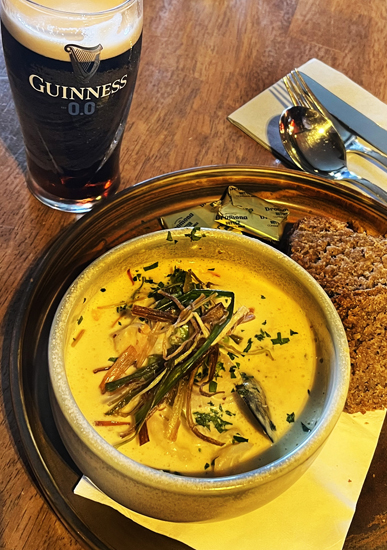
Before checking in at the Seaview Bed & Breakfast, where we would spend the night, we took a long walk next to the port in central Larne. It was a gray day, and the streets were surprisingly empty. We found Olderfleet Bar & Lounge, which proved convivial and a most satisfying spot for a light lunch of seafood chowder – “a nod to the sea,” to quote Olderfleet.
Olderfleet Bar & Lounge seafood chowder. Photo by Bo Zaunders.
Looking around, we noticed a number of quotes, all by prominent figures and all about drinking:
I drink to make other people more interesting. – Ernest Hemmingway
Work is the curse of the drinking class. – Oscar Wilde
There comes a time in every woman’s life when the only thing that helps is a glass of champagne. – Bette Davis
When I was younger, I made it a rule never to take a strong drink before lunch. Now, it is my rule never to do so before breakfast. – Winston Churchill
Age is just a number. It’s totally irrelevant unless, of course, you happen to be a bottle of wine. – Joan Collins
The problem with the world is that everyone is a few drinks behind. – Humphrey Bogart
Our first day in Larne also included a dinner of fish and chips at Brooklyn Bay Diner, a restaurant featuring a couple of large, darkish rooms with NYC references. When mentioning to our bartender, a young girl, how empty the street had been, she reacted with great force: “This place is dead,” she said. “I’ll be moving to Australia to get work as a hairdresser.”
Her comment brought to mind the economic difficulties Brexit has brought to Northern Ireland. It does seem that they suffered a blow after the UK withdrew from the EU.
Ballygally Beach. Photo by Bo Zaunders.
During our visits to the South (the Republic of Ireland), we were always amazed at its number of pubs. As the actor, Peter O’Toole, once put it, “In my hometown, the pubs lie so close together, it took me a week to walk 500 meters.” But this isn’t as evident in Northern Ireland.
Seaview B&B on Currant Road in Larne. Photo by Bo Zaunders.
Seaview B&B had given us a lovely room with a skylight, and breakfast the following morning served a Roxie favorite: Irish soda bread. In the afternoon before leaving for the village of Ballygally, we found Chekkers Vinebar off Larne’s Main Street.
It was packed with a crowd of older local guys having a good time but speaking so fast in their Irish dialect that we could only understand a few words. But the bartender introduced us to what he claimed to be the best Guinness in Northern Ireland.
Along the shore of the Irish Sea in Ballygally. Photo by Bo Zaunders.
It was 3:30 p.m. A 15-minute taxi ride took us to the small village of Ballygally. And there, a short distance to the south of the village on a small hill (to the left), stood the rather large, long, white building with the self-catering apartment that would be our home away from home for the next week.
Our view of the Irish Sea from our apartment in Ballygally. Photo by Bo Zaunders.
Called Ballygally Holiday Apartments, there are seven flats. Ours was spacious, impeccably clean, and well-equipped with WiFi, linens, appliances (including a dishwasher and clothes washer/dryer), TV and radio, and plenty of glasses, plates, and utensils. The living room featured a purple-colored glass ceiling below which stretched a row of five windows offering a spectacular view over the Irish Sea, the glens of Antrim, and a glimpse of faraway Scotland.
Ballygally Castle. Photo by Bo Zaunders.
A short walk to the village took us to Spars, a small grocery store where we found the necessities for a simple Croque Monsieur dinner. While in the village, we also paid a brief visit to the Ballygally Castle Hotel, a landmark dating back to 1625 and now the only 17th century building still used as a residence in Northern Ireland.
Ballygally Castle Hotel lobby. Photo by Bo Zaunders.
Like other castles in the region, several of the episodes of the TV series, Games of Thrones, were filmed there. Its 44 bedrooms boast antique pine furnishings and original beamed ceilings.
Glenarm Castle. Photo by Bo Zaunders.Pubs in Glenarm. Photo by Bo Zaunders.
Speaking of castles, in the village of Glenarm, 7 miles north of Ballygally, we ran into the ancestral home of the Earl of Antrim, now the home of his grand-grand-grand-grand-grand-grand-grand-grand-grand-grand-grand-grand-grand-grand-grandson Randal and his wife and two children. Apart from being in the family for quite a while, the castle is famous for its extravagant walled garden.
The garden next to the Glenarm Castle gate. Photo by Bo Zaunders.
The sheltered and picturesque harbor in the coastal village of Carnlough, a couple of miles north of Glenarm, has also been featured in Game of Thrones.
Carnlough Harbor. Photo by Bo Zaunders.
As we traveled up and down the Antrim coast, sometimes rugged and sometimes with inviting sand beaches, there were several must-sees we missed. These include the Dunluce Castle, a famous rope bridge, and not least, the Old Bushmills Distillery, which his arguably the world’s oldest.
The rugged coastline in County Antrim. Photo by Bo Zaunders.
That brings us back to Glenarm and to our stopover at Coast Road Inn, where I asked Patricia, the bartender, to bring me a shot of the whiskey she thought most superbly embodied the spirit of the region. She brought me two bottles: Lir Black Crest and Lir Green Crest. I sipped the Black Crest, and yes, it was as mellow and rich with flavor as promised. Superb!
Patricia brought us Lir Black and Green Crest, at Coast Road inn in Glenarm. Photo by Bo Zaunders.
We reached a high in Belfast, where we stayed overnight on our return back to NYC. First, there was the ornate, cozy Robinsons Bar, filled with Titanic memorabilia, and with a bartender who introduced me to Single Pot Still Irish Whiskey – exclusively made in Ireland and yet another winner.
Robinsons Bar in Belfast. Photo by Bo Zaunders.
Our Irish adventure culminated most appropriately at the Crown Liquor Saloon in the center of Belfast – a masterpiece in bar architecture known by millions the world over. A riot of Victorian decorative flamboyance, it dazzled us from the moment we stepped inside.
Crown Liquor Saloon in Belfast. Photo by Bo Zaunders.
Famous not only for its thousands of pretty objects filling the walls and ceilings, it’s also known for its heartily classic pub food. We had Irish Stew – a delectable end to our Antrim adventure.
Irish stew at the Crown Liquor Saloon in Belfast. Photo by Bo Zaunders.
Notre Dame reopening in Paris. After the devastating fire in 2019, the famous Notre Dame cathedral in Paris will reopen December 8, 2024!
Notre Dame in Paris. Photo by Melanie Votaw.
Las Vegas Sphere news. You might have heard about The Sphere in Las Vegas. Well, they’re going to build another one – in Abu Dhabi. No word yet on when it will be finished, but it will be about the same size as the one in Vegas, which seats about 20,000 people.
Universal Epic Universe opening in Orlando. This new theme park will open May 22, 2025 with a new Wizarding World of Harry Potter, Super Nintendo World, and a Dark Universe land, as well as a new Loews Hotel. Tickets are already on sale.
New Greenland airports. Greenland’s capital of Nuuk will open a new international airport at the end of November, which will allow larger planes to land. Two more airports in the country are planned to boost tourism.
La Bella Venezia (Venice). Photo by Manos Angelakis.
Higher Venice tourist tax. From Fridays through Sundays and on holidays starting from April 18th and ending July 27th, you’ll pay a 10 Euro tax if you enter Venice without making reservations four days in advance. That’s a 5 Euro increase. The tax is only in force during peak hours from 8:30 a.m. to 4:00 p.m.
Three-minute hugs at airport drop-off? I was amused to read that Dunedin Airport in New Zealand is now restricting goodbye hugs in its drop-off zone to three minutes. As a New Yorker, where goodbye hugs are barely allowed for three seconds, I couldn’t help but chuckle.
Biden Administration investigating air travel competition. The antitrust division of the U.S. Justice Department and the Department of Transportation are looking into the effects of mergers and joint ventures between airlines. Good!
Airplane. Stock photo.
American Airlines fined. Speaking of the Department of Transportation, it has fined American Airlines $50 million for mistreating disabled passengers and damaging mobility devices. American has the worst record among the few remaining U.S. airlines.
Phone calls and Zoom meetings on your flight? Well, that’s the way it is now on Qatar Airlines. Sounds like a nightmare, if you ask me. I hope other airlines don’t follow suit.
New DOT rule now in effect. In the U.S., the Department of Transportation rule is now in effect which gets airline customers a refund if their flight is cancelled or significantly changed.
JetBlue status match. They have now added Southwest, Spirit, and Frontier to their list, which already included United, Delta, Alaska, and American Airlines. If you already have status with one of these other airlines, see if you can get a match with JetBlue.
Italy building a bridge to Sicily! This is exciting. Italy is hoping to spend nearly 5 billion Euros (with some help from the EU) to finally build a bridge across the Messina Strait between the mainland and Sicily. It will be the longest suspension bridge in the world and will be for both cars and trains. As of now, you can get to Sicily by boat, plane, or a train that travels across the water via ferry. No word yet as to when construction might start or how long it will take to construct, although I’m assuming it will take years.
Mussels in a wine and herb sauce, Mediterranean-style is a favorite dish of ours. It’s a culinary delight!
On a recent driving trip to the south of France, we stopped for lunch at the fishing village of Saintes-Maries-de-la-Mer known for its Moules-frites or moules et frites (mussels with fries).
Just feet from the seashore are cobblestoned streets lined with gift shops, candy and ice cream kiosks, and restaurant after restaurant claiming their Moules-frites are the best in the village.
Le Rouget Restaurant in Saintes-Maries-de-la-Mer. Photo by Manos Angelakis.
We walked up and down the streets until we located a restaurant that had an available outdoor table under an awning, where we could enjoy our lunch al fresco as we watched the passing crowd.
The mussels were the best ever – large, silky, and succulent, as was the basket of crusty French country bread that was refilled over and over as we sopped up the liquid from the big bowl of mussels set before us. The fries were really good, as was the local white wine as we sat in the shade, enjoying the gorgeous ambiance of a beautiful autumn day and great food.
After lunch, we went for a leisurely stroll around town, and on the way, we had a spectacular peach gelato. The single scoop we started with didn’t seem enough, so we went back for a double.
We have tried to replicate the memory of that day by preparing mussels at home. While we can’t get shellfish pulled from the sea just moments before cooking, we made sure to purchase the freshest we could find. In this case, we used the cultured mussels from Prince Edward Island, Nova Scotia that are available at our local market.
Mussels in ice. Photo by Manos Angelakis.
Since mussels are alive, they need to breathe. So as soon as you get them home, remove them from the plastic covering or string bag they are packed in. They are already cleaned, but to be sure, we used a soft brush to remove any remaining sand or grit. We also pulled out the long strands called beards off the shells, using a paper towel to get a good grip.
Any mussels that remain open after tapping on the shell or have broken shells should be discarded. Place the cleaned ones in a large enough container to cover them with ice, and then refrigerate them until you’re ready to cook.
If you purchase mussels, don’t store them in the refrigerator for more than two days, and don’t purchase any with a heavy fishy smell, as they may have been sitting in the market for more than a day.
Mussels in a pot. Photo by Manos Angelakis.
This is a quick and easy dish to prepare once the ingredients are assembled. The dish is ready to go to table in 15 minutes or less. We like to serve it with lots of crusty garlic bread.
Dress the bread in advance, and pop it in the oven or toaster-oven to brown it just before serving. To prepare, slice a long baguette lengthwise, and slather it with salty butter on both sides. In a garlic press, place 1-2 large gloves of garlic (according to your personal preference), and spread the pressed garlic over the butter on one side of the bread.
Cover the garlic butter with grated Parmigiano Reggiano, Grana Padano, or any sharp hard Italian cheese of your liking. Sprinkle with chopped parsley or cilantro, and close the bread tightly until ready to toast. The bread will absorb the flavors while waiting to be dunked into the liquid of the mussels’ dish.
Mussels in a white serving bowl. Photo by Manos Angelakis.
We have many white wines in our cellar, and when using wine in a dish, we normally like to use wine from the area the dish was conceived. In our opinion, food and wine from the same region is a result of years of experimentation by local cooks and winemakers to achieve the best possible taste. Since this dish is usually Italian or French, we should use an Italian or French wine with it. But we found that a Spanish Albariño makes for a tastier sauce according to our preference.
INGREDIENTS for Mussels Mediterraneo:
2 tablespoons sweet butter
1 large shallot, sliced
3 cloves garlic, minced
Kosher salt to taste
1/2 teaspoon Italian seasoning (we like Spaghettata) or 1/4 teaspoon red pepper flakes or the seasoning of your choice
1 cup vegetable broth
1/2 cup dry white wine or 1-1/2 cups white wine and skip the vegetable broth
1/4 cup freshly squeezed lemon juice or to taste
2 pounds mussels
3 tablespoons fresh cilantro, shredded or chopped
For bread:
Long baguette
Salted butter
1-2 large cloves garlic
Parmigiano Reggiano, Grana Padano, or any sharp hard Italian cheese of your liking
Parsley or cilantro, chopped
METHOD:
In a large cast iron casserole or deep heavy pot, melt the butter and add the shallots, garlic, and seasoning until softened for 3-4 minutes. Do not brown!
Add the wine and/or broth and lemon juice, and bring to a boil.
Add the mussels, and steam for 5-6 minutes until all shells open.
Discard any shells that don’t open.
Meanwhile, toast the bread.
When all shells have opened, remove the pot from the heat, and sprinkle the cilantro on top. Bring the casserole to the table, serve with the bread and a good dry white wine. Enjoy!