About 66 years ago, I got my first taste of European travel when my father said, “We should instill culture in the children.” At the time, I was living in Greece with my parents and younger brother, and I was still in high school.
So my mother, a couple of her friends, and I embarked on an escorted summer trip to Austria and Germany departing from Piraeus by ship to Venice, spending a day in La Serenissima, then by “Pullman Bus” (as high-end motor coaches were called in Greece at the time) to Vienna over the Brenner Pass.
Madam Butterfly opera at Staatsoper in Vienna. Photo courtesy of Wiener-Staatsoper.
In Vienna, we stayed at the Imperial Hotel Wien for almost a week, attending operas at the Wiener Staatsoper – “Madame Butterfly” one night and “Tannhäuser” another, with Lehar’s “The Land of Smiles” operetta at the Volksoper Wien in between.
Frankly, except for “Tannhäuser,” I found the operas rather boring. But then, I was only 16 at the time. We also visited every palace that was open to the public and many of the palace gardens, plus art museums and other “interesting” city locations.
The lobby of the Imperial Hotel in Vienna. Photo courtesy of the hotel.
The only remembrance I have from the Imperial was some of the food at the hotel’s restaurants. At the time, even though my mother was considered one of the best home cooks in Athens, I was a miserable eater, surviving on only charcoal-grilled lamb chops and French fries (and very infrequently, a hardboiled egg).
But somehow, this was “different” food. I’d never had Wiener schnitzel before. The main restaurant at the Imperial offered a very tender and large schnitzel that almost overflowed the plate it was served on with a large patty of melty herbed compound butter on top.
Assiette Anglaise at the Imperial Hotel in Vienna. Photo courtesy of the hotel.
The less formal restaurant of the hotel had a delicious “Assiette Anglaise,” which consists of cold cuts, including rare, thinly cut roast beef.
Most of the meat in Greece was either lamb or pork, and what was called “rosebif” (sic) was usually a slice of overcooked and leathery veal. In Vienna, besides the roast beef, the Assiette Anglaise had slices of ham, salami, chorizo, and other preserved meats, a cold chicken drumstick, pickled pimientos and cucumbers, and potato salad. When washed down with a cold beer, it was ambrosia!
Prater Ferris Wheel in Vienna. Photo courtesy of Vienna Tourism.
The other thing I vividly remember from Vienna was visiting the Prater and the ride on the Riesenrad, thegiant Ferris wheel.
I had recently seen the atmospheric black and white Orson Welles film, The Third Man, that, even though it was produced in 1949, was showing in Greek cinemas in 1955-56. The ferris wheel ride was one of the key scenes. I was hoping to be able to also see the Vienna sewer system as portrayed in the film, but no luck. The ride on the Prater Wheel was good enough for me, though. I spent the rest of the day whistling the theme from the The Third Man.
Another disappointment was the view of the “beautiful blue” Danube. To my eyes, it was neither blue nor beautiful!
From Vienna, we drove through Germany to Munich. My mother and her friends went shopping in Munich because they could get high-end products that, even at retail prices, were much cheaper in Germany than in Athens.
At the time, luxury products from outside Greece (even cosmetics were considered “luxury products” by the government) were very expensive because the Greek government imposed import duties from 200% to 500%. That was on top of the total cost, including freight and insurance. Therefore, large half-empty suitcases were our luggage during the trip.
Camera exhibit in the Deutsches Museum in Munich. Photo by Nick A. Ross.
When my mother went shopping, I was thrilled to be dropped off at Munich’s Deutsche Museum. It was, and I believe still is, one of the world’s preeminent science museums with a multitude of interactive exhibits plus a full scale model of a mine shaft in the basement.
Munich’s beer halls are some of Bavaria’s most famous establishments, operating for hundreds of years in the same locations, usually as part of a brewery. The beer is fresh, and the food simple and very traditional. Lots of wurst!
Hofbräuhaus Oktoberfest beer mugs in Munich. Photo by Manos Angelakis.
One of the young men on the trip was a brewmaster for a brewery in Athens. He had friends in Munich where he had studied beer-making. So I was invited to go with him when he met his German friends at the Hofbräuhaus, a local institution and tourist attraction. They serve traditional Bavarian food and beer in a festive atmosphere with an oompah band and all!
Sausages at a biergarten in Munich. Photo by Manos Angelakis.
At the Hofbräuhaus, I had my first 2-liter beer mug and grilled bratwurst, bauernwurst, and other wurst with potato salad. Later on, during my European peregrinations, I returned to the Oktoberfest and had many more mugs.
Wurst is a key component of German national heritage. It incorporates more than 1,000 different varieties and includes not only sausages, but any type of smoked, cured, or preserved meat.
Another “exciting” activity while my mother was shopping was to wait for the Rathaus Glockenspiel at the town hall. The Marienplatz in front was full of tourists waiting for the clock to strike. Three times a day (11am, 12 noon, and 5 pm), 32 life-sized figures come to life in the 260-foot tower, reenacting scenes from Munich’s history.
You could also walk inside to the inner courtyard where there was a biergarten, visit the Ratkeller restaurant in the cellar, and climb the tower for a view of the square. As far as I know, this event still takes place daily in Munich!
Sauerbraten plate in Munich. Photo by Manos Angelakis.
We ate at the “Roter Huhn” restaurant – a tasty Sauerbraten, another first for me. When washed down with good Bavarian beer, it was another culinary revelation.
The return trip from Munich took us back through Salzburg and Vienna.
I don’t remember much of Salzburg, except for the hotel’s garden that was full of flowering hydrangeas. And the walk through the old town, where shops still sport exterior tin signs with images of what’s sold inside since most town residents were illiterate in medieval times.
A famed Sacher torte from Vienna’s Hotel Sacher. Photo courtesy of Leading Hotels of the World.
On our return to Vienna, we stayed at the Hotel Sacher this time – the home of the famous Sacher Torte!
Its cafés and bars are a meeting place for artists, writers, politicians and heads of state. The sumptuous rooms were furnished with comfortable antique furniture and portraits of emperors and other important members of the Viennese high society hanging on the walls.
The hotel’s restaurants are still integral parts of Viennese culture. Anyone who is anyone will eat or drink there at one time or another.
Of course, that’s where the famous Sacher Torte was created – a piece of culinary delight that I made sure I had every day we stayed there, accompanied by lots of Schlag (unsweetened whipped cream).
La Bella Venezia. Photo by Manos Angelakis.
Then, we headed back to Venice for another quick visit. We only stayed there overnight, as we boarded our ship for the return voyage the next afternoon. But I still made sure to have a cup of espresso at Café Florian, the famous pastry shop with tables in Piazza San Marco. Somehow, the square’s myriad pigeons never bother the people sitting at the piazza’s tables!
I haven’t been back to Munich since then. C’est la vie!
Some of the most beautiful rugged coastlines are within striking distance of San Francisco. I embarked on a private tour of Point Reyes with Eric’s VIP Tours to have an encounter with the rugged and unspoiled Pacific coastline.
Instead of taking the highways, I selected the scenic, coastal route that was filled with compelling scenery along the way. At the beginning of this journey, I saw the Pacific Ocean swells crashing against the rocks and the sheer beauty of Stinson and Muir Beaches. I travelled on winding paths lined with towering canopies of giant redwood trees.
Stinson Beach on the way to Point Reyes. Photo by Deirdre Frost.
As a private guide, Eric provides day tours and multi-day tours to various destinations that are accessible from San Francisco. He’s an expert who guided me around sites that I wouldn’t typically see on my own. He has a wealth of experience, so he knows where and when to go, as well as how to get the most out of the experience.
Upon reaching Point Reyes, I came across some unusual characteristics of the natural surroundings, such as native cypress trees bending sideways to adapt to the ocean and wind conditions.
California writer, John Hart, describes the Point Reyes National Seashore as an “Island in Time.” It isn’t hard to see why. It’s a peninsula with a commanding position on the sea and an unusual composition of open pastures, farmland, and wilderness.
A fascinating feature of Point Reyes is its weather, which is known as the foggiest place on the West Coast. At certain times, the weather is fickle, changing from sunny to fog in less than a few minutes. On the day of my tour, I was fortunate to have fair weather.
I hiked along the San Andreas Fault, which is the site of the 1906 earthquake that struck San Francisco and Point Reyes.
Tomales Bay. Photo courtesy of the National Park Service.
In Inverness, I discovered an old shipwreck with its original S.S. Point Reyes nameplate, beached on the shore. I wondered whether this old fishing vessel was pummeled due to stormy waters. I had a picnic lunch next to an oyster depot and waited for the fishermen to bring in their daily catch of fresh Pacific oysters from Tomales Bay.
In another part of the seashore, an unusual grove of trees forms an amazing archway that’s known as the Cypress Tree-Tunnel. At the end of this maze, I discovered the old KPH Maritime Radio Receiving Station that was built and operated as an overseas wireless transmission station to send telegraph communications across the Pacific.
Cypress Tree-Tunnel. Photo courtesy of National Park Service.
Leaving Inverness, I traveled through cow pastures and the rugged countryside to view the sheer beauty of Point Reyes Beach and the Pacific Ocean enroute to the Point Reyes Lighthouse. There, I found magnificent views of this lighthouse perched on the steep cliffs above the turbulent waters.
I ascended 313 steps to reach the observation decks on the rocky cliffs. The experience was breathtaking, especially in gazing out on the ocean and observing the spouting sprays from the blowholes of migrating humpback whales passing in the distance.
Point Reyes Lighthouse. Photo courtesy of the National Park Service.
I was spellbound by the view of these marvelous creatures from the observation platform. This experience was so exciting that I didn’t mind climbing up and down the vertical cliff. It was a real workout, but well worth the effort to view such an extraordinary wildlife spectacle. Looking out at the expanse of the Pacific Ocean, this historical landmark was strikingly beautiful and is one of the most memorable places in California.
At the lighthouse, the park ranger described how the lens and mechanism were actually constructed in France prior to its installation at Point Reyes in 1870. This lighthouse operated for over a century until it was retired in 1975, when the U.S. Coast Guard installed an automated light.
You can also see elephant seals lying on the beach, roaming elk, and cow herds moving through the pastures.
Hog Island Oyster Co. Sweetwater oysters. Photo by Deidre Frost.
Upon my return to San Francisco, I stopped by the Hog Island Oyster Co. and had some delicious, fresh Sweetwater oysters with a glass of chilled Napa Valley Chardonnay. This capped off such a wonderful day.
Eric reminded me that memorable experiences are what truly matters. Whether it’s whale watching, seeing crashing ocean breakers against rocky headlands, or visiting sandy beaches and open grasslands, Point Reyes is spectacular regardless of the time of year.
Note: the author received a complimentary tour from Eric’s VIP Tours, but as always, we are dedicated to providing unbiased accounts of our experiences.
New Jersey offers some of the finest farmers’ markets, and they’re a great produce source for both home and professional cooks, especially the very fresh vegetables sold by the locals who grow them.
In a previous life I must have been Neapolitan because I love pasta with tomato sauce, meatballs with tomato sauce, seafood with tomato sauce, Greek pastitsio that uses lots of tomato sauce – any kind of dish that involves and/or is drenched in tomato sauce!
At the recent Summer Fancy Food Show in New York, I found a New Jersey company called Hoboken Farms that makes great Marinara, Vodka Sauce, Basil Marinara, and Low Sodium Marinara. They are all high quality tomato-based sauces – chunky and very good!
I live in Northern New Jersey, and I chuckled at the thought of a farm in Hoboken, as there have been no working farms in this town for at least 100 years. As far as I know, Hoboken’s claim to fame is as the location where the first baseball game was recorded, as the birthplace and early home of Frank Sinatra, and the location of the Stevens Institute of Technology.
Hoboken Farms products were initially sold at assorted farmers’ markets. Today, the company offers four different jarred tomato sauce varieties that can be found at Princeton area ShopRite stores and Whole Foods Markets, as well as 30 weekly farmers’ markets across New Jersey and New York.
The sauces are also seasonally available at Amazon in two-jar packs. But you can buy them direct from Hoboken Farms and have them shipped to your home at no extra cost.
I went ahead and cooked a number of dishes in my kitchen using these sauces, and if I didn’t know they came from a jar, I would have thought an Italian grandmother had made them. I’m certain that’s the way a good tomato sauce made by a nona would taste.
Bucatini allamatriciana. Photo by Manos Angelakis.
I started with bucatini all’ Amatriciana, using as a guide a recipe I acquired 50 years ago from Il Luogo di Aimo e Nadia, a renowned Michelin-starred restaurant in Milan. I used the Marinara and added a sofrito of white onion, garlic, thinly sliced red peppers. and sliced guanciale – all sautéed in olive oil.
The Marinara uses Jersey-grown heirloom tomatoes and high quality olive oil, along with onion, garlic, and other aromatics. With the addition of the smoked pork cheek and the extra aromatics, the taste is what I remember it to be when I first had the dish in Milan.
I used the Vodka Sauce da solo on a dish of penne rigate and just sprinkled some grated Parmigiano on top.
Homemade pizza margherita. Photo courtesy of Naples Office of Tourism.
Since I have a pizza stone for my oven, I decided to make my own Pizza Marguerita. For that, I used the Basil Marinara and topped the thin, homemade New York Style pie with fresh mozzarella and basil leaves to achieve the red, white, and green colors of the Italian flag.
According to the story told to me during a visit to Naples where the Pizza Marguerita originated, that version of the pizza was invented in 1889 when the Capodimonte Palace asked the Neapolitan pizzaiolo Raffaele Esposito at Pizzeria Brandi to create a pizza in honor of Queen Margherita.
And I was not disappointed!
The secret to a good Margherita is the freshness of the basil leaves that should be placed whole on top of the mozzarella and sauce. Misting the pie will preserve some of the color of the green leaves while the pie is cooking, as well as make the pie dough crispy at the periphery.
Pici al Ragu Di Cinghiale. Photo by Manos Angelakis.
The final jar was the Low Sodium Marinara, which I used to make a dish I had frequently encountered in Western Tuscany in the region known as the Maremma. It’s called “Pici-al-Ragu-Di-Cinghiale” and is handmade pasta covered with a ragù of wild boar meat.
According to my hosts, it’s a very popular dish, made in revenge for the damage wild boars make to the vineyards. As I was told, when the wild boars go through the vines, not a single bunch of grapes is left. They leave it looking like a mechanical harvester has gone through! And even though no wild boar meat is available in New Jersey, the chunks of pork shoulder I used for the ragù were great.
I highly recommend this company’s sauces when you want something that tastes homemade without putting in the time and labor.
In my desire to taste some of the world’s premier wines and savor some culinary specialties, I spent an exciting day visiting the famous grape-growing regions of Sonoma and Napa. My adventure with Tower Tours entailed a Wine Aficionado Tour to two different wineries – one in Sonoma and the other in Napa. My visit would include tasting some of the best food and wine of these areas.
The air-conditioned, luxury van provided a cool and comfortable respite from the hot weather outside. Boarding the van from San Francisco, I found myself in the delightful company of eight fellow companions from Florida, Texas, Chile, and Mexico. This diverse group offered a chance to compare notes on the food and wine, as well as the wineries and vineyards we liked the best.
Traveling across San Francisco’s famous Golden Gate Bridge, we drove to Sonoma for an hour before reaching Cline Family Cellars. Formerly a horse ranch, this farmhouse winery has a stunning country setting surrounded by willowy trees and has a spring-fed pond.
Cline Family Cellars in Sonoma. Photo by Deirdre Frost.
In these tranquil surroundings, we were welcomed by our host, Kyle Ritchie, who described how these wines came from the local family-owned vineyards. In a tasting room, we sampled the varietals of wine that were grown in different regions around Sonoma County, including Dry Rosé, Chardonnay, Zinfandel, and Cabernet.
My favorite was the deep-colored Dry Rosé of Mourvedre from Contra Costa County, which was suitably well-balanced as I sat outside and sipped it under the lofty trees.
In a lovely garden setting, I had a picnic and enjoyed a charcuterie plate, pairing my wine with seasonal cheeses and crackers, salami, prosciutto, and fresh fruit.
Looking around, I noticed the emphasis on sustainability and observed how the fragrant roses near the grapevines provided a natural deterrent to insects.
There’s a private villa on the property where guests can stay, and visitors can also wander around and view the Sonoma Mission Museum on site.
Napa Cellars. Photo by Deirdre Frost.
Moving onwards, my wine adventure continued, passing through acres and acres of grapevines on the way to Napa. In less than an hour, we arrived at Napa Cellars, a part of the Trinchero Family Estates, which is known as the world’s second largest family-owned winery and fourth largest overall.
We were impressed with Napa Cellars, which produces more than 50 acclaimed wine and spirit brands, including the well-known Sutter Home.
Our tour provided tastings of Sauvignon Blanc, Chardonnay, Cabernet Sauvignon, and Winemaker Petit Verdot. Out of all of these wines, I liked the Winemaker Petit Verdot the best due to its smooth, full-bodied taste.
The beautiful Northern California wine country. Photo by Deirdre Frost.
Wine expert Lance Dupuis described how some of the wine grapes, such as those in Sauvignon Blanc, are sourced from a variety of vineyards in the Napa Valley’s districts of St. Helena, Calistoga, and Oak Knoll.
He told us that the success of wine production in Napa is largely due to the moderate climate that’s especially suitable for grape-growing. The temperature range is usually not more than 80 degrees F (26.67 degrees C) in the day and not less than 40 degrees F (4.44 degrees C) at night.
Apart from temperature, having the proper soil conditions is also important for growing grapes. Tasting Room Manager Albert Coito informed us that even though there are more than 500 physical wineries in the region, each wine has a unique taste because of its specific place or “terroir.”
Some of the gourmet food found at Oakville Grocery. Photo courtesy of Oakville Grocery.
Before ending the tour, I ordered some gourmet food at Napa’s historic Oakville Grocery. The store’s gourmet selections include mouthwatering artisan cheeses, fresh herbs, spices, a selection of caviars, and other delicacies.
A special feature is offering wine by the glass from self-serve dispensers in the cellar room next door. With so many food and wine choices, I indulged by dining with my tour companions on the outside terrace surrounded by vineyards.
As a food and wine lover, I couldn’t think of a better place to be than in this delightful countryside.
Note that the author was hosted by Tower Tours and the wineries, but as always, we are dedicated to providing unbiased views of our experiences.
United Airlines news: United is adding live radar maps to its phone app to help passengers track weather delays. Sounds good to me!
Emotional support llamas? That’s right! PDX airport in Portland has ’em. Take a look:
Therapy llamas.
Delta Airlines news: Delta’s transatlantic flights should have free Wi-Fi by the end of this summer!
Speaking of Delta… The U.S. government is opening an investigation to find out why they struggled to get back on track after the global power outage this month. It seemed to take Delta longer than other airlines to catch up with the loss of flights and get everyone to their destinations. They tried to make amends by waiving bag check fees during the past week, but I think that’s cold comfort after the NYTimes reported they barred children under 18 from traveling without a guardian during the post-outage recovery and ended up stranding some kids with little help. What a horror!
DOT Complaint form: If you don’t get satisfaction from your airline (just make sure they actually aren’t abiding by the law), you can file a complaint in the U.S. with the Department of Transportation using this link: https://secure.dot.gov/air-travel-complaint.
Southwest Airlines news: Starting sometime in 2025 (to be announced), Southwest will do away with its open seating model and be like all the other airlines with preferred seats available for a price. Thoughts?
Frontier Airlines news: Which U.S. airline received the most complaints in 2023? Yep, it was Frontier.
British Airways news: British Airways created a clever Bridgerton-themed safety video. Watch above.
New Amalfi Coast airport! A new airport on the Amalfi Coast opens this month in Salerno. The Salerno Costa d’Amalfi Airport is 20 minutes south of the city.
Terrified of turbulence? Experts say the worst place to sit is toward the back of the plane, and the best place to sit to avoid the worst turbulence is in the center.
GENERAL TRAVEL NEWS & ADVICE
Tourists go home? In a further development as Europeans become fed up with visitors, locals in Barcelona sprayed tourists with water earlier this month and chanted “tourists go home.” There have also been protests on Spain’s island of Mallorca.
Robot massage? Hotel spas are starting to use AI-powered robotic massage. Sounds ewwwww to me!
Watch the heat! As temperatures are heating up across the globe, we all need to be mindful of the dangers. A man from Belgium just experienced third-degree burns on the soles of his feet in Death Valley National Park because his flip flops were either lost or broken. (Personally, I don’t think you should be wearing flip flops there at all. How about closed shoes that protect your feet from the sun? Let ’em sweat!) The temperature was 123 degrees Fahrenheit, and he had to be rescued by helicopter.
A hot desert. Photo by lilla79.
Speaking of the heat… Experts say if the air is humid, use ice packs rather than spraying water on someone to cool them off. Spraying water can work in dry environments, however. They say we all have to be aware of the dangers of heatstroke, avoid wearing tight clothing in hot weather, and replenish our electrolytes.
Bedbugs in Hawaii? Talk about ewwww! It seems Hawaii is battling a bedbug problem, even in upscale hotels. Next month, I’ll publish an article on how to deal with these critters. Watch for it!
Friends of ours had invited my wife and me to a three-night stay in Gloucester, Massachusetts. They were housesitting for an old friend whose seafront home was well-equipped and spacious enough to accommodate several guests. We accepted, and embarked on a number of excursions in what prides itself as the oldest fishing port in America.
Amazed by its rich history, I was particularly struck by all the anecdotal stories I heard. Closing in on its 400th birthday, Gloucester has experienced numerous immigrant waves. In the early 1600s, the English already knew there was an abundance of codfish in the waters of the area.
Soon, the Irish and Scandinavians began occupying its shores, and in the 1840s, Portuguese fishermen, particularly from the Azores, arrived in large numbers. Then, during the great Italian wave of immigrants to the United States in the early 20th century, fishermen from Sicily learned of Gloucester’s thriving industry and made up the second-largest group of immigrants in Gloucester by 1930.
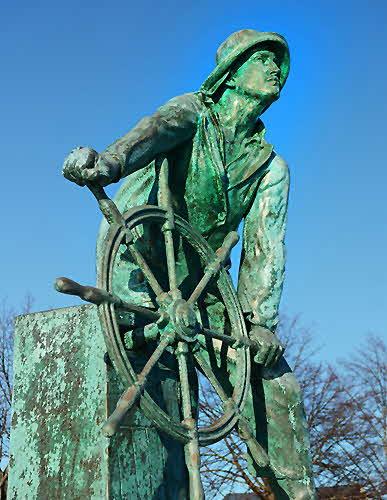
Gloucester’s famous fisherman sculpture. Photo by Bo Zaunders.
Their Sicilian heritage is now very much part of city life. In the mid-1920s, a Sicilian named Salvatore Favazza commissioned a sculpture of a fisherman, which is now carried around every June on a platform during the annual St. Peter’s Festival. This event includes nine days of prayer, traditional Sicilian songs, rowing contests, prayers for fishermen, fireworks, and most famously, a pole-walking contest.
So what’s pole walking? A 40-foot pole, the thickness of an old schooner mast, is extended from a high offshore platform and covered with grease. The challenge is to walk to the end of it and grab a flag. Most contestants just quickly fall into the sea below, but every now and then, someone succeeds. Flag in hand, the contender drops into the water and becomes a hero – not just for the day but for years to come.
To quote Mark Kurlansky, who wrote a book about Gloucester, “to be a successful pole walker, a contestant must be tremendously brave, extremely agile, and extraordinarily drunk.”
In the midst of Colonial revival style architecture and Cape Ann Shingle-style homes, we unexpectedly ran into (of all things) a medieval castle. Constructed in the 1920s, it was the home and laboratory of John Hayes Hammond, Jr., an inventor and pioneer in the study of remote control.
Ostensibly a wedding present to his wife who couldn’t care less about medieval architecture, it now operates as a museum displaying Hammond’s collection of Roman, medieval, and Renaissance artifacts. It also includes a large pipe organ with 10,00 pipes.
Gloucester lighthouse. Photo by Mohann.
Fishermen apart, artists and writers have kept coming to Gloucester for a long time. In the late 19th century, Winslow Homer captured its harbor in brilliant colors. Before him, there was Fitz Henry Lane, whose maritime depictions stand alone in detail and accuracy.
Much later, intrigued by the city’s architecture, Edward Hopper painted many of its ornate houses, one of which caught the attention of Alfred Hitchcock and became the model for the Bates Motel in the film, Psycho. Then, there are the paintings by Anthony Thieme, yet another artist fascinated by life in Gloucester.
As for writers, it was here that after hearing stories about its fishing fleet, Rudyard Kipling embarked on Captains Courageous. Gloucester was the adopted hometown of the 20th century poet Charles Olson and the place where the poet Vincent Ferrini lived and worked for 59 years (often quoted for noting that “women will change America because the women have balls and the men don’t.”)
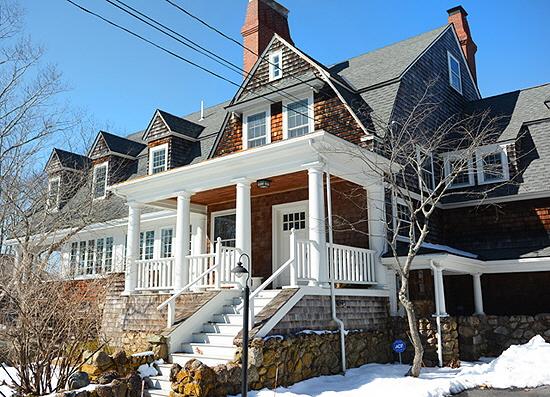
T.S. Eliot’s vacation home in Gloucester. Photo by Bo Zaunders.
This brings us to T.S. Eliot, a central figure in 20th century poetry. As a child growing up in America, he spent every summer in his father’s vacation home – a 5,611-square-foot shingle cottage in Gloucester. In 2015, it was acquired by the T.S. Eliot Foundation. Open from April to October, the place now functions as a Writer’s Retreat for poets, essayists, and playwrights.
The house has been upgraded and freshly repainted and is a haven for those writers invited to stay there. We understand it’s all paid for by royalties from Cats, the musical based on Eliot’s Old Possum’s Book of Practical Cats. The musical had nearly 9,000 performances in London and more than 6,000 on Broadway.
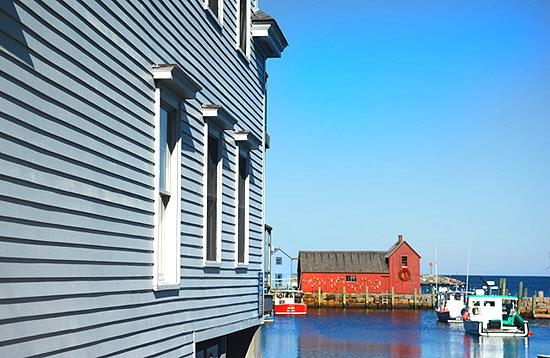
The most painted building in the United States. Photo by Bo Zaunders.
One of our walks took us to the granite wharf of Rockport, which is the town bordering Gloucester to the northeast and situated on the very tip of the Cape Ann peninsula. Here, we saw an unlikely celebrity – a red fishing shack known as #1.
A symbol of New England maritime life, it has been painted by the local artists so many times that it has become known as the most painted building in the United States. It has been featured on a postage stamp, on a Kentucky Bourbon bottle, and in a 1960s Winston cigarette ad.
Once I’d seen it, I had a hard time understanding how it could have become so extraordinarily famous.
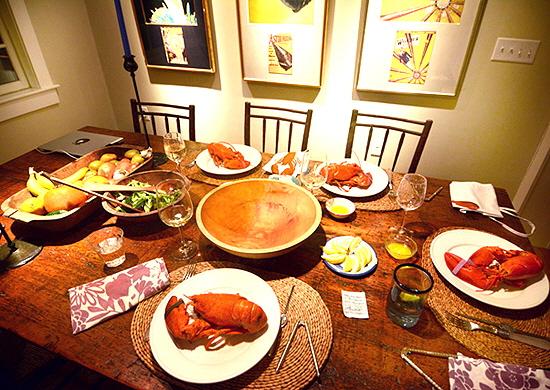
Our friends treated us to a lavish lobster dinner on our first night there. Photo by Bo Zaunders.
We received an interesting overview of Gloucester and its immediate neighborhood when, at the end of our stay, we visited the Cape Ann Museum. Fine art, oil, and watercolor paintings extended into several rooms. A special section was dedicated to printed textiles, and then, there was the Fishing, Trade & Granite room featuring tools, artifacts, models, and even full-size vessels. It also displayed historic photographs, one of which showed Howard Blackburn, a Gloucester character if there ever was one.
Gloucester’s Cape Ann Museum. Photo by Bo Zaunders.
As a young fisherman in 1883, he and his crewmate ran into a blistering snowstorm in their open dory. A devastating five-day ordeal followed. His comrade froze to death, and he lost all of his fingers to frostbite. Back in Gloucester, no longer able to fish, he was helped by sympathetic townspeople to get started as a businessman.
As such, he soon prospered but wasn’t satisfied, yearning instead for great adventure. So in 1901, without fingers, he single-handedly sailed in a 26-foot Gloucester fishing sloop all the way to Portugal, making the trip in 39 days.
Enduring and indomitable – a Gloucester man through and through.
Budapest, the capital city of Hungary, is one of the largest and surely one of the most beautiful cities in all of Europe. Whether on your first trip or your fifth, the World Heritage Castle District draws you like a magnet to the Buda side of the Danube from which there are wonderful views of Pest.
Yes, Buda and Pest are two sides of the Budapest story. First, there was Óbuda and Buda (on the hill) and Pest across the mighty Danube. Eventually, the towns became unified with Óbuda merging with Buda on the west bank and Pest on the east bank of the river.
Pest is easy walking, mostly on level ground, where you can view stunning architecture on beautifully laid out boulevards, while Buda is hilly (great for hikers) and offers the best views over this ancient city.
The Corinthia Hotel Budapest. Photo courtesy of Corinthia Hotels.
After landing at Ferenc Liszt International Airport – named after their most famous Hungarian composer – we were transported to the opulent 5-star Corinthia Hotel Budapest and Royal Spa. The Corinthia is a truly luxurious old world property but completely renovated with all the amenities, restaurants, meeting areas, and services that are necessary to our contemporary culture.
The lobby at the Corinthia Hotel Budapest. Photo courtesy of Corinthia Hotels.
The restored lobby is especially elegant with its sweeping grand staircase, polished marble floors, and richly appointed seating areas. Of note is the size, scope, and sheer beauty of the Grand Ballroom, richly restored and updated. It isn’t hard to imagine it dressed for a sumptuous affair.
The ballroom in the Corinthia Hotel Budapest. Photo courtesy of Corinthia Hotels.
My large room was beautifully appointed, just as I have grown to expect, having visited several of the European Corinthia hotels.
After dropping our bags at the hotel, we made a bee-line to Castle Hill. This district warrants exploring for its gothic architecture, and when you get too tired or too inspired, dining in one of its restaurants to experience local cuisine at its finest. There are so many exotic and quixotic medieval 18th and 19th century buildings to visit, many of them recently restored to their original splendor.
Tip: Note the colorful geometric tiles on the roofs that are characteristic of Hungarian design. Buda Castle was originally a medieval enclave with an underground labyrinth constructed by the residents to hide from marauders. Over the centuries and various occupying cultures and architectural styles, the area grew up.
Fisherman’s Bastion in Budapest. Photo by Barbara Angelakis.
So from the neo-Gothic Matthias Church to the Fisherman’s Bastion – with a turret representing each of the original 7 Magyar tribes – there is much to see and enjoy. There were 7 original nomadic tribes that settled in the Carpathian basin in 896. The Magyars were known also as Hungarians and were (and still are) the only people to converse in the Hungarian language.
The Parliament building in Budapest. Photo by Barbara Angelakis.
The next morning, we explored the Pest side of the river and began with the stunning neo-Gothic symmetrical Parliament building. Parliament Square is possibly the only square in the world to boast three Parliament buildings. There was a competition during the late 19th century to design a building worthy of Hungary’s world-class standing with the three winners commissioned to construct their entries.
The building completed on time was the ultimate winner, and across the square are the two losers (sic) – now a Federal Reserve building and a Folk Art Museum, both architecturally worthy competitors.
The Parliament has a visitor’s center on the far right side of the building from which you can visit the absolutely dazzling building reconstructed to its original design after its devastation during WWII.
Part of the interior of Budapest’s Parliament building. Photo by Barbara Angelakis.
Throughout the building, more than 20 pounds of gold were used to decorate the ceilings, and the walls are hung with precious works of art. You can also visit the Hungarian Holy Crown, which is kept under guard but still used in state ceremonies.
Tip: no photographs are allowed in the crown room, but there are no restrictions elsewhere in the building. The Crown may or may not have been sent by the Pope to King Saint Stephen according to tradition, but it’s the Holy Crown in which the divine power resides to rule the land. The power does not reside in its wearer. No king was considered legitimate unless he was coroneted wearing the Holy Crown.
Shoes on the Danube in Budapest. Photo by Barbara Angelakis.
Behind the Parliament on the riverbank is a moving tribute to the memory of Hungarian Jews killed by Hungarian Arrow Cross Militiamen in 1944/45. Referred to as the “Shoes on the Danube Bank,” it’s a heart-rending memorial.
Budapest’s Central Market Hall. Photo by Barbara Angelakis.
On a lighter note, a fun interlude was to visit the Great Market Hall, an 1897 neo-Gothic building and oldest, as well as the largest, indoor market in Budapest. It’s renowned for its colorful and very photographic food stalls on the ground floor and craft objects for sale on the first floor, some legit but many mass-produced for the tourist market.
The market serves both locals and tourists alike, but the locals know which shops and stalls to frequent, while tourists are mostly at the mercy of the sellers’ sales pitches. Unless you speak Hungarian or want the experience of buying souvenirs at inflated prices, shop around and negotiate before making your purchases. Tip: Hungarian paprika makes a great souvenir and is available in multiple combinations and containers in all price ranges.
Hungarian goulash in Budapest. Photo by Barbara Angelakis.
We had lunch at Fakanal (Wooden Spoon) Restaurant, a large cafeteria-style restaurant on the upper level, where we ate a typical Hungarian meal featuring goulash, stuffed cabbage, veal schnitzel, dumplings, and cherry strudel for desert. It was certainly not a gourmet meal, but nevertheless, it was an experience during which we were entertained by Roma musicians outfitted in traditional costumes. Again, enjoy yourself, knowing that you are contributing to the local economy.
Budapest’s Széchenyi Thermal Baths. Photo by Barbara Angelakis.
Budapest has long been known for the healing properties of its natural mineral springs, which may have been one of the original attractions for settlement in the Carpathian basin area. This brings me to another must-do in Budapest – the Széchenyi Thermal Baths. It’s a well-organized, family-friendly operation with outdoor and indoor hot and cold mineral baths.
You can rent a locked changing room and towels, but remember to bring your bathing suit and skid-free slippers. Once inside, you can spend as much time as you like visiting the various bathing opportunities, and it’s fun to try several. Like the Great Market Hall, this isn’t strictly a tourist attraction but serves the local community. Tip: Be mindful that some of the younger couples use the baths as a place for romantic assignations (wink, wink).
We ended our visit to Budapest with a farewell dinner in the lovely atrium at the Corinthia Hotel. This meal absolutely qualified as a gourmet feast, and we savored it long after we waved goodbye to Budapest.
I have dreamed for decades of seeing a blue whale – the largest animal that’s ever lived (as far as we know at least). When I first investigated the possibility, the only places to see them were remote and usually in very cold waters. Since then, they have become much more widespread, increasing in numbers in southern and northern California.
A few years ago, I made an attempt from Monterey, but we had no luck. So this year, I decided to give San Diego a try. After all, the landscapes and seascapes there are gorgeous, including the top photo of Point Loma – the southernmost point of the city. And I had been following a lot of whale watch company Instagram accounts and confirmed that they were having regular sightings throughout the summer.
I decided to go three different days. I would do a short whale watch cruise with one company one day, another cruise company the next day, and a biplane flight over the water the third day.
The first day, I was on a fairly large ferry boat run by City Cruises for about $60. The boat was quite comfortable with lots of seating and a decent intercom with commentary, as well as refreshments for purchase.
You’re likely to see sea lions and pelicans while whale watching in San Diego. Photo by Melanie Votaw.
Shortly after leaving the dock, we encountered a small pod of common dolphins. Then, we found a juvenile humpback whale who was playing in some seaweed. He brought his tail out of the water and gave us a little show from a distance.
Common dolphins in the waters of San Diego. Photo by Melanie Votaw.
Luckily, the different whale watching companies stay in radio contact with each other to always be informed about where whales are seen. But don’t worry – nobody rushes up on the whales and infringes on their territory. There are strict restrictions about distance, and the boats turn off their motors when they get anywhere near.
Trust me – we can’t get nearly as close as we’d like. If the whales approach a boat while its motor is off, that’s fine, but otherwise, we have to watch from afar. Certainly, I prefer maintaining respect for the animals, and we got fine looks at the humpback. But since I had seen humpbacks in the past, I was still hoping for the one on my wish list.
The back of a blue whale with its huge blowhole, looking gray under overcast skies. Photo by Melanie Votaw.
Then, our crew was told there were a couple of blue whales not far away, so we made our way in their direction. And we saw them! It was an overcast day, though, and their color looked very dark gray. If I hadn’t been told they were blue whales, I would never have known, as they only brought their backs out of the water – at first. Then, one of them lifted its tail out of the water, and that was a thrill!
The juvenile humpback whale’s tail. Photo by Melanie Votaw.
You see, a humpback whale’s tail is dark with a lot of very individual white markings on its underside. But a blue whale’s tail is solid in color and looks very streamlined by comparison. There was no mistaking it!
The blue whale’s tail. Photo by Melanie Votaw.
The other indicator that we’d actually seen a blue whale was what’s called a “whale slick” or “whale footprint.” After they’ve come up for air and gone back underwater, the ocean where they’ve been becomes very smooth for a few seconds. Having seen other species of whales, I could tell the blue whale’s enormous size from the length of the slick it left – about three school buses long!
After that day, I would have been satisfied, but I had another day to come on the sea. And am I glad I didn’t decide to skip it! This time, I went with Legacy Cruises for about $58. Once again, we first encountered common dolphins. But this time, we saw hundreds of them, and they were jumping right next to our boat! Let me tell you that this was enormously exciting! Check out my video below.
Pod of dolphins seen on my whale watch cruise from San Diego. Video by Melanie Votaw.
Then, lo and behold, we saw two blue whales again. Only this time, the sun was out, so we could see their blue color very easily. Plus, they brought a lot more of their bodies out of the water. We didn’t get to see a head or a tail, but we saw a lot of the length of their bodies. The views were simply much better, and I was a very happy whale-lover!
You can see the blue color of the whale and get an idea of its enormous length and blowhole here. Photo by Melanie Votaw.
My only complaint about Legacy Cruises is that their boat was a little smaller, and there wasn’t enough room for everyone to get a spot by a rail outside. For that reason, I had to strain to see from inside at times and take photos through windows. I hated that. Luckily, I eventually got a spot outdoors by a rail. Otherwise, they did a wonderful job.
You can really see the whale’s blue color here. Photo by Melanie Votaw.
My last day of whale watching, I spent a lot of money (more than $600) on a 40-minute biplane ride on the off-chance that I might see a blue whale from the air and view its full length from above. No such luck. In fact, we saw exactly nothing other than the water and the city.
The flight was pleasant enough, and the plane was gorgeous. BUT I wish San Diego Sky Tours had told me ahead of time that the cockpit would have no doors. Since I don’t know anything about biplanes, I didn’t realize this. If it’s on their website, I missed it.
Me in the biplane. Photo by my pilot.
Let’s just say that getting in and out of that cockpit was difficult. You have to step up on a peg above the wing and climb over the side. Then, you have to be very careful not to touch the brakes ahead of your feet or the gears to your left. My pilot (a former military flyer) strapped me in and put the helmet on me. There was a microphone and a button on top of a gear stick between my knees that allowed me to talk to him.
Okay – that’s all fine and good. But getting out of that cockpit? Holy cow! I had to hold on to a handle above me with both hands and stand up in the cockpit. The problem? There’s no way to stand up straight. You have to hold onto the handle, stand up, and bend back quite a bit while also raising your left leg to waist level to get it over the side of the cockpit and onto the peg. Then, you have to somehow get your other foot over and onto a small black piece on the wing. If you step on the rest of the wing, you can damage it.
Another interesting thing we saw on our cruise was this submarine as it was being serviced. We saw several navy ships as well. Photo by Melanie Votaw.
Then, you can jump off the wing. Let’s just say I needed a bit of help. I think I can tick “biplane ride” off my list. Next time, I’ll take a helicopter. But if you don’t mind any of that, you might really love being in an open cockpit zooming over San Diego.
All in all, my visit to San Diego was a great success, and I was beyond happy to finally see blue whales! If you visit the city, don’t miss a whale watch cruise. It’s quite a wonderful (and fairly inexpensive) experience for the whole family.
The Joseph Magnus story began in the middle of the 19th century when he was informed that his father had been killed during the Civil War. His late father had been a merchant, and Magnus followed in his footsteps, becoming a liquor wholesaler and building a liquor empire out of Cincinnati, Ohio.
In 1892, Joseph developed his own whiskey brand, and his most distinguished product was the Murray Hill Club Whiskey. He introduced this whiskey for discriminating customers to the leading bars, hotels, and cafes of his hometown.
Bourbon whiskey was recognized in 1964 by the U.S. Congress as a “distinctive product of the United States.” Bourbon branded whiskey sold in the U.S. must be produced within the country’s borders from at least 51% corn and stored in new barrels of charred oak.
There is a common fallacy that bourbon can only be distilled in Kentucky. Actually, it can be made anywhere in the country, though bourbon is strongly associated with the southern states in general and with Kentucky in particular.
One more bourbon product detail is that aging in a charred oak barrel is one of the legal requirements for it. Charring opens the wood up, making it easier for the spirit to extract a distinct flavor. It also produces chemical changes that are essential to give bourbon its nose.
Vanilla, coconut, toffee, and caramel aromas are created from the wood sugars in the presence of intense heat. Higher charring generally results in a darker color as well. And that’s what makes bourbon delicious.
Fast forward to the 21st century. In 2014, Magnus’ great grandson discovered a few carefully preserved bottles of 122-year-old Murray Hill Club Whiskey among the family’s “treasures.” The bottle shown below belonged to Julian Magnus, the younger of Magnus’ two grandchildren. It was opened and tasted in Louisville, Kentucky in June 2014.
An old bottle of Magnus whiskey. Photo courtesy of Jos. A. Magnus & Co.
In 2015, the Jos. A. Magnus Co. was reestablished in Washington, DC. Using the same blending and finishing techniques that Joseph Magnus employed more than 100 years ago, the company’s Master Blender created a 12-year-old bourbon in a triple cask finish using charred casks that previously contained Oloroso Sherry, Pedro Ximénez, and Cognac.
In 2020, Jos. A. Magnus Co. relocated to Holland, Michigan and reconnected the brand to the legacy of Joseph A. Magnus, who had spent his last years in Oden, overlooking Lake Michigan.
Actually, there are three Magnus whiskey variants currently on the market. The Joseph Magnus Bourbon, triple cask finished, is straight bourbon whiskey. The Murray Hill Club blends 18- and 11-year-old spirits with a lighter 9-year-old whiskey. The Cigar Blend Bourbon is blended to enhance the enjoyment of a fine cigar.
Jos. A. Magnus Bourbon bottle. Photo courtesy of Jos. A. Magnus & Co.
I now have a Joseph Magnus Bourbon bottle, triple cask finished, and my evaluation is based on the tasting of only that particular version. Yes, it can be used in cocktails, and many recipes appear on the website and promotions for that triple cask-finished tipple.
However, in my opinion, this very fine whiskey has to be treated with the same respect that a single malt Scottish Islay dram is treated. This bourbon should be enjoyed straight, da solo, meaning by itself, perhaps with just a single ice cube or just a splash of water to fully bring out the fine aroma and the body’s flavor. At least that’s what I did to enjoy my first glass!
In the very heart of the Mediterranean Sea ̶ south of Sicily, north of Libya, and east of Tunisia ̶ lie the islands of Malta. They make up a small archipelago with a 7,000-year-old history and the stunning physical evidence to prove it.
The first people to arrive on the Maltese Islands were thought to be from southern Sicily, its closest neighbor. It’s easy to question that theory, since the megalithic structures constructed by these Neolithic people and their artifacts unearthed by archaeologists bear no resemblance to the Sicilian culture (at least what’s been discovered so far).
So who were these Neolithic travelers really? Perhaps the mystery will be revealed in our lifetime ̶ perhaps not ̶ but needless to say, all who travel to Malta and gaze in wonder at what these ancient peoples created can’t help but be awed by the legacy in stone they left behind.
Ġgantija megalithic temple site on the island of Gozo. Photo by Barbara Angelakis.
Considered to be one of the oldest surviving free-standing structures in the world, the Ġgantija megalithic temple site (a local fable alleges a female giant built it) is on Gozo, the second island in the archipelago, and dates from about 3800 BC. From the artifacts found, it’s possible to deduce that the temple complexes on both Gozo and the main island of Malta were dedicated to the Goddess of Fertility, although the exact nature of their beliefs have so far been veiled by the mists of time.
While Ġgantija is the oldest UNESCO World Heritage site on Malta and the first to be rediscovered in the modern age, it hasn’t yet given up all of its secrets. Continuing excavations constantly unearth new information and will perhaps one day reveal who these people were and their beliefs. Nevertheless, the Maltese have taken care to protect their national treasures, and like all the megalithic sites, it’s well-organized for visitors.
Ħal Saflieni Hypogeum on the Island of Malta. Photo by Barbara Angelakis.
The Ħal Saflieni Hypogeum on the Island of Malta is the only known example of a subterranean structure surviving from the Bronze Age. Due to its location underground, access is limited and must be arranged in advance of the visit.
It’s a fascinating city of the dead, unlike catacombs found elsewhere. There is a structure with pathways and chambers, and at the center is a large vaulted cathedral-like room – all carved underground. The ceiling in the cathedral is a clear-cut series of ascending carved circles, while paintings of spirals in red ochre decorate the walls and ceiling of the passageways leading to it.
Noble Masters Banner in Malta. Photo by Barbara Angelakis.
The stones don’t indicate how the area was illuminated, and they don’t show any evidence of smoke or fire from the use of torches. So how did these ancient peoples fashion such intricate and precise architectural details such as columns and arches without light? And what was the room used for? Did they worship or participate in ceremonies in the dark?
Recent evidence has shown that when sound is introduced, possibly from drums or flutes, the room vibrates at a specific tone that’s scientifically known to alter consciousness and send the listener into an altered state of being. Human bones have been unearthed as well as votive figurines of the Fertility Goddess, but the evidence suggests that the bones were unceremoniously heaped there after decomposition was complete, compounding the mystery.
Ħaġar Qim site on the island of Malta. Photo by Barbara Angelakis.
My schedule didn’t permit visiting all 20 megalithic temples, but I did get to visit Ħaġar Qim (pronounced jar im). The site is extensive and so well-defined that I could almost feel the presence of the people who built and used (worshiped at?) these structures. They are called temples and constructed out of the naturally honey-tinted limestone native to the islands, but again, their purpose is unclear.
Ħaġar Qim was built on the crest of a ridge overlooking the sea to the south and the broad plain to the north that extends over the entire southern end of the island – an effective defensive position more suited to a settlement then a temple site. It’s a mystery why a relatively small population would expend so many manpower resources to build such an extensive temple complex.
The site of Mnajdra on the island of Malta. Photo by Barbara Angelakis.
The mystery deepens because not more then 500 meters down the hill to the west is another “temple complex” called Mnajdra. Excavations of decorated clay vessels with intricate designs, flint tools, and a representation of a human head fashioned in clay have been unearthed at this site. But so far, there’s no evidence of habitation.
Both sites are currently referred to as an Archeological Park and reached after passing through a museum, where there is an informative video and many artifacts on display. For information, visit www.heritagemalta.org.
A fertility goddess in Malta. Photo by Barbara Angelakis.
Around 2500 BC, construction stopped, and the temple builders mysteriously disappeared. This gave rise to the alternate theory that the islands may have been considered Sacred to the Gods and used only as a center for worship and religious practices for all the prehistoric nations surrounding the islands.
This could account for the number of different temple complexes. Since stone can’t be carbon-dated, we don’t know when the different structures were created, by whom, or over what period of time. There is no evidence of a natural catastrophe that damaged the site. So scientists have speculated that it was abandoned when the religious beliefs of the people changed, or perhaps war or climatic changes forced them to move as happened with so many ancient populations.
Chapel of the Blessed Virgin in Malta. Photo by Barbara Angelakis.
Once the temple builders departed, others were eager to take their place. The modern Maltese cultural mosaic is richer for having integrated the diverse influences from cultures like the Phoenicians, Greeks, Romans, Arabs, and Castilians, to the Knights of St John, the French, and finally the British. All have left their mark with monuments and monumental edifices, works of art and religious beliefs, languages (English is the second official language after Maltese which is Semitic in origin), as well as agriculture and cuisine.