I was aboard a small boat at the Cuero y Salado Wildlife Refuge – 35,000 acres near the Caribbean coast of Honduras. From our boat, we could view the jagged top of famed Pico Bonito Mountain, peeking through the clouds.
This quiet treasure of mangroves and waterways was set aside in 1987 to protect manatees. It would take 20 hours to see it all.
Our guide, Elmer, explained, “To see animals, you must be in the right place at the right time.” He hoped we would see manatees and crocodiles. Plus, armadillos and anteaters could be hidden along the river bank. All of us had to be on alert to find them. It was up to us to be good sleuths.
Our two hours there brought surprises. What seemed like little growths on a tree turned out to be tiny long-nosed bats that took flight when our guide used a laser to pinpoint their locations.
The Northern Jacana bird had a rust-colored body, yellow beak, and widespread feet as it stalked prey atop the water plants. Turkey vultures took flight, their gigantic wingspans like wavy punctuation marks in the sky.
Jesus Christ lizard. Photo by Hector P. Wolfe.
There are even Jesus Christ lizards there, which can walk on water! Our guide made “huh-huh” panting sounds like a monkey. Soon, we spotted a pair of howler monkeys and their four offspring on a tree.
“My, that’s a big log!” No, it was a 10-foot crocodile! It submerged, heading toward us, so we made our getaway into a canopy of trees almost touching our heads. Birds tweeted. Cormorants fled. Breezes cooled us. It was serene in this small private world covered by fig trees, mangroves, and coil palms.
The rail trip to get to this sublime location was an entrée into Honduran life. For this outing, we took a pair of small yellow metal, open-air coaches that were 6-feet across. Their top speed was perhaps 25 miles per hour. More like a trolley than a train, they clicked and clattered along on two slim metal tracks past palm trees, cabins, tethered horses, and the occasional chicken.
We came to a halt to pick up a mother and child. Another time, two teens hopped abroad, parking their bikes on the “running board” of this narrow-gauge train. I was hurled back in time to 1910 when this rig transported bananas.
Pico Bonito Lodge. Photo courtesy of Pico Bonito.
Sandwiched between Nicaragua, El Salvador, and Belize in Mesoamerica, Honduras has 8,500 square miles of protected land. It’s known for great coral reef diving and ziplining in Roatán and for outstanding Mayan ruins at Copán, both reachable by side trips from The Lodge & Spa at Pico Bonito, where I was staying.
Life is good at Pico Bonito, an eco-lodge in a tropical rainforest three miles from La Ceiba city on the north coast of the country.
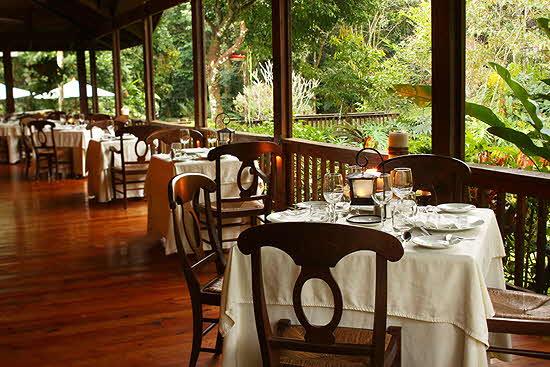
Pico Bonito Lodge dining area. Photo courtesy of Pico Bonito.
Pico Bonito towers at 8,000 feet. So pristine and bio-diverse is this area that UNESCO has declared Pico Bonito National Park a World Heritage site. Its 250,000 acres – much of it unexplored – are a wildlife sanctuary and a birders’ paradise. There are 500 species of birds concentrated there.
Honduras has as many as 725 species. The U.S. has about 900 species total dispersed in a country far larger.
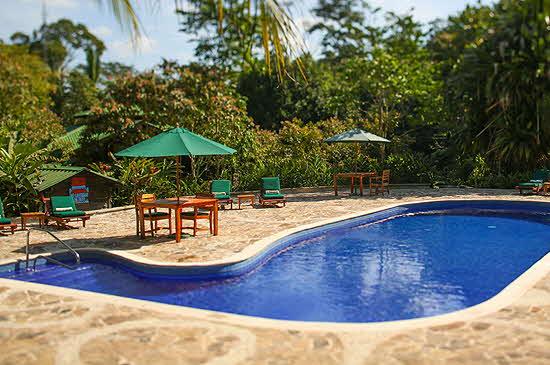
Pico Bonito Lodge pool. Photo courtesy of Pico Bonito.
At the base of the imposing mountain within the Park sits Pico Bonito Lodge. This rainforest luxury hideaway has amenities – Wi-Fi, warm showers in Mexican-tiled bathrooms, a swimming pool, and telephones. Trails beckon on the Lodge’s 400 acres, all available to guests. You need never leave the grounds to enjoy nature.
Macaw parrots at Pico Bonito Lodge. Photo courtesy of Pico Bonito.
But adventure opportunities abound. You can go whitewater rafting on the Rio Cangrejal through the park or hike to waterfalls. But let’s hear it for the birds! Indigenous ones like the Motmot and the sought-after “Lovely Cotinga” are rarities in most of Latin America, but readily seen here. Other birds migrate from North America during our winters.
The main building and its 22 well-spaced chalets are plantation-style with dark burnished wood and a hammock on every deck. The beautiful tropical plantings, cacao and coffee trees, and six miles of nature trails enticed Sports Illustrated to shoot a swimsuit issue here and have drawn celebrities like Michael Douglas, Catherine Zeta Jones, and America Ferrara.
Excursions are easily available, including to the wildlife refuge. The Lodge takes botany and biology seriously. Plants are designed to attract birds. Cameras are set up to record the jaguars that come through, and a whiff of Calvin Klein’s “Obsession” in the camera trap keeps the big cats around long enough to get an image.
A tree frog. Photo by Hector P. Wolfe.
On a brief night hike, we reached a pond and waterfall that the Lodge built to attract wildlife. It was pitch black. We heard only the waterfall and crickets until a loud repeating hiccup resounded. It turned out to be a small tree frog. These green frogs with red bulging eyes are emblematic of Honduras and Central America. And I was close up and personal with one who was belching loudly as though it had a megaphone.
The next day, we got up early for birding. Birdwatching is a favorite pastime for millions and a multi-billion-dollar industry. Our guide’s bird calls brought out feathered neighbors. The resident biologist pointed out a white-crowned parrot almost immediately. Its wings opened to a riot of color.
On the Lodge’s terrace, I spied a keel-billed toucan, often called the rainbow toucan because of its bright red, yellow, and green bill. “This is the toucan capital of the world!” the biologist told us.
Keel-billed toucan. Photo by Melanie Votaw.
Seen through a scope, a gray pygmy owl with yellow eyes staring back looked wise but vulnerable. After moving through palm ferns and morning glory vines, we climbed one of the lodge’s three observation towers to view the Name of God mountain range, Pico Bonito’s sawed-off peak within it.
Soon, we spotted local birds that we would never see stateside: a blue-crowned Motmot, the bright blue chest and purple throat of the sought-after Lovely Cotinga, a Montezuma Oropendola with its bright tail, and a turquoise-browed Motmot. I experienced psychedelic colors, softness, and utter amazement.
Lovely Cotinga. Photo by Hector P. Wolfe.
Our guide explained, “Birders come with a target bird, but then they want to see everything.” The Lodge lists sightings on a blackboard. They have identified more than 425 bird species in the area, and animals are listed, too, such as ocelots, jaguars, agoutis (small rodents), monkeys, and more.
Family-friendly here, children under 11 stay free for room and breakfast. Staff members even babysit for a fee. Many cabins have two connectible rooms.
The child in me was entranced with the Butterfly Farm set amidst flowers. An Iguana Farm and nearby Snake House provided more environmental education along with thrills and chills – all included.
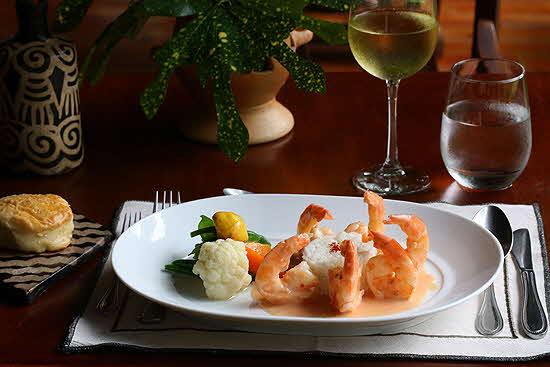
Coconut shrimp at Pico Bonito Lodge. Photo courtesy of Pico Bonito.
The food at the Lodge was excellent. Some had a Latin flavor – baleadas (tortillas with scrambled eggs and refried beans) or coffee-chili marinated ribeye. Many dishes used fruit from the Lodge’s own trees. Mango sauce covered an airy chocolate mousse. Avocado foam and guacamole were perfection. Soursop ice cream was a delight with a pina colada.
Meals were taken as hummingbirds hovered within reach. While I savored coconut shrimp, a furry agouti nosed around the giant crimson torch flowers within my sight. Vanilla bean orchids clung to branches. All of this was in one of the largest remaining true wildernesses. Two and–a-half days at the Lodge seemed a world away. And a full-size spa was right alongside the lovely swimming pool. Bonito? Yes?
I have found that many tourists are unaware that they can often see some of their favorite Broadway stars up close and personal in small cabaret rooms in Manhattan.
The likes of Betty Buckley, Patti LuPone, Jeremy Jordan, Brian Stokes Mitchell, Audra McDonald, Sutton Foster, and many more can sometimes be seen at these venues. If you’re planning a trip to see Broadway shows, it’s worth your while to check the schedules of the following venues to see if you can coordinate your trip with an appearance by one of your favs: 54 Below, Joe’s Pub, Café Carlyle, and The Green Room 42.
Broadway star Liz Callaway gives a concert at 54 Below in New York City. Photo by Melanie Votaw.
54 Below is so named because it’s in the basement under the location of the famous Studio 54 nightclub, where big stars danced the night away in the late 1970s and 1980s. It’s a beautiful room with great food. It will cost you as much as a Broadway show, but at least it includes dinner.
The cover charge varies depending on the popularity of the star and where you want to sit in the room, and the minimum food/drink charge is $25. That means you don’t have to eat a full meal, but you’ll have to have a couple of drinks (alcoholic or non-alcoholic) or one drink with an appetizer. It’s my favorite cabaret venue to see big names and is located on West 54th Street just north of the theater district and just south of Carnegie Hall and Lincoln Center.
Joe’s Pub is named after Joseph Papp, who founded the Public Theater, which is famous for being the first theater to produce celebrated shows like Hair, Hamilton, A Chorus Line, and Fun Home, among others. It’s the small cabaret venue attached to the Public’s several theaters in a building on Lafayette Street in downtown Manhattan. The closest subway stops are Astor Place and Bleecker Street.
Prices at Joe’s Pub also vary, and there’s a two-drink or one-food-item minimum besides the cover charge. The food here is excellent as well. Try the burger and the curried cashews! It has a cool downtown vibe, and it caters to both classy and irreverent entertainment (not to imply that irreverent entertainment isn’t also classy). Bernadette Peters once sat at the table next to mine, so you never know who might be in the audience.
Café Carlyle is in the famous Carlyle Hotel and is the fanciest of all of these venues. It will cost you to go there, but it’s a wonderful experience with a tasty menu. As I write this, Tony Danza is set to do shows at this place. Reservations for his show are $200 a seat, but you’ll also shell out for food and drink.
This is noted on the page for booking Tony’s show. “For all performances, there is an additional USD95 two-course menu requirement per person. Beverages, tax and gratuity are additional. For Bar Seating, there is a food and beverage minimum of USD50 per person.” Like I said, it’s pricey and definitely less casual than the other three. Bar seating, by the way, usually means a stool by the bar.
The Green Room 42 in New York City. Photo courtesy of the venue.
The Green Room 42 is the new kid on the block (started in 2017), but it also often features Broadway stars in their own cabaret concerts. You can eat here, but there’s no minimum required, which is nice. It’s located in a beautiful room upstairs in the YOTEL Times Square hotel, so it’s conveniently located in Manhattan’s midtown theater district.
Reeve Carney, star of Broadway’s “Hadestown” and “Spider-Man: Turn Off the Dark” performs at The Green Room 42. Photo courtesy of the venue.
“Cabaret-style” seating means that if you sit at a table rather than at the bar, you might end up sitting with other people you don’t know. 54 Below also gives me credits when I have to cancel. As a local, I can transfer those funds to a later concert. This comes in handy if you get sick. I also find that if a friend of mine makes their reservation separately from mine, we can still ask to be seated together. (I haven’t tested these things out at the other locations, however – only at 54 Below.)
When you’re in New York City, I highly recommend checking out the calendars of each of these beautiful rooms where you can hear great music.
A lot of visitors and locals aren’t aware that you can watch whales from Manhattan and Brooklyn in NYC. And I’m talking some major whale watching!
I recently took a cruise from Sheepshead Bay, Brooklyn with American Princess Cruises, where we saw seven humpback whales. They breached (throwing their body out of the water and slamming back down) and lunge-fed (lifting their head out of the water and opening their mouth wide to capture as many small fish as possible).
Both of these behaviors are absolutely thrilling to see! While humpbacks are the most common whale in the summer off New York City – sometimes even with the Manhattan skyline in the distance behind them – you can also see bottlenose dolphins, minke whales, and sometimes other species as well. We saw some stingrays and lots of birds. You might also see sharks, sea turtles, mahi mahi, and/or sea lions.
A whale lunge feeding. Photo by ttshutter.
The whales returned to New York Harbor in the last decade when fishermen stopped catching the small fish they like to eat most. The waters have also, purportedly, been cleaned up a bit. That means the wildlife activity in the Atlantic near the city has stepped up significantly. That activity does start to slow down in September and October, however, as the whales start to migrate. So summer months are best.
We only sailed an hour from Brooklyn before we saw our first whale. The cost of a three-hour cruise is less than $100 per person, so it’s a great activity for the whole family.
I managed to get this shot of a humpback whale tail during my recent American Princess Cruises whale watch from Sheepshead Bay, Brooklyn, NYC.
American Princess operates every day except Monday and Tuesday and sometimes operates a sunset cruise as well as their earlier one. I can personally vouch for American Princess, but a friend had a great time with Seastreak.
Seastreak offers cruises from points in Manhattan. Sheepshead Bay is deep into Brooklyn, which would be a trek if you’re staying in Manhattan, although it’s a beautiful fishing village that I recommend seeing if you have the time and inclination. Seastreak does many other types of cruises besides whale watching, including rides to Nantucket and cruises on the river to see fall foliage.
I can’t recommend this activity enough, whether you live in NYC or are visiting in the summer months. I’ll do this every summer from now on!
What if you get seasick? Read my article on how to combat this. I’ve battled seasickness my whole life, but I can now be on rough seas with no issues.
New international air routes: There are new routes internationally from the U.S.: Newark to Marrakech on United; Dallas to Brisbane on American; Portland, Oregon to Amsterdam on KLM; Minneapolis to St. Maarten on Delta; Providence to San Juan on JetBlue; Dallas to Nadi, Fiji on Fiji Airways; Los Angeles to Mazatlan on Delta; and New York to Bonaire and St. Vincent on JetBlue. Happy traveling!
Airplane in airport. Photo by cegoh.
Where in the U.S. will you have the worst TSA experience? According to a study by Upgraded Points, it’s Newark Liberty International Airport. I’ve never noticed anything out of the ordinary there, but it has received the most passenger complaints for nine full years!
Are you too close to that buffalo? After so many people have gotten too close to wildlife in national parks and been injured, Jackson Hole has created a filter on Instagram to help you determine if you should back up while trying to take that photo of an animal. I hope this works and that all national parks adopt it!
Buffalo. Photo by GidonPico.
Want to see North Korea? It’s reopening to international tourism in December, but the U.S. State Department has issued a “do not travel” warning to American citizens. I think I’ll steer clear, thank you very much.
Global Entry isn’t just for Americans! Did you know this? I didn’t. Several other countries have an agreement with our Global Entry, and Australia has just been added to the list to help some foreign travelers get through customs in the U.S. faster.
Free visas to Sri Lanka: As of April 2025, Sri Lanka is temporarily waiving its $50 30-day visa fee for 35 countries, including the U.S. and the UK.
Will Alaska and Hawaiian Airlines merge? Maybe. The Justice Department has given them the okay, but now, the Department of Transportation has to say yes.
Horrible accident at Atlanta Airport: Two Delta employees were killed and another injured when an airplane tire exploded on August 27th. I didn’t know this could happen. I hope they investigate and give us more information on what caused it. Is it another Boeing problem? Whatever the cause, our condolences to the families of the victims.
I just discovered a new service called Bounce that has a luggage storage network around the world. They work with local businesses that are willing to hold your bags for a set period of time. The business hours vary, but you can check that information on the website and hopefully find a place in a convenient location.
While I haven’t personally tried this service yet, I plugged in a hypothetical situation on their website in which I stored a checked bag and a piece of hand luggage in the financial district of Manhattan, New York City for about 8 hours one day. The total cost was just over $15.
I didn’t know this existed and thought some of you might find it useful. I’m sure it will come in handy for me sometime. I can imagine needing it at some point.
If you try it out, please come back and comment to report about your experience!
2025 Update: Christopher Elliott recently reported on a consumer problem with this service. Read it and decide for yourself if you want to use Bounce.
Pastitsio is the Greek answer to Italian lasagna, but what sets it apart from the Italian version is mostly the use of numerous aromatic spices in the meat ragù. The other difference is that pastitsio uses a thick, long pasta with a hole, topped by a hearty cheesy béchamel instead of the flat Italian lasagna.
Actually, pastitsio is the same as Egyptian macaroni with béchamel and Australia’s “Mexican lasagna.”
Misko Pastitsio No. 2 Pasta. Photo courtesy of Loumidis Foods.
Authentic pastitsio uses either a very thick bucatini type of pasta or ziti. If you are near a Greek grocery, and they carry the MISKO brand of pasta, ask for “Pastitsio pasta No. 2,” which is thicker than standard Italian bucatini. You will get the proper, traditional size of pasta for your pastitsio.
The dish is layered, starting with a layer of pasta, a layer of the hearty meat sauce, another layer of pasta, another layer of meat sauce, and finally topped with the béchamel. It slices neatly with the layers clearly visible, and the tubular Greek bucatini-style pasta is also very discernible.
However, you can also use only two layers of pasta and a single, thicker, layer of meat sauce between the pasta layers. The layering differs regionally in Greece.
Bolognese sauce with bay leaf. Photo by Manos Angelakis.
The meat ragù is ground chuck or another inexpensive beef cut, ground and cooked in tomato and red wine with onions, garlic, and aromatics of cinnamon, ground cloves, and a dash of nutmeg. I will usually add a couple of bay leaves in the sauce, which I remove before building the pastitsio. But that’s my personal taste, not traditional.
Classic Béchamel sauce. Photo by Nick Ross.
The béchamel is made with all-purpose flour cooked in butter and thickened with milk, plus eggs and cheese to create a creamy white sauce that serves as the topping for this dish. It should just brown in the oven. Don’t let it burn!
First, prepare each component of the dish – cook the pasta, make the meat sauce, and make the béchamel.
Making the meat sauce is really no different than making a good Bolognese. It’s very straightforward, but there are two important differences: The cinnamon, cloves, and nutmeg. The aroma from these spices is what makes the meat sauce Greek, rather than an ordinary Bolognese.
And the sauce is much thicker. This is intentional so that the sauce can stand comfortably between the pasta layers rather than seep through them. This is how you get proper layering.
Unlike a Bolognese, the pastitsio sauce needs to be simmered for a good hour to reduce it and make it thick enough. The added bonus is that the long simmering makes the beef tender and intensifies the taste of the sauce.
Time permitting, let the meat sauce cool before layering over the pasta. It thickens and holds together better when cooled first.
To most Greeks, any dish with pasta, a meat sauce, and béchamel topping screams comfort food!
Tomato/Meat Sauce:
3 tablespoons extra virgin olive oil
1 1/2 chopped yellow or white onion (about a cup)
1/3 cup diced carrots
1/3 cup celery
1 pound lean ground beef, chuck preferred
1 pound lean ground lamb
1/2 cup dry red wine
1 tablespoon minced garlic (2-3 large cloves)
3 bay leaves
1 tablespoon ground cinnamon
1/4 teaspoon ground cloves
1 1/2 teaspoon dried oregano
Pinch of cayenne pepper
1/2 teaspoon granulated sugar
1 can (28 ounces) crushed tomatoes in purée
1 tablespoon tomato paste, diluted in 1/4 cup of water
Kosher salt and freshly ground black pepper, to taste
For the Béchamel:
3 extra-large eggs, beaten Salt and freshly ground black pepper, to taste
Add olive oil to a large pot over medium-high heat. Add onion, carrot, and celery, and cook until softened about 4-5 minutes.
Stir in the ground beef and lamb, stirring occasionally to break up the meat, and cook for about 10-12 minutes until cooked through.
Pour in the red wine to deglaze the pan. Cook it for a few minutes until most of the wine has evaporated.
Stir in the garlic, bay leaves, and spices until well-incorporated.
Stir in the sugar, canned tomatoes (if using whole tomatoes, crush them up a bit when added to the pot), and tomato paste diluted in a little water. Bring to a boil. Once simmering, turn the heat to medium-low, and let it simmer with the lid on until the sauce has cooked down and most of the liquid has evaporated. Set aside.
Method for the béchamel:
Whisk the 3 eggs together in a bowl, and set aside.
Make the béchamel by adding butter to a medium pot over medium-low heat. When the butter has melted, add the flour, and whisk constantly until a paste forms.
Stir in the milk in 1/2 cup increments, whisking constantly after each addition to make sure the sauce doesn’t get lumpy.
Continue whisking, and add in salt, pepper, and nutmeg.
Whisk in the cream and shredded cheese until combined.
Remove the pan from the heat, and stir in the whisked eggs, whisking quickly to combine and make sure the eggs don’t get lumpy.
Put back on low heat for about 30 seconds to 1 minute, and continue whisking. The sauce should be smooth and of the consistency of a cheese sauce. Set aside.
Assemble and bake:
Preheat the oven to 350 degrees F.
Place the pasta in a 9×13 baking dish, arranging the noodles facing the same way and making the layer as level as you can.
Add the meat sauce as the next layer and smooth out the surface.
Place the second pasta layer the same way as the first.
If you’re creating a triple-layer pastitsio, add the second layer of meat sauce.
Place the third layer of pasta just as the first two.
Pour the béchamel sauce over the top pasta layer, and gently smooth out the surface.
Bake for 30-40 minutes or until the crust is golden brown. You can always broil for a minute or so on low toward the end of the baking time to help the crust turn golden.
Let the pasta cool for at least 15 minutes and up to 30 minutes before cutting and serving.
Store any leftovers in a sealed container in your fridge for up to four days. The pastitsio is still delicious when reheated. Enjoy!
Towering jagged peaks rise like formidable granite columns, overlooking a pristine white sandy beach that seems at first to fade into low lying clouds further beyond the shoreline and the incoming receding waves. The Lofoten Islands of Norway have many transcending scenes, which continue to grab the attention of the seasoned travelers who are willing to explore this enchanted archipelago.
For the final leg of my journey, which began in New York, I took a 25-minute flight from Bodø on the mainland to Svolvær, which has one of the two airports on the island chain.
On my very first night in this coastal town, I discovered by chance the spectacular northern lights, which displayed intriguing green swirling patterns on a dark blank canopy. This most unexpected encounter lasted less than an hour but will forever be an unforgettable experience.
This event took place during a quiet leisurely stroll along the harborside, not far from my hotel but far enough away from the town lights that gradually faded in the distance. On my hotel balcony later that evening, I enjoyed the delightful view of the shimmering moon that seemed to shiver in the cold still air while bright, multiple-illuminated reflections lightly flickered on the calm waters of the harbor below.
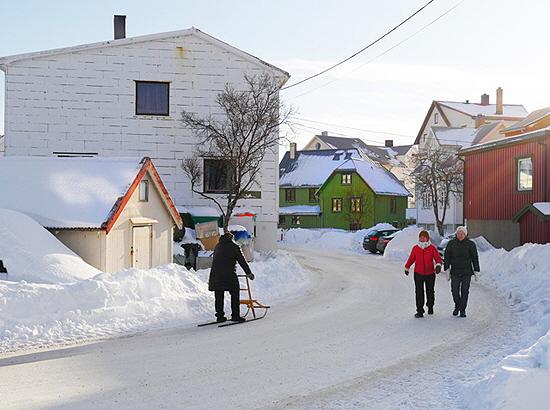
Svolvær, Norway’. Photo by Sebastian Price.
My stay at the Scandic hotel in Svolvær turned out to be the ideal location, situated near the middle of the harbor on a small island connected by a short causeway. From the comfort of my hotel balcony, I had wonderful views of the surrounding harbor, the town center, the fishing boats leaving early in the morning and returning at dusk, various species of arctic seabirds on the water, and the spectacular mountains that seemed so close.
A local guide, Jann Engstad of Lofoten Aktiv, came to my hotel to give me a personal tour of two fishing villages – Kabelvåg and Henningsvær. These two charming tightly knit communities soon provided some interesting scenes that fulfilled my keen photographic interests.
An enthusiastic photographer himself, Jann knew the time and place best for capturing some unique local aspects of daily life in the community: fishermen mending nets onboard while making repairs to the boat docked on the jetty. Children and older folk sledding to school or to the local shop. Racks of codfish hung for drying in the cold fresh air near the fishing boats.
This centuries old tradition of preserving cod is very much part of the cultural fabric of the Lofoten islands. Many of the local restaurants prepare this popular fish as a main course.
While in these small vibrant communities, I had the unexpected opportunity to meet many locals whose genuine friendliness and refreshing openness I will always fondly remember. Many shared their personal experiences of living on these faraway islands and provided meaningful insight into their unique way of life.
Later in the day, Jann drove to the town of Lekness, where I would spend several days at a new hotel.
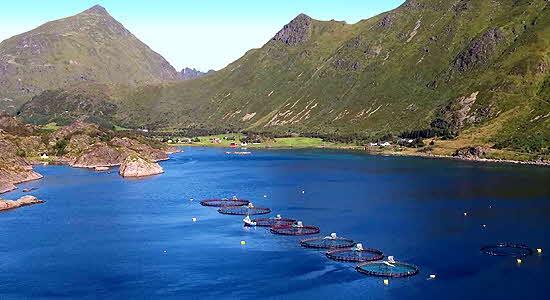
The salmon pens of the Lofoten Seafood Center. Photo courtesy of the Norwegian Tourism Board.
On the following day, I visited the Lofoten Seafood Center located not far from my hotel. The visit afforded an opportunity to learn more about the economic mainstay of the archipelago’s fishing industry, while experiencing an enjoyable introduction to salmon farming.
Early on the day of my visit, snow gently fell as our small launch left the jetty heading toward the salmon pens. Cold, misty air revealed clear outlines of small barren islands and snowy caps in the far distance. As the boat plowed through the icy waters, our charming young skipper kept up an interesting banter of relevant details about the day-to-day operation of the salmon farm.
Reaching the pens, I saw huge fish jumping and disturbing the surface water in these oval-shaped, netted enclosures. The skipper said some salmon can weigh as much as four kilos, and each pen can hold about 60,000 fish. I counted eight pens.
I soon learned that salmon farming is very much a computerized operation. The entire fishing stock is fed four times a day and is fully automated with an above-water machine that sprays food back and forth on the surface like a stationary garden hose.
After returning to the jetty, I went inside the small adjacent fish-processing factory and saw the newly arrived catch of cod, which is the very traditional fishing mainstay of the region. Spotlessly clean stainless-steel containers held the codfish.
Later that day, I had the great pleasure of dining at the Lofoten Seafood Center’s restaurant and enjoying the freshly caught seafood.
The restaurant’s executive chef prepared various dishes using a variety of local seafood, ranging from fresh cod and halibut to delicious local crab meat, enhancing each dish with special seasonings and fresh vegetables.
I enjoyed the chef’s carefully selected wine pairings with each course. The restaurant has a wide-ranging selection of international wines, especially prominent wines from Northern Italy and France.
The beautiful Lofoten Islands. Photo courtesy of the Norwegian Tourism Board.
The town of Leknes is conveniently located within striking distance of the coastal Lofoten Seafood Center and is central to most other major attractions on the Lofoten archipelago. The town itself is unassuming with a main street and a small residential population scattered outwards from the main shopping district.
I stayed at the Scandic Hotel, which proved to be a well-placed choice since it has a nice in-house dining room serving wholesome and satisfying three-course dinners. Sometimes just relaxing in comfortable quarters after dinner without a constant need to venture out to restaurants can be a most desirable option.
Only about a ten-minute drive from Leknes, Haukland Beach is a beautiful wide stretch of blond sand and gentle waves. It can be even more beautiful when changing shades of daylight enhance the natural surroundings.
The beach is enclosed by steep rugged mountains on all sides, and beyond the breakers, large barren rocks break the momentum of the surging sea. Walking along and observing the incoming clear aqua marine waters that retreated along the beach, I enjoyed the solitude.
Some of this trip was subsidized by the Norwegian Tourism Board, but as always, we are dedicated to providing unbiased assessments of our experiences.
Just found another of my mother’s recipes – an aromatic sponge cake that is steeped in orange syrup. This one is a classic Eastern Mediterranean sweet cake called “revani” or “ravani” in Greek or “rebane” in Turkish. it’s also very popular in Egypt and Yemen.
While in Greece, it’s served with a smashed pistachio meat or smashed almond meat topping. In Egypt, it’s served with grated, unsweetened, desiccated coconut meat. In Yemen, it’s sprinkled with poppy seeds, and in Turkey, it’s topped with kaymak – a double-condensed clotted cream.
The name’s origin is Ottoman, and I believe it means “syrupy.”
Syrup Ingredients:
2 cups granulated sugar 1 cup water at room temperature 1 cup orange juice at room temperature Juice of half a lemon 3 teaspoons grated or slivered orange peel
Cake Ingredients:
3 large eggs at room temperature.
2/3 cup granulated sugar
1 teaspoon vanilla extract
1/2 cup vegetable oil (you can use any kind of neutral oil for the cake, including vegetable, grapeseed, canola, or sunflower oil. Even though in the Greek Islands, olive oil is used, avoid it as, it will make the cake greasy and heavy.)
1 cup plain yogurt (whole milk or low-fat, but avoid nondairy yogurt)
1-1/4 cup fine semolina flour
1 cup all-purpose flour (don’t substitute whole wheat or any other kind of flour)
2-1/4 teaspoons baking powder
1/4 teaspoon fine sea salt
Optional toppings: 1/2 cup unsweetened desiccated coconut or 1/4 cup smashed pistachio meat or almond meat or poppy-seeds, sprinkled over the cake before slicing. Alternatively, add 1 tablespoon of kaymak per slice.
Method
Start by making the syrup. Place the sugar and water in a saucepan over medium-high heat.
Once it comes to a boil, turn the heat to medium, and add the orange and lemon juices and grated orange peel. Simmer for 15 minutes.
Turn off the heat, and let the syrup cool completely. Then, remove the grated peel with a slotted spoon or strainer.
Preheat the oven to 350⁰ F, and line a 9×13 baking pan with parchment paper.
Beat the eggs and sugar in a bowl using an electric mixer or a whisk for about 5 minutes. The mixture should become fluffy and light in color.
Add the vanilla extract, vegetable oil, and yogurt to the egg and sugar mixture, and mix to combine.
Add the semolina, all-purpose flour, baking powder, and salt. Stir to combine.
Pour the cake batter into the prepared pan, and smooth the top using a spatula. Thump the pan a couple of times on the counter to release possible air bubbles.
Bake the cake in the oven for 30 minutes until a toothpick comes out clean.
Remove the cake from the oven, and let it cool for 5 minutes.
Slice it into 12 diamond-shaped pieces, but leave the pieces in the pan. Then, using a ladle, pour the cool syrup all over the cake.
Let the cake sit for 1 to 2 hours at room temperature.
Gently take the slices out of the pan with a spatula, and place them on a serving platter. Add your chosen topping.
Very important to use cool syrup: You need to make sure that the syrup is completely cool before pouring it onto the cake. The warm cake and cold syrup is the key to a moist and fluffy revani cake. You can make the syrup up to 2 days in advance.
Lining the baking pan: To easily line the pan, first coat it with cooking spray. Then, line it with parchment paper. You don’t need to line the sides of the pan – just the bottom.
Store leftovers in an airtight container, and refrigerate it for up to 5 days. Serve at room temperature. Freezing this cake is not recommended, since the slices will dry up, and the texture won’t be the same.
Kaymak is quite difficult to find unless you live in an area with a large Turkish population. Turkish patisseries most commonly carry Kaymak, and groceries that cater to a Turkish or Arabic community might also have it.
Dispute with a travel-related company? Whenever you have a problem with a travel-related company that you’re struggling to resolve, check out the contact information for executives in Christopher Elliott’s handy list. Don’t waste more time – go right to the top! https://www.elliott.org/company-contacts/
The building resentment in Europe about overtourism: Apparently, locals are most upset about short-term rentals and how they’re forcing out local people due to lack of housing and overpriced housing. Mostly, reports say they want their governments to change policies to prevent this from happening. It isn’t as much about tourists themselves. That said, read the next entry…
Hiding popular sights? Amsterdam is obscuring Dam Square with a large wall, and Copenhagen is hiding some popular spots with art and greenery to try to prevent so many tourists from converging on the same places. Will it work? We’ll see.
Crowd of people. Photo by Keith JJ.
CLEAR is raising its prices again: The service that gets you through TSA faster is raising its individual prices to $199 per year.
United Airlines news: Travelers in basic economy can now check in online. Before, they had to wait to check in at the airport to verify they weren’t bringing a carry-on bag.
The TSA liquid rule is here to stay: Other countries may do away with the liquids rule, but in the U.S., the TSA can’t spend the money to change the scanners. So they say it won’t change until at least the year 2040. (Eye roll.)
Since the invention of alcoholic beverages, hangovers have become a universal curse that every culture has to deal with. From “hair of the dog,” to raw egg sucking, to the South American ceviche, both ancient and modern men and women have had to deal with “the Morning After.”
Pliny the Elder. Photo courtesy of Verona Tourism Authority.
Pliny the Elder was the most famous compiler of hangover remedies in ancient times. To date, you can’t find any ancient story on the effects of overconsumption where Pliny has not been mentioned. One of his suggestions was wearing an amethyst necklace when drinking (amethyst is a Greek word meaning “not being drunk”).
Another was wearing a necklace of flat leaf parsley while retiring after a heavy drinking session. I already tried it and can report that it doesn’t work! Another possibility he suggested was lightly boiled owl’s eggs for breakfast. But where can you find owl’s eggs to lightly boil nowadays? If the eggs didn’t bring the desired relief, he suggested a “snack” of eels stewed in red wine.
Early Jewish belief, as well as later apocryphal Christian stories, claimed that the “Tree of Knowledge” in Paradise wasn’t an apple tree as medieval painters would have us believe, but a grapevine with the forbidden fruit of grapes. Actually, viticulture, the cultivation of grapevines started a few years after the Great Flood more than 10,000 years ago. So mankind has been trying to cure the hangover for a very, very long time!
Bacchus. Photo courtesy of Ashmolean Museum, the University of Oxford’s Museum of Art and Archaeology.
Greeks and Greek-influenced cultures around the Mediterranean basin had Dionysus or its Roman counterpart Bacchus as the God of Wine. All Hellenized cultures sacrificed to Dionysus, from the Hellenic supermen of the Iliad, to Alexander the Great and his warriors, who conquered the “then known world” all the way to Eastern India.
Antiphanes, a respected ancient Greek historian, wrote that a good hangover remedy is:
Take the hair, it is written, Of the dog by which you’re bitten Work off one wine for its brother
In other words, the remedy, “Hair of the Dog,” has been with us for more than 2,500 years.
The Regimen Sanitatis Salernitanum. Photo in the Public Domain.
Medieval “healers” developed all kinds of strange concoctions hoping to cure hangovers. Regimen Sanitatis Salernitanum, a “medical” compendium, suggests combining wine with ashes of scorpions or wolf’s liver steeped in what we would call medicinal alcohol. (Good luck putting that one together.)
And, of course, the “laying of hands” by a bishop was presented as extremely effective.
A painting of a Viking ship. Photo courtesy of Hurtigruten Cruises.
The Vikings, known for their love of spirits made from different fruits and grains, such as apples, pears, peaches, rye, wheat (and after the New World was “discovered” – corn), swore by the following remedy: moss cultivated in a human skull. They would dry the moss, powder it, and snort it. (I also don’t recommend trying this one.)
When I lived in Greece, a teacup instead of a demitasse of very strong Greek coffee without sugar – known as “polla vari ke ohi,” which means “very heavy without” – was considered the perfect remedy. If the hangover was not too intense, it kind of shortened the misery.
An old Zulu hangover remedy is pickled sheep’s eyes in juice of tomato. Okay…
Traveling through Munich more than 60 years ago, I was told that the best way to kill a hangover is to down an aspirin with a glass of rainwater. I do NOT recommend trying that, as acetylsalicylic acid, the aspirin’s ingredient, will negatively affect your liver when mixed with a large amount of alcohol.
A modern remedy suggested by a friend while I was visiting Finland in the 1980s was a “Panacea” of mixing stale beer laced with angostura bitters, adding canned anchovies and raw mashed garlic, then downing it in one long gulp! I tried this horrible concoction once … Ugghh!
A far more pleasant suggestion from another Scandinavian friend was to sweat out an upcoming hangover in a sauna. I tried it after an Ålborg Aquavit session, and it seemed to work. Skol to you!
When I lived in London in the early 1960s, Milk Thistle capsules were considered a great recovery aid from multiple pints of Bitter Ale.
Chicken Congee. Photo by Nick Ross.
In China, one of the most popular hangover cures is Chicken Congee, a porridge made with rice and Chicken stock. Another is Sour Plum Soup that helps to replace lost salt and potassium due to dehydration caused by the alcohol.
Bao He Wan, an age-old Chinese herbal formula popular in Southeast China and Hong Kong as an herbal tea, is thought to help relieve hangovers, headaches, and boost your Chi.
A very popular herbal remedy with a very long history is tea from leaves of Hovenia dulcis – the Japanese raisin tree. It was first brewed at Cathay’s Imperial Court as a hangover-fighting tea around 660 BC.
Haejangguk Soup. Photo by Nick Ross.
The “Bacchus” beverage has been popular in South Korea for many years. Originally, it was sold in pharmacies as an herbal medicine to prevent colds and cure hangovers. But the most popular remedy for a hangover is considered the Haejangguk, a vegetable soup. To many of my Korean friends, that and water or fruit juices to prevent dehydration are thought of as extremely effective.
The US National Institutes of Health admit that “alcohol re-administration alleviates the symptoms of alcohol withdrawal and hangover” (sic).
Actually, after considerable very early personal experiences on the subject, I believe that prevention rather than cure is the best approach. But if you do over-indulge, a blend of fruit and vegetable juices or a green tea will help with dehydration.
Having said that, I will also confess that I actually loved some of the remedies like seafood ceviche and mote (large kernels of white corn) served at 4:00 in the morning at Santiago’s Mercado Central. Whether it worked or not, I had a lot of it.