Vegetarians and vegans don’t have to miss out on wine pairings. The kind of wine we serve also matters when meat isn’t on the menu, according to VinoVoss Wine Expert Sylvia Ba.
From the earthy undertones of roasted vegetables to the vibrant zest of fresh herbs, each vegetable dish holds a unique flavor profile that, when paired with the right wine, can be elevated via enhancing flavors and overall meal complexity.
Vegetarian dishes often feature a variety of vegetables, grains, legumes, and plant-based proteins. Each ingredient brings its own flavor profile, from the earthy tones of mushrooms to the sweetness of roasted bell peppers. When pairing wine, consider the dominant flavors of the dish. For instance:
Mushrooms: Earthy and umami-rich mushrooms pair well with Pinot Noir or Chardonnay. For example, mushroom risotto’s creamy texture and deep umami flavors are beautifully complemented by a Pinot Noir, whose earthy undertones enhance the dish’s richness.
Mushroom Risotto. Photo by albacaro.
Tomatoes: The acidity and sweetness of tomatoes complement well with Sauvignon Blanc. The savory and slightly tangy tomato sauce used in eggplant parmesan pairs excellently with Chianti. Its bright acidity and red fruit flavors balance the dish’s robust flavors.
Greens: Leafy greens like spinach and kale, with their slight bitterness, match nicely with crisp whites like Pinot Grigio or Grüner Veltliner. Take Kale and Apple Salad with Lemon Vinaigrette as an example – the fresh, slightly bitter kale combined with sweet apple and tangy lemon vinaigrette pairs beautifully with Grüner Veltliner. The wine’s crispness and slight peppery notes enhance the salad’s flavors.
Root Vegetables: Sweet and earthy root vegetables, such as carrots and beets, pair wonderfully with wines like Merlot or Zinfandel.
White wine. Photo by Manos Angelakis.
Cooking Methods
The way a dish is prepared can significantly influence its wine pairing. Here are some common vegetarian cooking methods and corresponding wine suggestions:
Grilling: Grilled vegetables often have a smoky, charred flavor. Pair them with robust wines like Syrah or Malbec, whose robust fruit flavors and tannins stand up to the boldness of the dish.
Roasting: Roasting enhances the sweetness of vegetables. Consider wines with a hint of sweetness or spiciness, such as Riesling or Grenache for Roasted Butternut Squash Soup. The sweet, creamy flavors of the soup are complemented by the slight sweetness and acidity of these wines, balancing the richness.
Stir-frying: Stir-fried dishes, especially those with Asian influences, pair well with aromatic whites like Gewürztraminer or light reds like Gamay. This wine’s floral and lychee notes, along with its slight sweetness, balance the flavors of a stir-fry.
Raw: Fresh, raw dishes, such as salads or crudités, benefit from crisp, light wines like Sauvignon Blanc or Rosé. The fresh tomatoes, basil, and mozzarella in a Caprese salad, for example, pair nicely with a crisp Rosé. Its acidity and light fruit flavors enhance the freshness of the dish.
Classic Greek salad with white wine. Photo by geraine0812.
Seasoning and Sauces
Seasonings and sauces can dramatically alter the flavor profile of a dish, impacting the wine pairing. Here are some examples:
Herbs: Fresh herbs like basil, cilantro, and mint call for wines that enhance their freshness. Think of Sauvignon Blanc or Vermentino for your favorite Pesto Pasta. The citrusy and herbaceous notes of these wines will complement the freshness of the basil.
Spices: Spicy dishes, whether it’s a dash of chili or a complex curry, pair well with slightly sweet wines like Riesling or off-dry Chenin Blanc. The heat and aromatic spices in a chickpea curry, for example, are balanced by an off-dry Chenin Blanc, whose slight sweetness tempers the spice.
Creamy Sauces: Creamy or cheesy sauces, often found in vegetarian pastas or casseroles, pair excellently with full-bodied whites like Chardonnay or Viognier. The rich, creamy sauce in Fettuccine Alfredo finds a perfect match in Chardonnay with its full body and buttery notes, complementing the dish’s richness.
Tangy Sauces: Tangy sauces, such as vinaigrettes or lemon-based dressings, match nicely with high-acidity wines like Albariño or unoaked Chardonnay. The tangy lemon and fresh herbs in a quinoa salad pair well with these.
With a master’s degree in wine business from Burgundy School of Business, Sylvia Ba has been a junior editor for a leading Chinese wine media outlet and a fine wine salesperson for ASC Fine Wines, the largest fine wine importer in China. She also served as Export Manager for Vinum Hadrianum, an artisanal winery in Abruzzo, Italy.
Near Miami’s luxe hotels is a place that drew me in with all my senses. I was in Miami, but was I really? This was Little Havana – authentic and easy.
Miami has more than a million people of Latin origin who live and work there. It’s an American city with a distinctive Latin feel.
As soon as I entered this district between Fourth and 27th Avenues, I felt like I was in a foreign country. Signs are in Spanish. Latin music blares into the street. The smell of strong coffee permeates the air from streetside coffee windows. I was serenaded by clucking chickens, singing grackles, screeching parrots, and cooing doves.
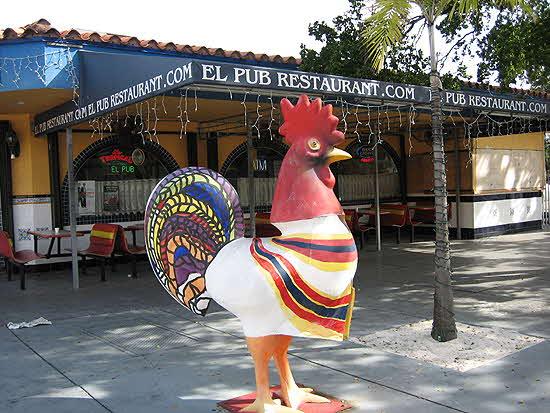
A rooster in front of El Pub Restaurant in Miami’s Little Havana. Photo by Norma Davidoff.
This enclave, also called Calle Ocho (Eighth Street), has traditionally been the first place new Latino immigrants settle in Miami. It’s just a mile from luxury hotels like the Four Seasons, the Mandarin Oriental, and the Brickell Financial District.
In the 1950s, Calle Ocho became a refuge for Cuban exiles, where they could find or establish small businesses. Many have moved up and on, their places taken by Nicaraguans, Dominicans, Salvadorians, Mexicans, and Uruguayans. And they’re all eager to share their stories from the past.
They gave me information on where to eat, what foods to try, and how to get around. I soon discovered that the easiest way to do so was walking or by bus.
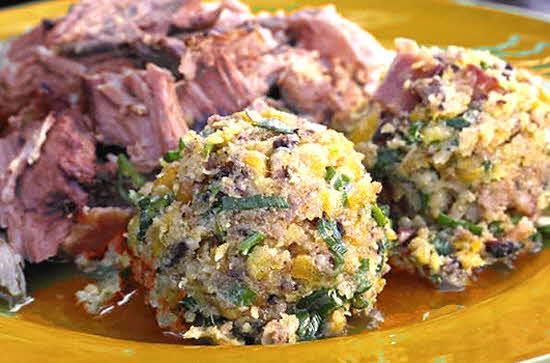
Mofongo with roast pork. Photo by Manos Angelakis.
Before long, I was popping into colorful shops and trying local fruits I had never heard of before. Anyone for mamy? How about zapote?
Food was abundant at the most famous Little Havana restaurant called Versailles. It’s run by the Valls family, who are Cuban immigrants. This landmark has served the Latin community and eager tourists for more than 50 years.
I checked out its opulent chandeliers and drapes. Was it like France’s Versailles? No, not with this Versailles’ formica counters and chrome tables. Still, the food was fit for a king. I tried one of their specialties: roast pork with black beans and rice. Muy bueno.
We tried several other Latin restaurants in the neighborhood. If you have a yen for Nicaraguan or Dominican specialties like mofongo – mashed plantains mixed with everything from salami to chicken or goat – Little Havana is the place to be. Instead of bread, I scarfed down plantain chips and was in my own special heaven.
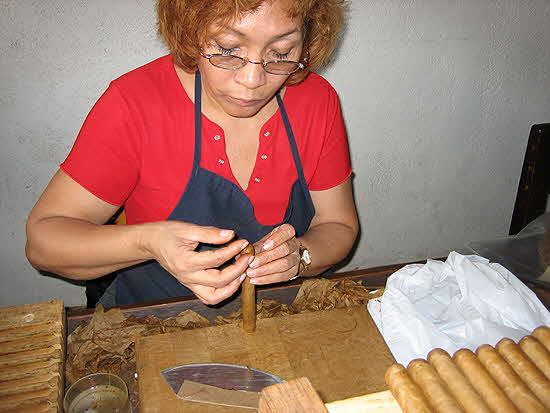
The art of cigar rolling in Miami’s Little Havana. Photo by Norma Davidoff.
Then, it was time for a smoke. No Cuban meal would be complete without one. There are several small manufacturers still creating cigars right in Little Havana. We went to high-end Moore and Bode for a tour and to watch the fine art of cigar rolling. The owner spoke of it as an art form. The company returns émigrés to their traditional employment, while supporting the embargo on Cuban tobacco.
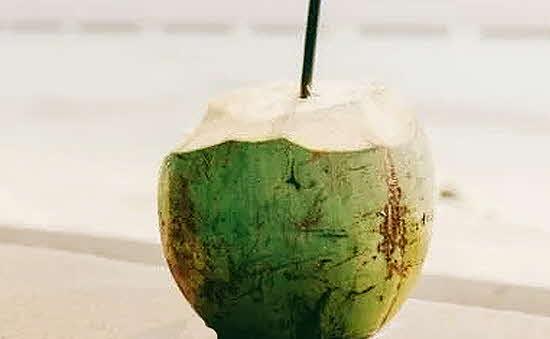
Coconut water. Photo by Manos Angelakis.
Next up: a refreshing coconut juice (coconut water) with a straw right in the shell. Los Pinarenos Fruteria offers other natural fruit juices like papaya, guayaba, and the Latin staple sugar cane juice. The family that owns it cooks one pot of stew a day. If you get there early, you might be one of the lucky few. We were sitting in the garden when the family rooster strolled by.
It seems that roosters are often pets of Calle Ocho residents. The everyday rooster is the symbol of this district. They stand outside businesses and on advertising. There’s even a “doctor” rooster outside a medical practice.
Men in Miami’s Little Havana playing games outdoors. Photo by Norma Davidoff.
To lighten things up, I strolled through Domino Park at 14th and Eighth. There were scores of people playing dominoes and chess. A big mural featured presidents of the New World, including Bill Clinton. The place looked as though it was airlifted from pre-Communist Cuba. The viejos (old men) could see our excitement as we watched them play. After a while, they asked us to join in!
But we begged off, as we wanted to go for a swim. I sure hope to join in a game sometime, though. This non-Latina New Yorker came home with a new appreciation for a distinctive part of Miami and its residents.
If you’re wondering why the price of potato chips, an American snacking staple, has been rising so rapidly, there are two reasons. General inflation is one; according to the the Federal Reserve, the US dollar has lost 87% of its purchasing power since 1971. But another reason that has not been considered by the buying public is an overheating planet!
A bag of potato chips now costs over 50% more than it did 10 years ago! Worldwide warming is a major factor in driving up potato prices.
Potato crop. Photo by Budabar.
Idaho and Washington states are the potato producers. Idaho had the third warmest year on record in 2024, and Washington had the 15th warmest.
Pennsylvania is the largest processor of potato products and fourth in the production volume. For years, it has seen a decline in the acres devoted to potatoes used in chips because of the rising temperatures, as much as rising farm labor costs.
Professor J. R. Ehleringer of the University of Utah has said that soil temperature greatly affects potatoes, which are sensitive to heat, and causes a reduction in crops. He says that cotton and wheat crops are also affected by the extreme weather.
Other causes of rising farm product prices include increased costs for equipment, fertilizer and fuel, supply chain disruptions, labor shortages, and overall inflation.
Cattle. Photo by Manos Angelakis.
According to the USDA, prices received for livestock increased in 2021, as strong demand and supply chain hurdles pushed prices up 18% from the previous year. Aggregate livestock prices increased further in 2022 to an all-time high level. In 2025, overall food prices are anticipated to rise close to the historic average rate of growth. In 2025, prices for all food are predicted to increase by 2.2 to 2.15%.
A combine harvester. Photo by Manos Angelakis.
Between the 1970s and early 2000s, food-at-home prices and food-away-from-home prices increased at similar rates. However, between 2009 and 2019, their growth rates diverged. While food-at-home prices deflated in 2016 and 2017, monthly food-away-from-home prices increased consistently.
Differences between the costs of serving prepared food at restaurants and retailing food in supermarkets and grocery stores explains this variance. As farmers are struggling to make shipments, the prices will continue to rise. And now, with the Trump Administration’s freeze on aid to farmers, shortages are likely to become pronounced.
Auguste Escoffier, a chef of acknowledged genius, published his Le Guide Culinaire in France toward the end of his career. To the end of his days, he mastered no more than a few words of English because, as he would jokingly explained, if he spoke the language, he might also end up cooking in the English fashion, “God forbid.”
Short of stature, he constantly wore high heels to enable him to see over the huge kitchen ranges. He seldom tasted a dish, relying almost entirely on his sense of smell.
He was a courtier of the kitchen, who knew how to flatter his guests, creating “poularde Tosca” and “Pêches Melba” for the famous diva Nellie Melba, as well as “zéphyr du poularde Belle Hélène” for Sarah Bernhard, a personal friend since the days when he was cooking at the fashionable Le Petit Moulin Rouge in Paris and she was an ingénue at the Comédie Française.
Bisque d’Ecrevisses with croutons. Photo by Manos Angelakis.
Looking through his recipes, I found the following Bisque d’ Ecrevisses, a dish that I recently enjoyed at a friend’s home in Florida. This friend is from Alsace, and she prepared it according to her mother’s recipe. It was the same as Escoffier’s with the exception of one ingredient – the addition of finely chopped fresh chives.
Ingredients:
2 pounds live crayfish 4 tablespoons butter 4 ounces. mirepoix (carrot, onion, one celery, and two parsley stalks) finely chopped 3 ounces rice Sprig of thyme and a bay leaf 1/4 cup cognac 1/4 pint white wine 3 cups white consommé 1/8 teaspoon saffron 2 tablespoons heavy cream Cayenne to taste 3/4 tablespoon finely chopped chives Sea salt and ground black pepper to taste
Method:
Brown the mirepoix, thyme, and bay leaf in 2 tablespoons of butter in a saucepan. Add the crayfish, and toss in the mirepoix until they acquire a very red color.
Sprinkle with the cognac and white wine, season with a pinch of salt and a pinch of ground pepper, and set to reduce.
Moisten with 1/4 cup of white consommé, and cook for 10 minutes.
Also cook the rice in a half pint of the white consommé.
Crayfish. Photo by Manos Angelakis.
Drain the crayfish of the cooking-liquor, and reserve.
Shell the crayfish, and reserve ten to twelve tails aside.
Finely pound the remaining crayfish and the mirepoix, and strain any liquid through a fine sieve.
Take the rice and the balance of the crayfish tails, and pound in a mortar to a paste.
Add all liquids to the balance of the white consommé and the saffron, and bring to a quick boil.
Take it immediately off the fire, and add the rice/crayfish purée, constantly stirring with a whisk.
Keep the resulting preparation in a bain-marie, taking care to place a few lumps of butter on the surface, lest a skin should form while the bisque is waiting to be served.
Adjust the salt and pepper to taste.
Finish the preparation when serving by whisking the balance of the butter, the heavy cream, and a pinch of cayenne. Garnish with the crayfish tails and the finely chopped chives.
Cheese plates and cheeseboards are a fantastic way to elevate the end of a meal or titillate the palate at a friendly gathering. With so many cheeses available in the market from all over the world, you can go overboard and create a spread that overflows with a variety of the available domestic and international varieties. But here’s a piece of advice: don’t do it!
A balance of similar tastes and textures is preferred so that your guests can easily navigate the selections. First, if you have too many flavors, it will be impossible to create pleasant pairings with accompanying fruits, honeycomb, preserves, and complementary wines.
Another reason to avoid too many very diverse selections is that the palate can become fatigued rather than thrilled by the large variety, creating a less pleasant eating experience.
In addition, fig jam might pair great with aged smoked Gouda but won’t taste as good with Stilton and could actually taste unpleasant with Stinking Bishop, another British specialty. Another possible poor pairing would be fatty feta cheese with fresh aromatic herbs like rosemary, basil, lavender, or dill.
Cheese and wine pairings. Photo by Manos Angelakis.
That said, there’s a biological reason why wine and cheese go so well together. Astringent beverages and fatty foods like cheese work beautifully to complement and enhance each other’s tastes.
Some great cheese and wine pairings include: Cabernet Sauvignon and well-aged cheddar or Stilton; Pinot Noir or Sangiovese with Gruyère; Chardonnay and brie and a Chilean Rosé – perhaps composed of 85 percent Syrah and 15 percent Grenache – with fresh Greek Kefalotiri. Sweet Sauternes, an aromatic and sweet Riesling or a Pedro Ximenez Dulce also pairs well with goat cheese. All of these are matches that I would consider “classic pairings.”
Fruit and cheese plate. Photo by Manos Angelakis.
Pairing fruit and cheese is also a stylish culinary practice. Sweet and luscious fruits work wonderfully with a rich cheese assortment, and the flavor contrast itself brings out the best in both. Of course, adding a young demi-sec white wine does wonders for a succulent fruit/cheese pairing.
When creating a cheese plate or cheeseboard, make sure there is always some sweet fruit like grapes, fresh ripe black figs, dried apricots, or dates present. Other possible accompaniments would be preserves like orange marmalade, quince, or a piece of honeycomb dripping with honey.
One of my favorite snacks is sweet pumpkin or banana bread with Sultana raisins and Roquefort or Gorgonzola. I have that combination every Thanksgiving and Christmas, when my wife bakes both pumpkin and banana breads for the holidays.
Another snack I like is very ripe apricots stuffed with Cretan Anthotyros – a soft, fresh white cheese that tastes similar to Ricotta Salata. Since Anthotyros, also known as Aged Mizithra, is difficult to find in the U.S. because it’s made with unpasteurized milk, I now use the dryer Ricotta Salata. (Anthotyros can occasionally be found in Greek groceries, however, in areas with large Greek immigrant communities like Astoria in New York City, Chicago, Boston or Tampa.)
Balducci’s cheese section. Photo by Manos Angelakis.
In Manhattan, one of the best sources for cheese is Murray’s in the West Village, as well as Balducci’s in New York, Connecticut, Maryland, and Virginia. They have huge varieties from around the world. Another possibility for cheeses from middle-Europe and what used to be the “Eastern Block” is Gourmanoff by NetCost Market in Brighton Beach, New York and Paramus, New Jersey.
Some of the local supermarkets also carry a large variety of cheeses, and if you’re not looking for something really exotic, their delis and cheese departments have excellent examples, especially when it comes to hard cheeses or cheddars from the UK, Northeastern US, or Canada.
Cheese and wine pairings. Photo by Manos Angelakis.
In addition to the fruit and preserves pairing, the kind of bread accompanying the cheese is important. As I mention above, sweet breads like a banana or pumpkin pair beautifully with dry, complex red wines. However, a well-made white bread like a baguette is also a great pairing partner with a good cheese.
What I don’t recommend are wheat crackers or something like Doritos. Their flavors distract from the taste of many cheeses. Let me know your favorites in the comments.
Jagged white peaks speckled with pines, stretches of parched terrain alongside vast lakes, glacial blue water sliding into creeks, and black ridges iced with snow. These are among the images that stick with you when you travel through the remarkably diverse landscapes of western Canada. And there’s no better or more relaxing way to see these panoramic spectacles than on board the Rocky Mountaineer train.
View from the Rocky Mountaineer train. Photo by Melanie Votaw.
I traveled on the train from Vancouver to Calgary via the GoldLeaf Dome service, which is the best service available on the train. The Rocky Mountaineer is not a sleeper, which is even better. You aren’t stuck in your car all night in a tiny sleeping berth. You simply spend leisurely days traveling through some of the most striking scenery you will ever see, followed by comfortable nights in a hotel with a large bed and a hot shower.
View from the Rocky Mountaineer train. Photo by Melanie Votaw.
The next level down of service is called SilverLeaf, which I’m sure is also wonderful. The bi-level GoldLeaf Dome coach is indeed shaped like a dome so that there is lots of glass for prime viewing. The best location is in the back because you can then stand in the covered open-air vestibule at the end of the train and take photographs without the obstruction of the windows. The seats are assigned, so you would have to request this location.
View from the Rocky Mountaineer train. Photo by Melanie Votaw.
Rocky Mountaineer is a truly luxurious train. The chefs are top-notch, and you couldn’t ask for finer service. The mimosas flowed, and we enjoyed meeting new people in the dining car for breakfast and lunch, where we were served gourmet creations, including a chocolate-shaped train car for dessert.
Dessert on the Rocky Mountaineer train. Photo by Melanie Votaw.
Our attendants on board seemed to genuinely enjoy their jobs. They were friendly and gave us a running commentary about where we were, what we were seeing, and the historical significance of the varied locales. It was actually much like traveling in the first class cabin of an airplane with comfortable reclining seats and snacks and other amenities offered periodically. Of course, unlike an airplane, we also learned a great deal about Canada and saw much more than clouds at eye level from our windows.
View from the Rocky Mountaineer train. Photo by Melanie Votaw.
Our particular trip from Vancouver to Calgary took us through jade green forests filled with giant evergreens, the barren brown desert of Kamloops, and the other-worldly white rock mountains of Banff National Park. We saw bald eagles flying alongside the train and bears frolicking next to the tracks. It’s the kind of experience that can be enjoyed by all age groups, although very young children might get restless sitting on a train all day.
View from the Rocky Mountaineer train. Photo by Melanie Votaw.
Packages include limousine pick-up from your hotel and transport to the Rocky Mountaineer train stations. One of the best parts was the luggage service. Each night, our luggage was transported for us from the train to our hotel rooms. By the time we checked in, our bags were waiting for us.
The company has a relationship with Fairmont Hotels, so that’s where we stayed in the larger cities that had a Fairmont property.
View from the Rocky Mountaineer train. Photo by Melanie Votaw.
Rocky Mountaineer is especially great for people who love to look at the outdoors without traipsing through it or for people who have been working hard and want an unusual but relaxing escape. Of course, people who like to do more than sit can add a train journey at the beginning or end of a more active trip. Relaxing on a luxurious train while looking at beautiful scenery and eating gourmet cuisine might just be the perfect way to end an action-packed vacation.
Rocky Mountaineer has four routes – three in western Canada and one in the U.S. from Moab to Denver (or vice versa).
View from the Rocky Mountaineer train. Photo by Melanie Votaw.
More cruise ship bans. The city of Nice, France is banning cruise ships that carry more than 900 passengers. Overtourism is becoming a major problem, especially in popular European destinations.
Venice increases tourist fees. Venice is on the forefront of the overtourism fight. It’s city access fee is now being increased from 5 to 10 Euros for daytrippers who aren’t staying the night. It applies only from 8:30 a.m. to 4:00 p.m., and it’s in effect only on certain days during high season, which include Fridays, Saturdays, and Sundays through July 27th.
If you’re planning on making a day trip, you can book at least four days ahead of time and pay only 5 Euros. People with disabilities who have a disability card and children under the age of 14 don’t have to pay the fee. If you aren’t exempt, you have to pay the fee before entering Venice. Otherwise, you’ll incur a hefty fine. Use the Venezia Unica website to pay in advance.
La Bella Venezia (Venice). Photo by Manos Angelakis.
Seattle plane collision. Early this month, a Japan Airlines plane and Delta plane collided in Seattle on the tarmac. No one was injured, but these incidents lately, including the fatal airplane and helicopter collision in Washington, D.C., give us pause.
Air New Zealand sleep pods. In coach? Yes! Sleep pods called “Skynest” (different from “Skycouch”) will be launched by Air New Zealand in economy for long flights in 2026, first on Boeing 787 Dreamliners from New York to Auckland. They’re like bunk beds, and you book them for four-hour nap sessions. They do come with a pillow, sheets, blanket, and privacy curtain. Prices are supposed to be $400-$600. Better than nothing, I guess?
JetBlue TrueBlue changes. Now, you can book Blue Basic seats using TrueBlue points. Some short flights cost as few as 700 points, considerably less than the other types of seats. Nice one, JetBlue.
Picture gazing out over the unpolluted sparkling royal blue waters of the Adriatic Sea, breathing in salt-infused, pure, sweet air and the fragrance and beauty of dark-green pine forests silhouetted against the azure sky.
All the while, 1,100 aromatic herbs and flowers cover the hillsides and captivate the senses with the tantalizing scents of myrtle, lavender, laurel, lemon, orange, rosemary, eucalyptus, oleander, and many others. That’s what you get on the island of Lošinj, Croatia . . . the Island of Vitality.
Scientific studies have proven that due to the immaculately clean air and warm sea currents with favorable temperatures and humidity, Lošinj is uniquely situated to help in the treatment of chronic lung disease and respiratory disorders.
The author on a sailboat in Croatia. Photo by Manos Angelakis.
In fact, Lošinj has been known as a healing paradise, frequented by the Austro-Hungarian aristocracy since 1889 when Austrian Emperor Franz Joseph, King of Hungary, Croatia, and Bohemia, proclaimed it a health resort. The Lošinj archipelago includes five islands – Cres, Lošinj, Ilovik, Susak, and Unije, as well as more than 250 kilometers of walking paths with spectacular views of the deep royal blue water of the Adriatic Sea.
The essential oils from scented herbs, many native to the island, are a major tourist attraction. They are made from the tedious labor of dedicated families that have passed the process down for generations.
We visited the island of Cres and the picturesque fishing village of Martinscica (St. Marten) for a stop at the Oil House. Since 1903, the Kučić family has been producing essential oils, mainly used for holistic healing elixirs and aromatherapy. Julino and Rena are continuing the family’s small press production of oils, which they sell in their small, fragrant shop, along with soaps, candles, and jams.
The extensive use of herbs isn’t limited to small entrepreneurial producers making essential oils for local use. A whole new cosmetic product line called “Mirta” has been developed using 100% natural ingredients sourced from the herbs on Lošinj.
We visited the Vitality Hotel Punta in the village of Veli Lošinj to hear about their health and wellness programs that include aromatherapy and active exercise. It’s a full-service wellness resort offering health & fitness, beauty & spa, beach & pools, sports & recreation, and gourmet meals & accommodations with high-end amenities. The hotel is beautifully situated overlooking the sea and has a no-nonsense approach to wellness tempered by pampered luxury.
Strawberry puree in Lošinj. Photo by Barbara Angelakis.
Our next stop was the Aurora Wellness Hotel & Laurus Slow Spa, where we met with Anamarija Pažin Morović, aromatherapist and founder. Anamarija demonstrated how locally grown essential oils are used to infuse products for the spa and generously gave us the results from the demonstration to take home as mementos. Laurus Slow Spa has been listed by Premier Traveler as one of the top ten spas in the world.
The 5-star Hotel Bellevue and SPA Clinic in the city of Mali Lošinj was our base hotel during our visit. The Bellevue has been completely revamped and is the standard against which all other hotels on Lošinj will have to measure up.
Hotel Bellevue in Lošinj. Photo by Barbara Angelakis.
The arresting entrance is flanked by large white columns, accented by indirect ground lighting. With its stunning Italian rose marble columns and floor-to-ceiling wall of spiral Ammonite prehistoric fossilized shells, the atrium lobby sets a new benchmark of luxury, as do the large and beautifully furnished guest rooms with state-of-the-art amenities.
Appetizers in Lošinj. Photo by Barbara Angelakis.
As much as I appreciated the comforts and beauty of the property and their gourmet kitchen, my prime interest was in the spas and the health treatments for which the island is renowned.
I could get lost for many days in the SPA Clinic at Hotel Bellevue. It’s a large and inviting area with many facilities in addition to the usual sauna, steam, and whirlpool. There’s a Turkish Bath with Hammam table and an outdoor spa garden, indoor and outdoor seawater pools, and state-of-the-art exercise equipment.
There are medical programs, nutrition and wellness training sessions available for short or long-term treatment, and beautifying and relaxing spa treatments provided by highly trained estheticians and cosmetologists.
One room in the spa holds three heated water beds where you can adjust the warmth and color to achieve your goal: red for Excite, blue for Relax, green to Tone, white to Purify. Once you adjust the color and heat to your specifications, you lie down and allow the good vibrations to soak in.
There are beautiful areas for relaxing and cooling down, as well as a darkened room with lounge chairs constructed of black marble. These can be adjusted for angle and heat. You can enjoy all of these areas on your own either before or after treatments or wellness classes.
Octopus in Lošinj. Photo by Barbara Angelakis.
My first treatment was performed by Ivica, a specialist in the state-of- the-art LCM System or Diamond machine. You lie fully clothed in the technologically advanced therapeutic light table, while Ivica manipulates the machine to achieve balance and healing throughout the body using light, color, and movement (LCM).
It’s a no hands-on, painless, and calming treatment that leaves you feeling refreshed and energized. There are more advanced uses for the LCM to handle physiological and physical dis-ease, but I just got a taste of what the machine is capable of doing.
I also enjoyed a SPA Clinic signature back massage with Emma and a spectacular new special booster facial with Sanela using the luxury British product line, Elemis. It’s one of several cosmetic lines used at the SPA depending on the needs of the client.
One of the most memorable days during our visit was a sailboat ride on the “Alhambra” to the islands of Susak and Ilovik. Susak is the only all-sand island in the archipelago and is a geological mystery. The sea here is warm, clean, and inviting, and you can practically walk to the horizon in knee-deep water.
Standing in the placid water with tiny fish swimming around my legs was magical, and I could almost hear the siren sound of old enticing me to come closer . . . all the while, warm breezes planted silent kisses on my exposed skin as a church bell chimed the hour in the distance.
The church was at the top of the island in the old town, accessible through narrow winding lanes of manicured homes, many oozing scents of baking bread and promises of the noon-day meal to come. Overwhelmed by the smells, we stopped at a bakery for meat and veggie pies and passed them around so that all could share in the local delicacies.
You can travel to Lošij to improve your physical health or your mental well-being . . . or both. Either way, the Island of Vitality is a paradise on earth. For more information visit: https://croatia.hr/en-gb.
People are fascinated by apes and monkeys, probably because they appear to be so human-like in many ways. Around the world, the variety, adaptations, and behaviors of these creatures will intrigue and fascinate any traveler. Here are 15 apes and monkeys around the globe that should be on your “must-see” list.
But before we launch into this list, it’s best to acknowledge that there is much confusion as to just exactly what is an ape versus a monkey.
APE vs. MONKEY
For starters, primates include apes and monkeys, as well as lemurs. And apes include gorillas, orangutans, and chimpanzees, as well as Homo (humans). On the other hand, monkeys are divided into Old World (Africa and Asia) and New World monkeys (Americas).
In other words, all monkeys are primates, but not all primates are monkeys. And chimpanzees and orangutans are primates, as well under the category of apes, but they aren’t monkeys.
So how best to tell whether you’re seeing an ape or monkey? Well, the old saying goes: when in doubt as to whether it’s an ape or monkey, check for a tail. Monkeys have tails.
Once you determine it’s a monkey, what are the differences between New World (Americas) and Old World (Africa and Asia) monkeys?
New World vs. Old World Monkey
One of the most notable differences between Old World and New World monkeys lies in their physical characteristics. Old World monkeys typically have narrow, downward-facing nostrils that are close together, while New World monkeys possess broad, outward-facing nostrils that are widely spaced.
Furthermore, Old World monkeys generally have non-prehensile tails, which may be used for balance but not for grasping, while many New World monkeys have prehensile tails that allow them to grasp branches and aid in their arboreal lifestyle. Old World monkeys tend to be larger, and New World monkeys tend to be smaller.
Behaviorally, Old World and New World monkeys exhibit distinct social structures and communication methods. Old World monkeys tend to have more complex social systems and often live in larger groups, known as troops.
Their communication includes a variety of vocalizations, facial expressions, and body postures. In contrast, New World monkeys often have smaller social groups and may exhibit more diverse social behaviors, including cooperative breeding and varied parental care strategies.
Old World monkeys are more likely to be omnivorous, consuming a mix of fruits, leaves, and insects. On the other hand, New World monkeys primarily eat fruits and have specific adaptations, like the ability to digest certain types of fruits that Old World monkeys cannot.
Finally, the habitats of these two groups also differ significantly. Old World monkeys adapt to a range of environments from savannahs to forests and are often more terrestrial, spending considerable time on the ground. New World monkeys are predominantly arboreal, thriving in the trees of tropical rainforests where they have evolved to navigate the canopy effectively.
THE AMERICAS
The only apes seen in the Americas are Homo (humans). However, there are plenty of New World monkeys in the lush rainforests and cloud forests of Central and South America. With more than 150 species in the Americas, you are bound to have many encounters.
Squirrel Monkeys are best known for their gymnastic antics while swinging through the trees. Photo by Karin Leperi Pezo.
Squirrel Monkey (Irresistibly cute)
Squirrel monkeys are known as the arboreal “goats of the jungle.” This omnivore has a diet primarily of flowers, fruit, leaves, nuts, seeds, insects, spiders, and lizards. Just about anything. They are most active during the late afternoon.
A sociable monkey that is diurnal, they live in the canopy in large groups of sometimes up to 500 individuals. Within these groups are female-dominated troops of 45-75 monkeys. They are known to be aggressive during mating.
The squirrel monkey became famous when back in 1959, the United States launched the first of two animals into space and recovered them alive. One of them was a squirrel monkey born in Iquitos, Peru. Known as Miss Baker, she was born in 1957 and died on November 29, 1984.
With their long limbs and curious eyes, some might say they even have a sinister look, Peruvian Spider Monkeys remind us that adventure awaits in every branch. Photo by Karin Leperi Pezo.
Spider Monkey (Agile climbers and extremely intelligent)
The spider monkey is yet another incredible species that deserves attention. With their long limbs and prehensile tails, spider monkeys are agile climbers, often seen swinging gracefully through the treetops. Their social structure is matriarchal, with females leading the group. This unique dynamic offers insight into the diversity of primate societies.
They are agile climbers with a tail that acts like a fifth limb, and they possess a bigger brain than all other monkeys, making them the most intelligent primate in the region.
However, they are territorial and have large canine teeth to protect their turf. Some images even suggest that the monkey can give the “evil” eye to those that don’t respect its territory.
The Night Monkey, usually seen at night and seldom during the day, is usually spotted with close-knit family members. Photo by Karin Leperi Pezo.
Night Monkey (Only true nocturnal New World Monkey)
The Night Monkey is the only true nocturnal New World Monkey. Also known as the Owl monkey, they have monochromatic vision which helps them with contrast to differentiate visual cues at night. Their big brown eyes allow for more light, so it’s easier for them to see in the dark.
With round heads, large eyes, and furry bodies, these adorably affectionate monkeys live in lowland forests and dense tropical rainforests. A total of 11 species can be found across Panama and much of South America.
Arboreal, they spend their life in tropical trees searching for their diet of flowers, insects, nectar, leaves, moths, beetles, spiders, and large orthopterans. Living in small family groups, they are very territorial, defending their territory using threatening and aggressive behaviors. The male and female are similar in size, and they’re monogamous for life. These tiny tropical tree-dwellers are also known to be very affectionate with their mates.
The charming White-faced Capuchin monkey of Costa Rica is known for its playful personality and intelligence. Photo by Karin Leperi Pezo.
Capuchin Monkey (Intelligent and adaptable)
One of the most striking New World monkeys is the Capuchin. Named for the cap on its head that resembles the cowl of Capuchin monks, they range from Central America to as far south as northern Argentina.
They are known for their intelligence and social behavior, and they have been observed using tools, such as stones to crack open nuts. They are the most adaptable of all the New World monkeys.
Living in troops made up of 8-14 members containing more females than males, they are diurnal, arboreal, and territorial, yet sociable. But they are also known to be aggressive.
Their omnivorous diet is varied and opportunistic: leaves, flowers, fruits, nuts, seeds, pitch, woody tissue, sugarcane, frogs, reptiles, birds, insects, bats, and even other primates. Because their diet is varied, they are extreme foragers because they gain sustenance from a wide collection of unlikely food. This adds to their adaptability and resilience.
Their relatively long lifespan of 45 years also makes them attractive as pets. These monkeys are most associated with organ grinders, and due to their intelligence, you may have seen them in films like Night at the Museum, Outbreak, Monkey Shines, Pirates of the Caribbean: The Curse of the Black Pearl, Zookeeper, George of the Jungle, and The Hangover Part II, as well as the TV show Friends.
The Red Howler monkey prefers the higher forest canopy, but it’s easy to spot because of its vibrant red fur and unique howl. Photo by Karin Leperi Pezo.
Howler Monkey (Some of the largest monkeys in the New World)
Another captivating species is the howler monkey, famous for its distinctive vocalizations. After all, this is how they got their name. They come in red, brown, and gray, with the Red Howler as the biggest of this monkey family. As the most widespread primate in the Neotropics, they are slow-moving and the only folivores (leaf eaters) of New World monkeys.
Often found in groups, their calls can be heard up to three miles away. Their dawn chorus of loud, repetitive booms is performed mostly by males and is an important part of their social behavior. Howling is thought to relate to intergroup space and territory encroachment, as well as possible protection in mating.
Howler monkeys play a crucial role in seed dispersal, helping to maintain forest diversity. An encounter with a howler monkey in its natural habitat reveals the beauty of its communication and the significance of its ecological role. Their haunting calls echo through the trees, making them a must-see for any nature lover.
Tamarin Monkey (Squirrel-sized monkeys)
These squirrel-sized, small primates are known for their high-pitched calls and social behaviors. Living in tropical rainforests of Central and South America in close-knit family groups consisting of a dominant breeding pair and their offspring, they’re also known for their distinctive physical features. These can include long tails and facial fur, often resembling a mustache or beard.
Their diet is omnivorous, consisting of fruits, insects, and small vertebrates. They are also known for their unique reproductive strategy. Twins are usually born to Tamarins, so both parents, along with older siblings, help with caring for the young. This unique cooperation enhances survival of the offspring in the wild.
Photographed at top, the Golden Lion Tamarin, an endangered species, is also known as the golden marmoset. They are very sociable and friendly animals, huddling and playing together. (Photo by Karin Leperi Pezo.)
An immature Brown Woolly monkey finds comfort on the shoulder of the author at a local rescue center in Iquitos, Isla de los Monos. They grow to be quite a bit bigger as adults. Photo by Karin Leperi Pezo.
Woolly Monkey (Known for their thick fur)
Closely related to Spider Monkeys, the Woolly Monkey lives in the rainforests of South America, in large social groups. Their ideal habitat is humid and mature tropical forests.
With colorations from brown, red, and gray with black, hairless faces, they are known for their thick fur and strong social bonds. Expect to find them grooming each other, which strengthens their relationships. However, the female woolly can be very possessive and will attempt to harass other females trying to approach their partners.
Main predators are humans, who hunt them for food and the illegal pet trade. They are also hunted by eagles and large cats such as the jaguars. And they have a loud scream.
AFRICA
The De Brazzas monkey is one of the most widespread arboreal African primates. It’s easily identified with its unique looks that include a white beard and orange forehead cap. Photo by Karin Leperi Pezo.
De Brazzas Monkey (Unique appearance)
This primate, native to the wetlands of Central Africa, possesses distinct features that set it apart from other species. The facial appearance is striking, with a white mustache and beard that contrast sharply with its dark face, giving it a wise and expressive look. This facial hair is not just for show; it plays a role in communication among the monkeys.
They live in small groups, usually consisting of a few adults and their offspring. A clear hierarchy is established, which reduces conflicts and promotes cooperation. For example, when a predator approaches, the dominant monkey will usually sound an alarm call, alerting the others to danger. This collective behavior not only protects the group but also strengthens social bonds.
Their diet includes fruits, leaves, and flowers, demonstrating their ability to use a variety of resources.
The Olive Baboon is the most wide-ranging of all baboons, inhabiting 25 countries throughout Africa. They are one of the most common primates seen on safaris. Photo by Karin Leperi Pezo.
Olive Baboon (Distinctive olive-colored coat)
The olive baboon is a fascinating primate species native to various regions in Africa, particularly in savannas, woodlands, and mountainous areas. Characterized by its distinctive olive-colored fur, this baboon is one of the largest members of the baboon family. Adult males can weight up to 50 pounds and possess long, powerful limbs.
They are omnivorous, feeding on a diverse diet that includes fruits, seeds, insects, and small animals. This flexibility in diet allows them to thrive in various environments from grasslands to rocky hills.
The Ring-tailed Lemur is a medium-sized primate and one of the most recognized lemur species, owing to its long, black-and-white ringed tail. Photo by Karin Leperi Pezo.
Lemur (Only live in Madagascar)
There are about 100 species of lemurs, but they all live in Madagascar off the coast of the African continent. About 2,000 years ago, the early lemurs were sometimes the size of a gorilla. Now, there is quite a variety, but the larger ones became extinct many years ago.
With their large expressive eyes, lemurs possess excellent night vision, allowing them to forage for food after dark. These unique primates display a remarkable range of characteristics that highlight their adaptability and social behavior.
Their strong sense of smell allows them to locate food and smell danger when predators are around. Because of this, they communicate with scents as well as vocalizations, rather than visual signals.
Most are herbivorous, but diets vary based on size and different lemur species. For example, smaller lemurs feed on fruits, insects, or sap. In contrast, the larger lemurs feed on plant material like bark, flowers, fruits, leaves, nectar, and shoots.
A couple of interesting notes about lemurs are that they sleep up to 16 hours a day, waking only to feed and socialize with each other. Finally, a group of lemurs is called a “conspiracy.”
The Chimpanzee is one of our planet’s “great apes,” along with gorillas and orangutans. They are considered to be the closest relatives to humans. Photo by Karin Leperi Pezo.
Chimpanzee (Most closely related to humans)
Chimpanzees possess a unique blend of intelligence, social structure, emotional depth, and communication skills, making them one of the most intriguing species in the animal kingdom. Closely related to humans, they display a variety of traits that highlight their complexity and adaptability in the wild.
One notable characteristic is their intelligence. Research shows that they possess problem-solving skills and can use tools, such as sticks to extract termites from mounds. This ability reflects their cognitive abilities, which are similar to those of early humans.
Chimpanzees also exhibit a wide range of emotions, such as joy, sadness, and even empathy. Socially outgoing, they are more extraverted than either gorillas or orangutans.
Primarily vegetarians, chimps eat a wide range of food items from fruits, berries, leaves, and seeds to bird eggs, insects, and sometimes carrion.
A Western Lowland Gorilla studies his fingers at the ABQ BioPark Zoo in Albuquerque. Photo by Karin Leperi Pezo.
Gorilla (Largest primate on earth)
Gorillas embody both strength and vulnerability. All species of gorilla are listed as endangered or critically endangered. They inhabit dense forests, primarily in the rainforests of central Africa, covering a wide range of elevations. Next to chimpanzees, gorillas are the closest living relatives to humans. About 95-99% of their DNA is highly similar to man.
They are herbivores, enjoying fruits, leaves, and stems. Sometimes, their diets are supplemented with larvae, snails, ants, and even rotting wood. They are known to eat all day.
As ground-dwelling great apes and unlike chimpanzees or orangutans, gorillas prefer to sleep in ground nests. They can sleep an average of 12 hours per day.
ASIA
Native to the Indian subcontinent, Gray Langurs are found at low to moderate altitudes and enjoy their time on the ground. Photo by Karin Leperi Pezo.
Langur Monkey (Extremely adaptable)
Known for their long tails and slender bodies, these monkeys are terrestrial and inhabit forests, as well as lightly wooded areas. Gray langurs are mostly within India, with all seven species having at least part of their range in this country. They are extremely adaptable.
Primarily herbivores, they eat coniferous needles and cones, fruits and fruit buds, leaves, seeds, grass, bamboo, mosses, and lichens. An interesting fact is that they get most of their water intake from moisture in their food. Langurs are considered sacred in the Hindu religion.
Macaques are known for their intelligence and their ability to develop and pass on new behaviors to subsequent generations. They are also known for their swimming and leaping abilities. Photo by Karin Leperi Pezo.
Macaques (Known as the “language monkey”)
Sometimes referred to as the “language monkey,” Macaques are known for their complex social systems, which can mirror those of humans. Their social behavior and vocalizations exhibit complex social structures, often communicating through a combination of vocalizations, body language, and facial expressions. They can mimic sounds and gestures. As a result, some researchers consider this as a rudimentary form of language.
Macaques are found in various environments across Asia from urban areas to forests, especially the rhesus macaque and long-tailed macaque. They live in groups called troops, where social interactions play a crucial role. Each troop has a hierarchy with dominant individuals leading the group.
This female Sumatran Orangutan is critically endangered and only found in the north of the Indonesian island Sumatra. This particular female is located at the ABQ BioPark Zoo in Albuquerque. Photo by Karin Leperi Pezo.
Orangutan (Possess cognitive skills comparable to gorilla and chimpanzee)
These intelligent primates possess cognitive abilities on par with the gorilla and chimpanzee, the only primates more closely related to humans. They are known for their social behavior and problem-solving skills, and they are crucial for maintaining the health of tropical forests.
Though not as powerful or strong as the gorilla, they are larger than the chimpanzee. And their beautiful reddish orange is a stand-out.
In contrast to gorillas, who prefer spending most of their time on the ground, orangutans are the largest arboreal great ape, spending 90 percent of their waking hours in trees. They are also known to be adept escape artists in zoos. Zookeepers know that if a habitat can keep an orangutan inside, it will keep any other great apes inside.
How Best to See Apes and Monkeys
As always, my answer is with a local guide. When in the jungle, they know the habitats best and guides have inside knowledge on recent sightings. Plus, they can tell you all kinds of information about primate behaviors, what they eat, how they socialize, where they nest, and whether they are rare. Plus, they will keep you safe.
But the truth of the matter is that sightings in the wild can sometimes be difficult due to weather, seasons, and breeding. And unless you have a telephoto lens, it may be difficult to capture good images, especially of arboreal species that stay high up in the trees.
Don’t overlook visiting rescue or rehab centers, game reserves, or even local zoos. It’s true that these viewings are more controlled, but you will get closer and be able to learn much about the different species.
When you think wine, your first thought is Missouri, right? No? Well, it doesn’t have to be your first thought, but it should certainly be on your radar. I’ve visited a lot of local vineyards around the U.S., and admittedly, I’m rarely impressed. The one I visited in Rocheport, Missouri – Les Bourgeois Vineyards – was a real treat.
Just a 15-minute drive from Columbia, Missouri, Rocheport has several wineries you can visit. It’s on the Katy Trail, the longest trail in the U.S., which follows an abandoned railroad system along the Missouri River.
The second largest winery in Missouri, Les Bourgeois is located right on the river in a beautiful setting. Its rustic Blufftop Bistro has high ceilings and plenty of glass so that you can overlook the river and the surrounding forest while you dine. I was there in early spring, but I’m sure it’s especially colorful in autumn.
Missouri varietals include Chardonel, Seyval, Traminette, Vidal Blanc, and Vignoles among the white grapes. Reds are Catawba, Cambourcin, Concord, and the state grape, Norton.
Les Bourgeois wines. Photo by Melanie Votaw
My party and I were provided a special tasting menu that was indeed special. We started with a Brie flatbread on naan with poached cranberries, walnuts, and rustic honey syrup. It was paired with the vineyard’s Vignoles, which is an award-winning citrus white that’s fresh and light. It was one of my favorites.
Our salad course consisted of micro greens, apples, red onions, dried figs, golden raisins, apricots, goat cheese, and rosemary balsamic reduction. This was paired with a bottle of red – the Norton that is Missouri’s official state grape.
Catfish po boy at Les Bourgeois. Photo by Melanie Votaw.
I’d love to go back and have our entrée again. I’m generally not a fan of catfish, but this was a particularly delicious dish – a Tempura po’ boy catfish sandwich with micro greens, pickled red onion, Sriracha remoulade, house-made focaccia, lemon pepper fries, and country slaw. It was paired with a fresh sparkling LBV Brut made primarily from Vidal Blanc grapes.
Les Bourgeois Bistro. Photo by Melanie Votaw.
As a special treat after our lunch, we had wine and chocolate pairings with artisanal chocolates from Columbia’s nearby Candy Factory (pictured at top). My favorite wine of the day was a particularly sweet one – a collector’s edition Vignoles and Traminette blend, also an award-winning bottle for the vineyard. Light and acidic, this white is both floral and fruity.
Les Bourgeois’ tasting room is open daily from 11-6, and the website has an online store. Part of the Missouri River Wine Trail, Les Bourgeois is hardly the only game in town. Wines in Missouri are a 150-year-old tradition that has been growing with leaps and bounds. The Missouri Wine website has a wealth of information for you if you’re in the region.
While you’re in the area, check out the foodie scene in Columbia. It’s quite impressive. Columbia and Rocheport are located only a couple of hours east of Kansas City and just over two hours west of St. Louis. The region can easily be added to a trip to either of the more well-known cities in the state, or visit during one of Columbia’s festivals like True/False in February/March or Roots ‘n Blues ‘n BBQ in September.